RCM Level 5 Italian Music Terms and Theory
Pitch and Notation
Writing Down Pitch
Music is made of sounds, and one of the most basic qualities of any sound is its pitch. Pitch is simply how high or low a note sounds. A bird's chirp is high-pitched, while a big dog's bark is low-pitched.
To write music down, we need a way to show pitch visually. We do this using a system of lines and symbols that has been developed over centuries.
Pitch
noun
The quality of a sound that is determined by the rate of vibrations producing it; the degree of highness or lowness of a tone.
The foundation of modern music notation is the staff (also called a stave). It consists of five horizontal lines and the four spaces between them. Each line and each space represents a different pitch.
By itself, the staff is just a grid. To give the lines and spaces specific note names, we need a symbol called a clef. The clef is placed at the very beginning of the staff and acts as a key, telling us which pitch corresponds to which line.
The Main Clefs
There are several types of clefs, but the two you'll see most often are the treble clef and the bass clef.
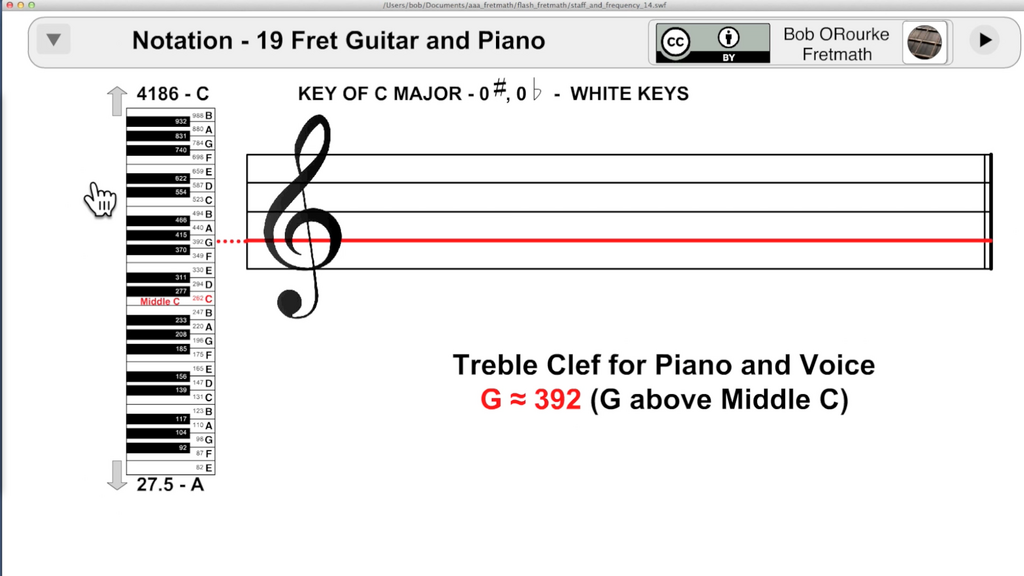
The treble clef is also known as the G-clef. The large, elegant curl of the clef wraps around the second line from the bottom. This tells us that any note placed on this line is the G above Middle C. The treble clef is used for higher-pitched instruments and voices, like the flute, violin, and the right hand of the piano.
The bass clef, or F-clef, is used for lower-pitched instruments and voices, such as the cello, tuba, and the left hand of the piano. Its two dots are placed on either side of the fourth line from the bottom, indicating that this line represents the note F below Middle C.
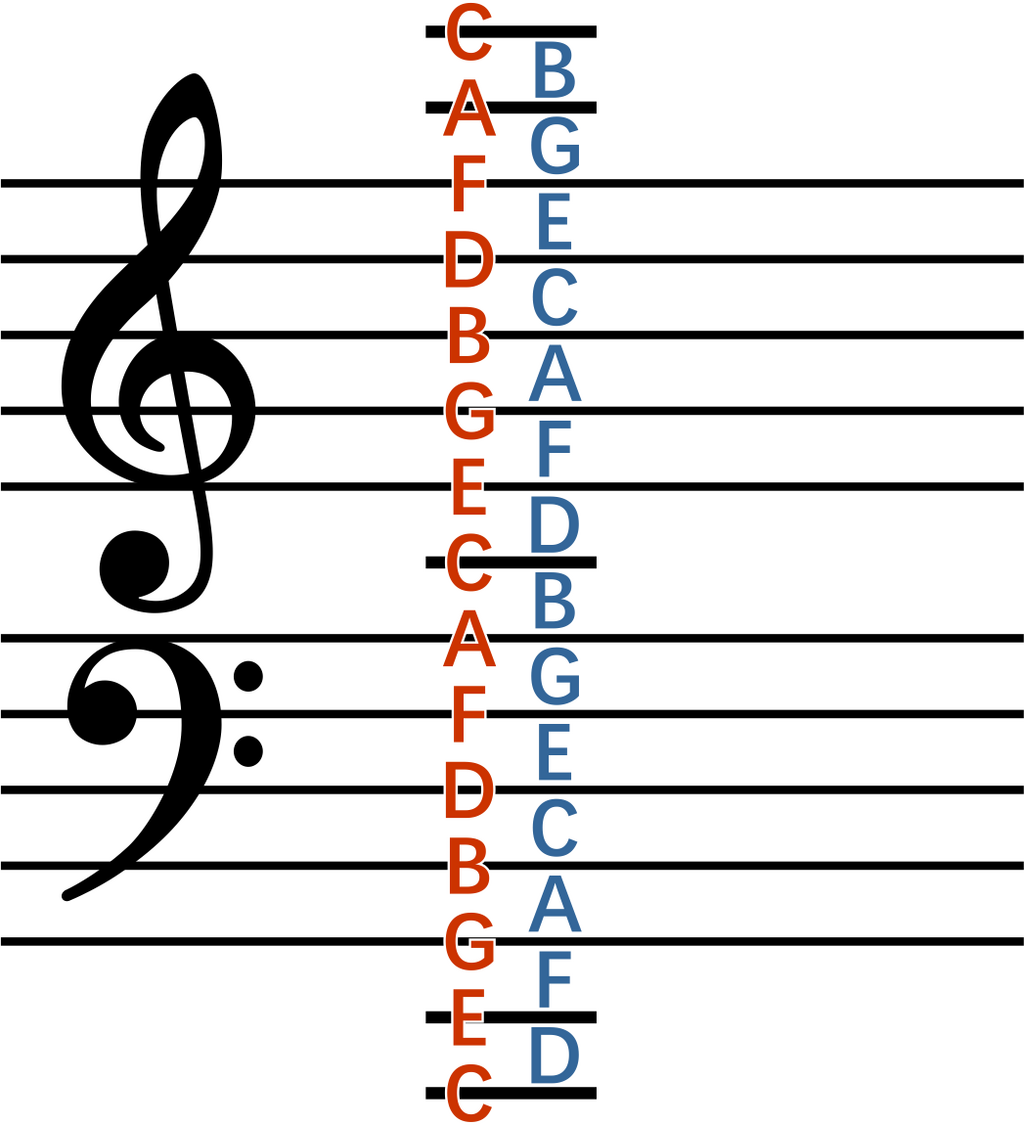
When the treble and bass staves are joined together by a brace, they form the Grand Staff. This is the standard format for piano music. The staves are connected by a special note called Middle C, which can be written just below the treble staff or just above the bass staff.
Notes and Ledger Lines
Notes are named using the first seven letters of the alphabet: A, B, C, D, E, F, and G. After G, the cycle repeats. On the staff, notes ascend alphabetically as they go up the lines and spaces.
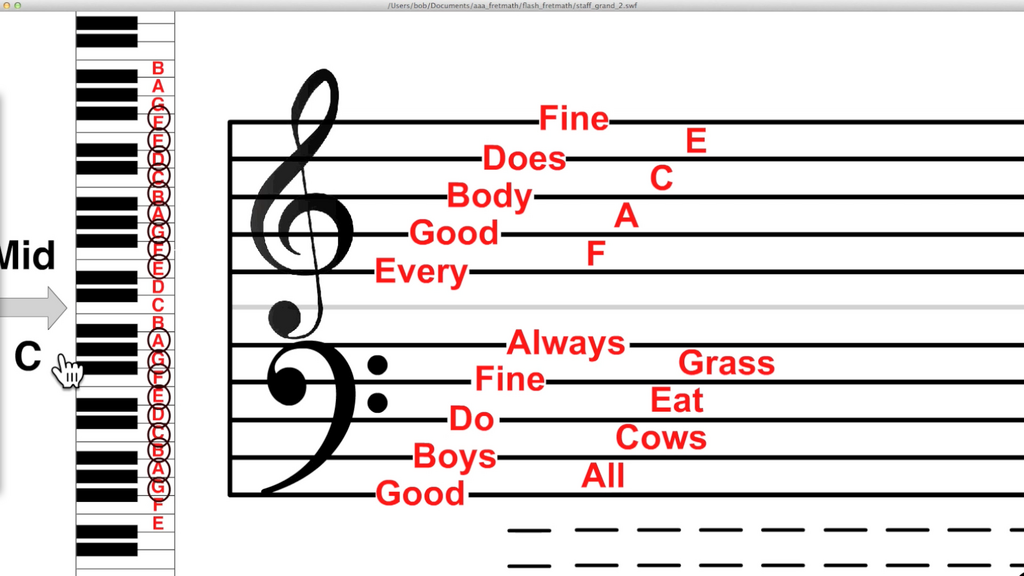
To remember the note names, many people use mnemonics. For the lines of the treble clef, a popular one is Every Good Boy Does Fine. For the spaces, the notes spell out the word FACE.
For the bass clef, you can remember the lines with Good Boys Do Fine Always, and the spaces with All Cows Eat Grass.
But what about notes that are higher or lower than the five lines of the staff? For these, we use ledger lines. These are short, extra lines drawn above or below the staff to extend its range. Middle C, for example, is written on its own ledger line.
Enharmonic Equivalents
Things get interesting when we add sharps () and flats (). A sharp raises a note's pitch by a half step, and a flat lowers it by a half step. Sometimes, two notes with different names can have the exact same pitch. These are called enharmonic equivalents.
Enharmonic
adjective
Relating to notes that are the same in pitch (in modern tuning) but are spelled differently.
For example, the black key on a piano between F and G can be called F-sharp () or G-flat (). They are played with the same key and sound identical, but they're written differently depending on the musical context, like the key signature of the piece.
Another common example is C-sharp () and D-flat (). Both refer to the same black key on the piano.
There are also double sharps ( or ) and double flats (). A double sharp raises a note by two half steps (a whole step), and a double flat lowers it by two half steps. This leads to more enharmonic equivalents. For example, G double sharp () sounds the same as A. And C double flat () sounds the same as B-flat ().
Now, let's test your understanding of these foundational concepts.
What is the primary function of a clef at the beginning of a musical staff?
Which mnemonic is commonly used to remember the notes on the lines of the bass clef from bottom to top?
Understanding how pitch is written on the staff is the first big step in learning to read music. With these basics, you're ready to explore how notes are organized into scales and keys.