Rayleigh Jeans Law and the Physics of Standing Waves
Cavity Resonator Physics
The Perfect Absorber
To understand how objects radiate heat, physicists imagined an ideal object called a blackbody. A blackbody absorbs all electromagnetic radiation that falls on it, from radio waves to gamma rays, reflecting nothing. While no real object is a perfect blackbody, we can construct something very close: a hollow metal box with a tiny hole in it.
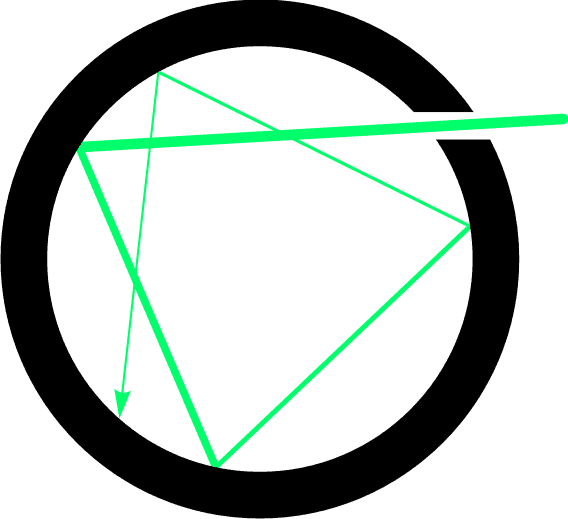
This box, known as a cavity resonator, traps radiation. The energy inside takes the form of electromagnetic waves bouncing around. But these aren't just any waves; they are standing waves, constrained by the physical boundaries of the cavity itself. Think of them as the specific resonant notes a guitar string can produce, but for light in a three-dimensional space.
Waves in a Box
The metallic walls of the cavity impose strict rules, or boundary conditions, on the electromagnetic waves inside. Since the walls are perfect conductors, the component of the electric field parallel to the surface must be zero right at the wall. If it weren't, it would create a current and dissipate energy, which can't happen in our idealized system.
This single requirement, that the electric field vanishes at the walls, dictates everything. It forces the waves to arrange themselves into precise patterns that fit perfectly within the cavity's dimensions. To simplify the maths, let's imagine our cavity is a perfect cube with side length .
Pinning Down the Patterns
Any wave travelling in three dimensions can be described by a , which points in the direction of travel. Its magnitude, , relates to the wavelength . For a standing wave to exist in our cube, its pattern must go to zero at the walls. This means an integer number of half-wavelengths must fit perfectly along each of the cube's axes (x, y, and z).
This constraint forces the components of the wave vector (, , and ) to take on only specific, discrete values. They can't be just any number; they are quantized.
The set of three positive integers defines a unique standing wave mode, or nodal pattern, within the cavity. Each integer tells you how many half-wavelengths fit along that specific axis. For example, the mode is the fundamental mode, the longest wavelength that can resonate in the box. The mode would have two half-wavelengths along the x-axis, but only one along the y and z axes.
By establishing these boundary conditions, we have shown that the electromagnetic field inside a cavity isn't a continuous wash of energy. Instead, it behaves like a collection of discrete, independent oscillators. Each possible mode represents a different oscillator, each with its own specific pattern and frequency. This insight is the crucial first step toward understanding the quantum nature of light.