Rainbow Science and Physics
Refraction Dynamics
Crossing the Boundary
When a beam of white light travels through the air, it moves at nearly its maximum cosmic speed. But the moment it hits the curved surface of a water droplet, it crosses into a denser optical medium. Because water is packed with molecules, this transition forces the light to suddenly slow down. This abrupt change in velocity causes the incoming light wave to pivot and bend at the boundary, a fundamental physical process known as .
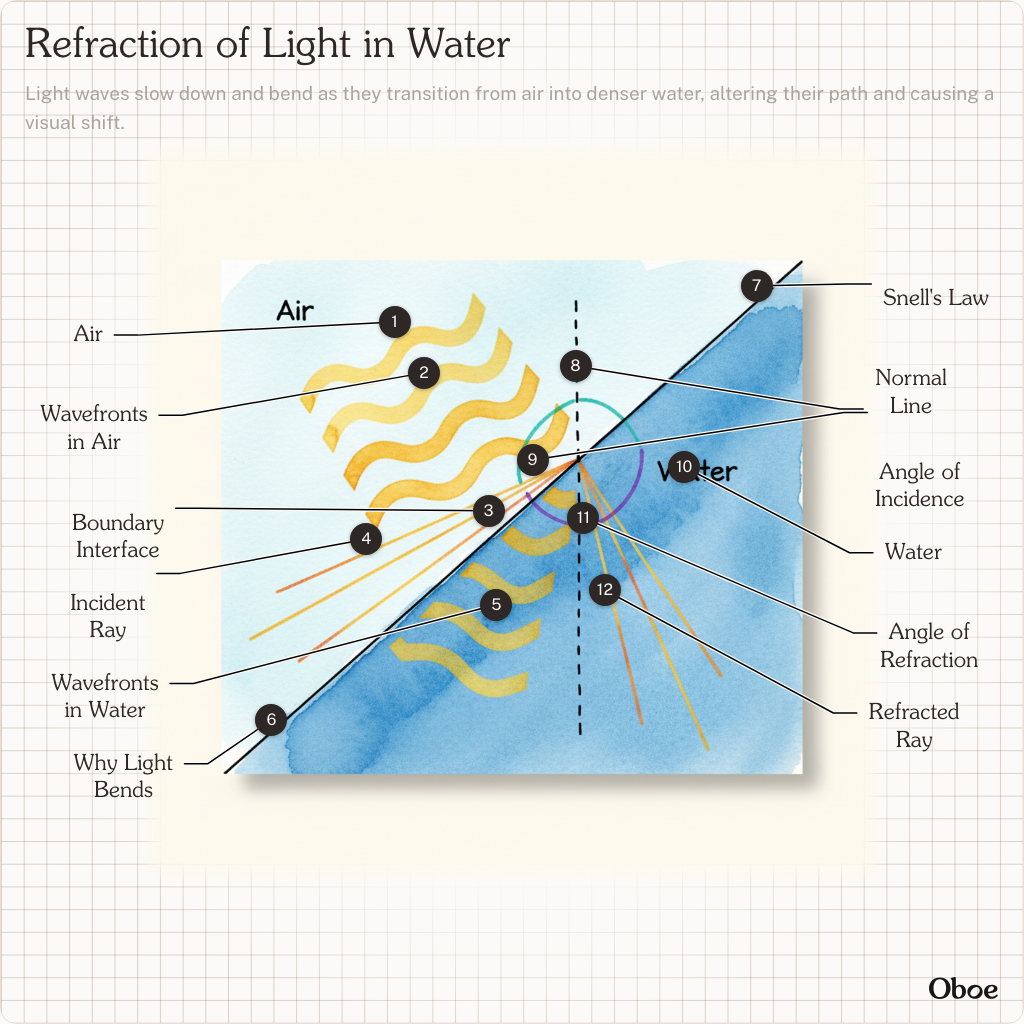
How much the light slows down and bends depends entirely on a property called the of the medium. Water has a refractive index of approximately , which means that light travels about times slower inside the droplet than it does in a vacuum. This ratio dictates the precise angle of the light's initial path inside the drop, establishing the exact trajectory for the beautiful colors that will eventually emerge.