RAG Vector Search Explained
Introduction to Retrieval-Augmented Generation
Giving LLMs an Open Book
Large Language Models (LLMs) like the ones that power ChatGPT are impressive. They can write essays, generate code, and answer complex questions. But they have a fundamental limitation: their knowledge is frozen in time. An LLM only knows about the information it was trained on. It can't look things up on the internet or access new data. This leads to a couple of big problems.
First, their knowledge gets stale. An LLM trained in 2022 won't know who won the World Series in 2023. Second, they can confidently make things up. This is often called 'hallucination,' and it happens when the model doesn't actually know the answer but generates a plausible-sounding, yet incorrect, response.
hallucination
noun
The tendency of an AI model to generate false information or perceive patterns that do not exist in the data, presenting it as factual.
This is where Retrieval-Augmented Generation, or RAG, comes in. RAG is a technique that gives an LLM an open-book test. Instead of relying only on its pre-existing knowledge, a RAG system first retrieves relevant, up-to-date information from an external source and then uses that information to generate a better answer.
Retrieval-Augmented Generation (RAG) effectively addresses issues of static knowledge and hallucination in large language models.
How RAG Works
The process is straightforward. When you ask a question, the system doesn't immediately send it to the LLM. First, it uses your question to search a specific knowledge base, like a company's internal documents, a collection of recent news articles, or a product manual.
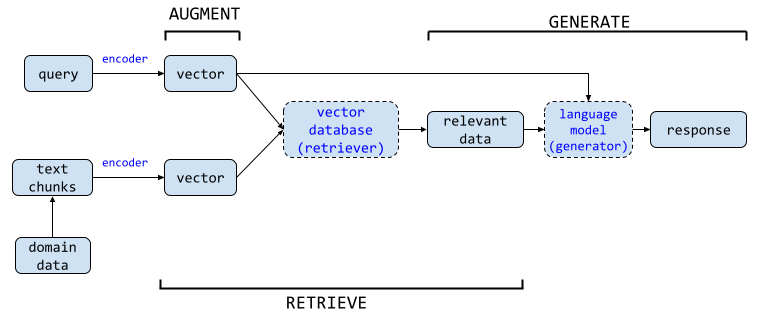
The key is finding the most relevant pieces of information. This is where vector search comes into play. The system converts your question and all the documents in the knowledge base into numerical representations called vectors. Think of these vectors as coordinates on a map. Concepts that are similar in meaning will have vectors that are close to each other on this map.
By comparing the vector of your question to the vectors of all the documents, the system can quickly find the chunks of text that are most semantically similar to what you're asking about. This is far more powerful than simple keyword matching.
Instead of just looking for the word 'revenue,' vector search can find documents talking about 'earnings,' 'sales,' and 'profits'—all related concepts.
Once the most relevant information is found, it's bundled together with your original question and sent to the LLM. The LLM is then instructed to use the provided information to answer the question. This grounds the model's response in reality, using timely and accurate data, which dramatically reduces the chance of hallucination and ensures the answer is up-to-date.
Why It Matters
RAG transforms LLMs from being know-it-alls with potentially outdated information into expert researchers that can use a library of specific knowledge. This makes them much more reliable for real-world applications.
For a business, this means you can build a customer support chatbot that uses your actual product manuals to answer questions. For a financial analyst, it means getting summaries based on the latest market reports, not data from two years ago. By connecting LLMs to live, curated knowledge sources, RAG makes AI more trustworthy, accurate, and useful.
Ready to check your understanding?
What is a primary limitation of standard Large Language Models (LLMs) that Retrieval-Augmented Generation (RAG) is designed to address?
In a RAG system, what is the main purpose of converting documents and user queries into vectors?
This ability to dynamically pull in external information is a major step forward in making AI systems more capable and reliable.