RAG in AI Explained
Introduction to RAG
Giving AI a Library Card
Large language models (LLMs) are powerful. They're trained on vast amounts of text and can write, summarize, and code with impressive skill. But they have a fundamental limitation: their knowledge is frozen in time. An LLM only knows what it learned from its training data, which eventually becomes outdated.
Imagine an expert who read every book, article, and website—but stopped in 2021. They could tell you all about history, science, and culture up to that point. But ask them about last year's World Series winner or the latest stock market trends, and they'd be stumped. This is the challenge with traditional LLMs. They can't access real-time information, which limits their usefulness for many tasks.
Worse, when an LLM doesn't know an answer, it might try to guess and invent plausible-sounding but incorrect information. This is often called a hallucination.
This is where Retrieval-Augmented Generation, or RAG, comes in. It’s a technique that gives an LLM a connection to an external, up-to-date knowledge source. Think of it as giving that brilliant expert a library card and a live internet connection. Before answering a question, the AI can first search for the latest, most relevant information.
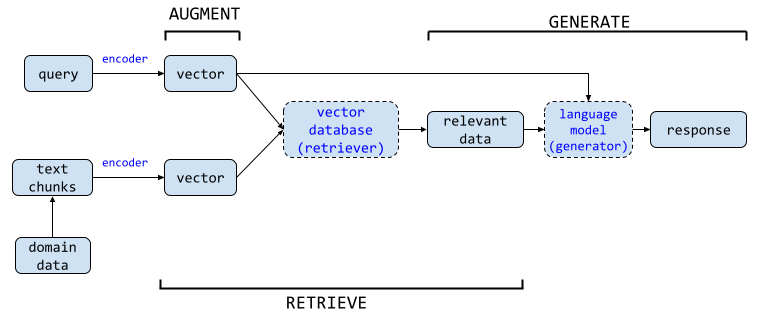
How RAG Works
The process is straightforward. When you ask a RAG-powered system a question, it doesn't immediately jump to generating an answer. Instead, it first performs a search.
-
Retrieve: The system takes your query and searches an external knowledge base for relevant documents or data snippets. This knowledge base could be anything: a company’s internal wiki, a database of legal documents, a collection of product manuals, or even the live internet.
-
Augment: The most relevant information found during the retrieval step is then added to your original prompt. This new, expanded prompt now contains both your question and the fresh context needed to answer it accurately.
-
Generate: Finally, this augmented prompt is fed to the LLM. With the retrieved information right there for reference, the model can generate a response that is not only coherent but also grounded in timely, factual data.
RAG vs. Traditional LLMs
The difference between a standard LLM and a RAG-enhanced one is like the difference between a closed-book and an open-book exam.
| Feature | Traditional LLM | RAG-Enhanced LLM |
|---|---|---|
| Knowledge Source | Static training data | Dynamic, external sources |
| Timeliness | Knowledge is frozen at time of training | Can access real-time information |
| Factual Accuracy | Prone to hallucinations if knowledge is missing | More accurate and verifiable |
| Domain Specificity | General knowledge | Can use specialized, private data |
By grounding its responses in specific, retrieved documents, a RAG system can also provide citations. This allows users to verify the information and builds trust in the AI's output.
Common Applications
RAG's ability to tap into specific, current information makes it valuable for many real-world applications.
Customer Support: Chatbots can access a company's latest product information and support articles to provide customers with accurate, up-to-date help, reducing the workload on human agents.
Business Intelligence: Analysts can ask natural language questions about their company's sales data, market trends, and internal reports. The RAG system retrieves the precise data needed and synthesizes it into a clear summary.
Legal and Medical Fields: Professionals can quickly find information in vast libraries of legal case law or medical research papers. A RAG system can surface relevant precedents or studies, saving hours of manual research.
Retrieval-Augmented Generation (RAG) has emerged as a pivotal technique in artificial intelligence (AI), particularly in enhancing the capabilities of large language models (LLMs) by enabling access to external, reliable, and up-to-date knowledge sources.
Essentially, any task that requires accurate answers based on a specific and evolving body of knowledge is a great fit for RAG. It makes AI not just more knowledgeable, but more reliable and trustworthy.
What is the primary limitation of traditional Large Language Models (LLMs) that Retrieval-Augmented Generation (RAG) is designed to address?
Arrange the three steps of the RAG process in the correct order.