RAG for CSV Data Analysis
Introduction to RAG
Giving Language Models a Library Card
Large language models (LLMs) are incredibly knowledgeable. They've been trained on vast amounts of text from the internet, books, and articles. Think of an LLM as a brilliant student who has read a massive library but is now locked in a room with no new books or internet access. Their knowledge is extensive, but it's frozen in time and lacks specific, private information.
This is where Retrieval-Augmented Generation, or RAG, comes in. RAG is a technique that gives the LLM a library card to a specific, curated collection of information. Before answering a question, the model can first search this external knowledge base to find relevant facts. This simple but powerful idea dramatically improves the quality and accuracy of its responses.
Retrieval-Augmented Generation (RAG) is an AI framework that connects a language model to an external knowledge repository, allowing the model to fetch and include relevant information when generating an answer.
Instead of relying solely on its pre-trained memory, the LLM uses RAG to ground its answers in specific, up-to-date data. This could be anything from a company's internal HR policies to real-time financial data or a collection of legal documents.
The Four Steps of RAG
The RAG process can be broken down into four core stages. It’s a workflow that transforms raw data into a useful knowledge base and then uses it to answer questions.
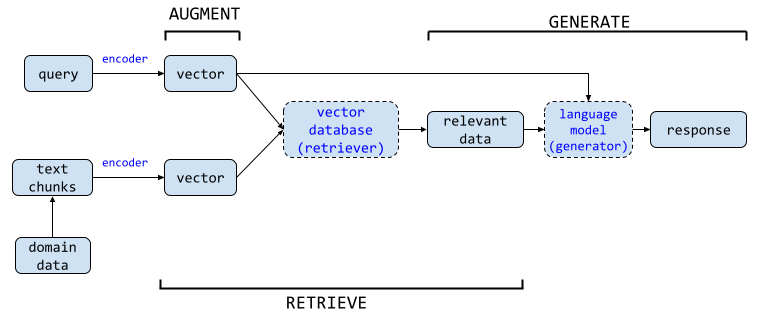
1. Ingestion First, you need to prepare your knowledge base. This involves taking your documents—like PDFs, web pages, or database entries—and breaking them into smaller, manageable chunks. Each chunk is then converted into a numerical representation called a vector embedding. This process is like creating a detailed index for a library, where each vector represents the meaning and context of a piece of information.
2. Retrieval When a user asks a question (a "query"), the system converts that question into a vector as well. It then searches the knowledge base to find the text chunks with the most similar vectors. This is the "retrieval" step. A specialized database, called a vector database, is often used to perform this similarity search quickly and efficiently.
3. Augmentation The most relevant chunks of text found during the retrieval step are then gathered. This retrieved information is combined with the user's original query to create a new, much more detailed prompt. This is the "augmentation" part. You're not just asking the LLM the question; you're giving it the question along with a cheat sheet of relevant facts.
4. Generation Finally, this augmented prompt is sent to the LLM. The model uses the provided context to generate a final answer. Because the answer is based on specific, retrieved data, it's far more likely to be accurate, relevant, and detailed than if the model had relied only on its internal memory.
Benefits and Applications
The primary benefit of RAG is that it makes language models more reliable. It helps reduce "hallucinations," which are instances where an LLM confidently states incorrect information. By grounding the model in factual data, RAG ensures the answers are based on verifiable sources.
RAG keeps models honest by forcing them to base their answers on real data, not just patterns from their training.
This approach also allows LLMs to use information that is current or private. An LLM's knowledge is static, but a RAG system can connect to a database that is updated every minute. This makes it possible to build applications that can answer questions about recent events, internal company knowledge, or customer-specific data.
Because of this flexibility, RAG is used in many different domains. Customer service chatbots use it to access the latest product information and user manuals. Financial analysts use it to query up-to-the-minute market reports. Legal professionals can use it to quickly search through thousands of pages of case law to find relevant precedents.
This technique essentially transforms general-purpose LLMs into specialized experts, without the need for costly retraining.
Now that you understand the what and why of RAG, you're ready to see how these components work together to build a practical application.