RAG Engineering Fundamentals
Introduction to Retrieval-Augmented Generation
Giving Language Models a Library
Large language models (LLMs) are powerful. They can write emails, summarize articles, and even generate computer code. But they have a fundamental weakness: their knowledge is stuck in the past. An LLM only knows what it learned from its training data, which can be months or years old. It has no access to real-time information.
This limitation leads to a major problem called hallucination. The model, trying to be helpful, will sometimes invent facts, sources, or details when it doesn't know the correct answer. It presents this made-up information with complete confidence, making it difficult to trust.
Hallucination
noun
The tendency of an AI model to generate false or nonsensical information and present it as fact.
How can we make LLMs more reliable and up-to-date? We can give them a library card. That’s the core idea behind Retrieval-Augmented Generation, or RAG. Instead of relying solely on its internal, static knowledge, a RAG system first looks up relevant, current information from an external source before generating a response.
Retrieval-Augmented Generation (RAG) is an AI framework that connects a language model to an external knowledge repository, allowing the model to fetch and include relevant information when generating an answer.
How It Works
The process is straightforward and can be broken into two main steps: retrieval and generation.
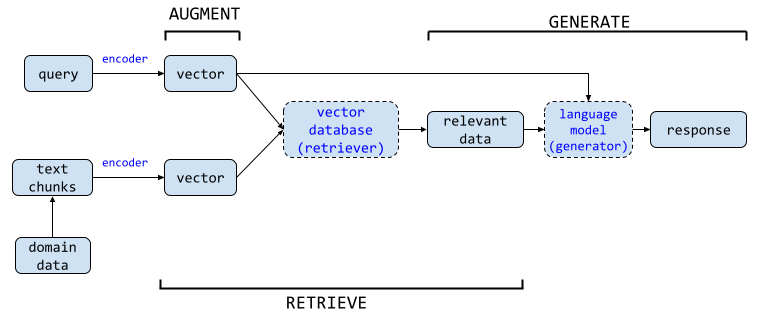
First, the retrieval phase. When you ask a question, the system doesn't immediately send it to the LLM. Instead, it uses your query to search a knowledge base—a collection of documents, articles, or database entries. This search component is called the retriever. It finds snippets of text that are most relevant to your question.
Next comes the generation phase. The original question and the relevant information found by the retriever are bundled together and sent to the LLM. The LLM then uses this extra context to generate a well-informed, accurate answer. It’s like an open-book exam; the model has the source material right in front of it.
The Benefits of RAG
Integrating a retrieval system addresses the core weaknesses of standalone LLMs. The benefits are significant.
Reduced Hallucinations: By grounding the model's response in factual, retrieved data, RAG makes the LLM far less likely to invent information. The answers are based on real data, not just patterns from its training.
Current Information: The external knowledge base can be updated continuously. This allows a RAG system to answer questions about recent events, new products, or changing policies—information the original LLM never saw during its training.
Domain-Specific Expertise: RAG allows developers to connect an LLM to a private or specialized knowledge base. A company could use its internal documents to create a chatbot that answers employee questions about company policies, or a medical institution could use research papers to build a tool for doctors.
In short, RAG makes LLMs more accurate, timely, and trustworthy by giving them access to verifiable facts.
Every RAG system relies on two core components working together.
| Component | Role |
|---|---|
| Retriever | The search engine. It queries the knowledge base to find information relevant to the user's prompt. |
| Generator | The LLM. It synthesizes the retrieved information with the user's prompt to create the final, human-like answer. |
This simple but powerful architecture is transforming how we build applications with LLMs. Now, let's test your understanding of these fundamental concepts.
What is the primary weakness of standalone Large Language Models (LLMs) that Retrieval-Augmented Generation (RAG) is designed to address?
In the RAG process, what is the main function of the "retrieval" step?
By connecting language models to external knowledge, RAG provides a practical way to create more reliable and capable AI systems.