RAG and LLM Integration
Introduction to RAG and LLMs
What Are LLMs Missing?
Large Language Models (LLMs) like ChatGPT are incredibly powerful. They can write essays, debug code, and answer questions on a vast range of topics. Their knowledge comes from the massive amounts of text they were trained on. This training data is like a giant, comprehensive library of books, articles, and websites.
But this library has a critical limitation: it's locked in time. An LLM's knowledge is frozen at the point its training ended. It doesn't know about events that happened yesterday, and it certainly doesn't know about your company's internal documents or your personal emails.
When you ask an LLM a question it can't answer from its training data, it has a tendency to guess. This is often called a hallucination. The model provides a confident, plausible-sounding answer that is partially or completely wrong.
An LLM is like a brilliant scholar who has read every book published up to 2022, but has been locked in a library ever since. They can't tell you today's news or look up a specific fact in your private notes.
Giving LLMs a Library Card
So, how do we give an LLM access to current or private information without the massive expense of retraining it? The answer is Retrieval-Augmented Generation, or RAG.
RAG
other
Stands for Retrieval-Augmented Generation. It's an AI framework that enhances a large language model's response by first retrieving relevant, up-to-date information from an external knowledge base.
RAG connects the LLM to an external knowledge source, like a collection of company documents, recent news articles, or a product database. Instead of just relying on its static memory, the LLM can now look things up. It's like giving our scholar a library card and an internet connection. Before answering a question, the system first finds the most relevant snippets of information and provides them to the LLM as context.
Retrieval-Augmented Generation (RAG) enhances Large Language Models (LLMs) by incorporating external, domain-specific data into the generative process.
How RAG Works
The RAG process is a straightforward workflow that combines information retrieval with text generation. It works in a few key steps.
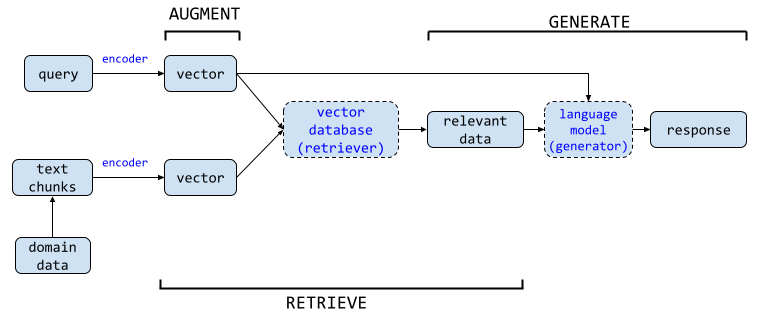
First, when you ask a question, the system doesn't immediately send it to the LLM. Instead, it uses your query to search through a specialized database, called a vector database, which contains your external data. This step is the Retrieval phase. It finds the text chunks that are most relevant to your question.
Next, the system takes these retrieved text chunks and combines them with your original question. This new, expanded prompt is then sent to the LLM. This is the Augmentation phase. You're giving the LLM the exact information it needs to form a good answer.
Finally, the LLM reads the combined prompt, which now includes both your question and the relevant context, and produces an answer. This is the Generation phase. Because the LLM has been given the specific facts it needs, the response is grounded in that data, making it far more accurate and reliable.
Let's review the key concepts before we move on.
Now, let's check your understanding of these core ideas.
What is the primary limitation of a standard Large Language Model (LLM) that Retrieval-Augmented Generation (RAG) is designed to address?
When an LLM is asked a question it can't answer from its training data, it may generate a confident but incorrect answer. This phenomenon is known as a ________.
By adding a retrieval step, RAG makes LLMs smarter, more accurate, and much more useful for real-world applications that require up-to-date or specialized knowledge.