RAG and GraphRAG Explained
Introduction to RAG
Giving Language Models an Open Book
A Large Language Model (LLM) knows a lot, but its knowledge is frozen in time. It only knows what it learned from the vast amount of text it was trained on. Asking an LLM a question is like giving a student a closed-book exam. They can only rely on what they've already memorized.
But what if you could give the model an open-book exam? That's the core idea behind Retrieval-Augmented Generation, or RAG.
Retrieval-Augmented Generation (RAG) is an AI framework that connects a language model to an external knowledge repository, allowing the model to fetch and include relevant information when generating an answer.
Instead of relying solely on its internal memory, a RAG system first retrieves relevant, up-to-date information from an external source. Then, it uses that information to generate a better, more accurate response. It's a simple but powerful way to make LLMs smarter and more reliable.
Why It Matters
Connecting LLMs to external knowledge solves a few key problems. First, it makes them more truthful. When an LLM doesn't know something, it can sometimes invent an answer, a phenomenon known as "hallucination." RAG grounds the model in factual documents, significantly reducing the chances of it making things up.
Second, it keeps them current. The world changes constantly, but retraining a massive language model is incredibly expensive and time-consuming. With RAG, you can provide the latest information simply by updating the external knowledge source. The LLM can then access this new data instantly, without needing a complete overhaul.
Finally, RAG allows LLMs to become specialists. A standard LLM has broad, general knowledge. By connecting it to a specific database—like a company's internal documents, legal case files, or medical research papers—it can provide expert-level answers on that particular topic.
How RAG Works
The RAG process has two main phases: retrieval and generation.
1. Retrieval: When you submit a prompt, the system doesn't immediately ask the LLM. It first searches a dedicated knowledge base for documents or text snippets relevant to your query. This knowledge base could be anything from a set of PDFs to a massive database.
2. Generation: The system takes the relevant information it found and combines it with your original prompt. It then sends this augmented prompt to the LLM. With this extra context in hand, the LLM generates a response that is not only fluent but also factually grounded in the provided data.
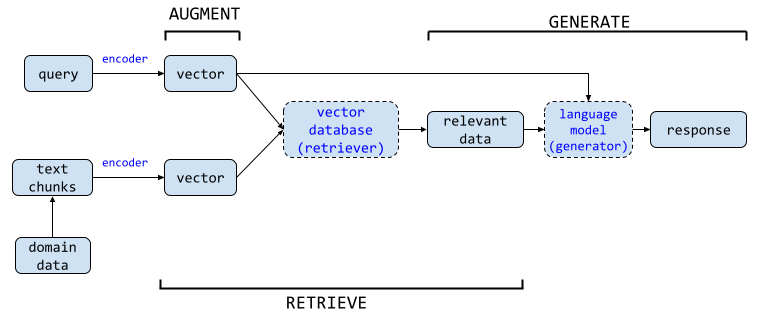
This two-step method ensures the model isn't just pulling from its static memory. It's using a custom-built, relevant cheat sheet to answer your specific question accurately.