Radioactivity Unveiled
Atomic Structure
Inside the Atom
Everything you see around you is made of atoms. They are the fundamental building blocks of matter. At the center of every atom is a dense core called the nucleus.
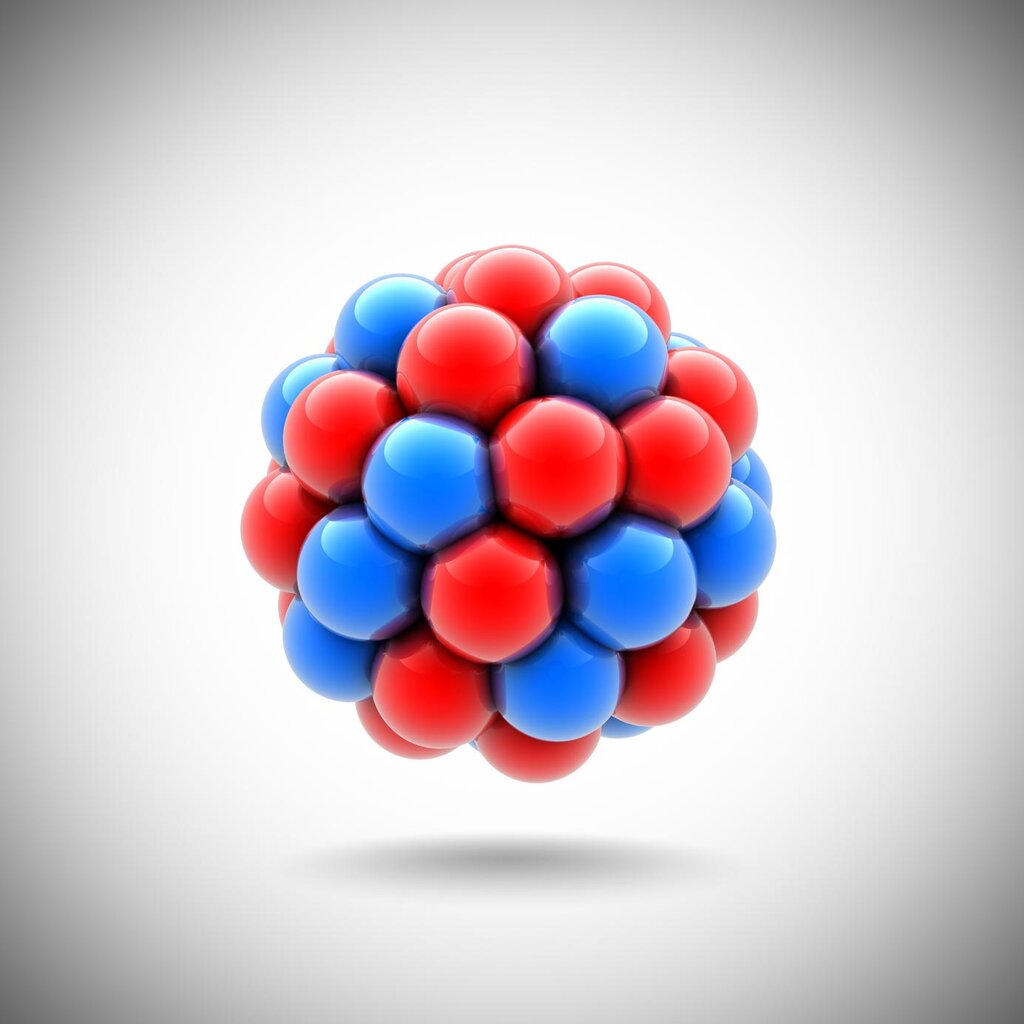
The nucleus is packed with two types of particles: protons and neutrons. Together, they are known as nucleons.
Proton
noun
A subatomic particle found in the nucleus of every atom, with a positive electric charge.
Neutron
noun
A subatomic particle of about the same mass as a proton but without an electric charge, present in all atomic nuclei except those of ordinary hydrogen.
Protons give the nucleus its positive charge, while neutrons are neutral. The number of protons determines what element an atom is. For example, an atom with one proton is always hydrogen. An atom with six protons is always carbon. Change the number of protons, and you change the element entirely.
Electrons and Shells
Whizzing around the nucleus are much smaller, lighter particles called electrons. Electrons carry a negative charge, which is equal in magnitude to the positive charge of a proton. In a neutral atom, the number of electrons equals the number of protons, balancing the overall charge to zero.
Electron
noun
A stable subatomic particle with a charge of negative electricity, found in all atoms and acting as the primary carrier of electricity in solids.
Electrons don't just swarm the nucleus randomly. They exist in specific energy levels, or regions, called electron shells. Think of them like planets orbiting a star at different distances. Shells closer to the nucleus have lower energy, while those farther out have higher energy.
Isotopes
While the number of protons defines an element, the number of neutrons can vary. Atoms of the same element that have different numbers of neutrons are called isotopes.
Same number of protons, different number of neutrons.
For instance, every carbon atom has six protons. Most carbon atoms also have six neutrons (this is called carbon-12). However, some have seven neutrons (carbon-13) or even eight (carbon-14). They are all still carbon, but they are different isotopes of carbon.
The number of neutrons in a nucleus is crucial. It affects the atom's mass, but more importantly, it affects the stability of the nucleus. The ratio of neutrons to protons is a key factor in determining whether an atom is stable or unstable. Unstable atoms are the ones that undergo radioactive decay, a process we'll explore next.
Let's check your understanding of the atom's basic structure.
What two particles are found in the nucleus of an atom?
If you change the number of protons in an atom, you change the element.
This fundamental structure—protons, neutrons, and electrons—governs how atoms behave, bond together, and, in some cases, become unstable.