Radio Engineering and Signal Theory
Wave Propagation Dynamics
From Field to Wave
You know that an alternating current in a conductor creates oscillating electric and magnetic fields. When the frequency is high enough, these fields don't just collapse back into the conductor. Instead, they detach and become a self-propagating electromagnetic wave, radiating energy outwards at the speed of light. Think of it as the ripple effect when you drop a stone in a pond, but in three dimensions and made of pure energy.
How this wave travels from transmitter to receiver isn't a single, simple story. The path it takes depends heavily on its frequency and the environment it moves through. These different travel methods are called propagation modes. We'll explore the three main modes: ground wave, sky wave, and space wave.
Down to Earth and Up to the Sky
At lower frequencies, primarily in the VLF, LF, and MF bands (like AM radio), signals travel via ground wave propagation. The wave follows the curvature of the Earth, with the ground itself acting as a sort of guide. The conductivity of the surface matters a great deal; propagation over saltwater is far more efficient than over dry, desert land. This mode is reliable for consistent regional coverage, but its reach is limited as ground losses absorb the wave's energy over distance.
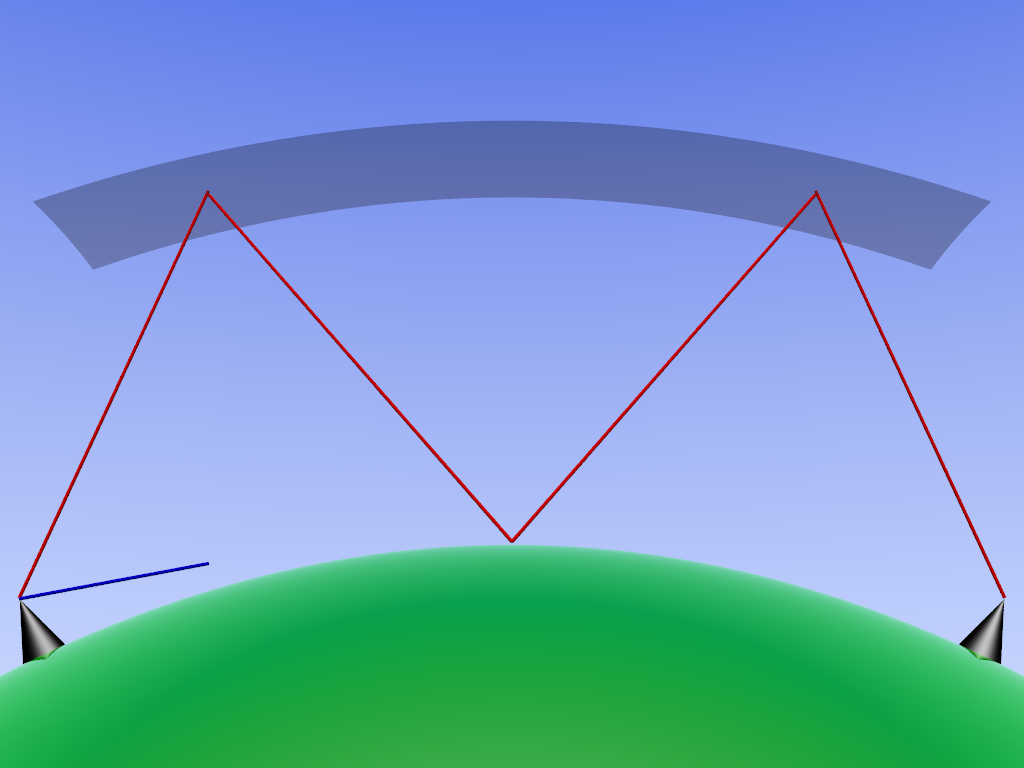
Things get more interesting with higher frequencies, particularly in the HF band (shortwave). These signals use sky wave propagation, bouncing off a layer of the upper atmosphere called the to travel vast distances, well beyond the horizon. The ionosphere is a region from about 60 to 400 km altitude where solar radiation ionizes gas molecules, creating a sea of free electrons. This ionized plasma doesn't simply reflect radio waves like a mirror. Instead, it refracts them.
The angle of refraction depends on the wave's frequency and the ionization density of the layer. As the wave enters the ionosphere, it is bent progressively. If the angle and frequency are right, the wave is bent all the way back down toward Earth, hundreds or thousands of kilometers away. This is called a "skip." The distance from the transmitter to the point where the first sky wave returns is the skip distance, and the region between the end of the ground wave coverage and the start of the sky wave coverage is the skip zone, an area where the signal cannot be received.
The Straight and Narrow Path
As we move to even higher frequencies, such as VHF, UHF, and microwaves, the ionosphere can no longer refract the waves. They are too energetic and simply pass right through it into space. For these frequencies, the primary mode is space wave propagation. This is often called line-of-sight (LOS) communication because the transmitting and receiving antennas must effectively "see" each other.
The communication range is limited by the curvature of the Earth and any obstructions like hills or buildings. This is why antennas for FM radio, television, and cell service are placed on high towers. Even in a clear, unobstructed path, the signal doesn't travel forever. Its strength decreases predictably with distance, a phenomenon known as (FSPL).
In the real world, signals rarely travel a single, clean path. In urban or indoor environments, the transmitted wave reflects off buildings, walls, and other objects. The receiver ends up getting multiple copies of the signal arriving at slightly different times. This is called multi-path interference.
When these multiple wave fronts arrive at the receiver, their phases determine the outcome. If they arrive in phase, they add up, strengthening the signal (constructive interference). If they arrive out of phase, they can cancel each other out, causing the signal to weaken or disappear entirely (destructive interference). This rapid fluctuation in signal strength is known as fading, and it's why walking just a few feet can sometimes be the difference between a clear cell phone call and a dropped one.
Which propagation mode is primarily used for AM radio broadcasts and relies on the wave following the curvature of the Earth?
In a city, you might find that your cell phone reception improves by moving just a few feet. What is this phenomenon of rapid signal strength fluctuation called?
Understanding how waves propagate is key to designing and troubleshooting any radio system, from a simple walkie-talkie to a global satellite network. Each mode has its own strengths and weaknesses, dictated by the unchangeable laws of physics.