Racetrack Driving Essentials
Vehicle Dynamics
The Dance of Weight
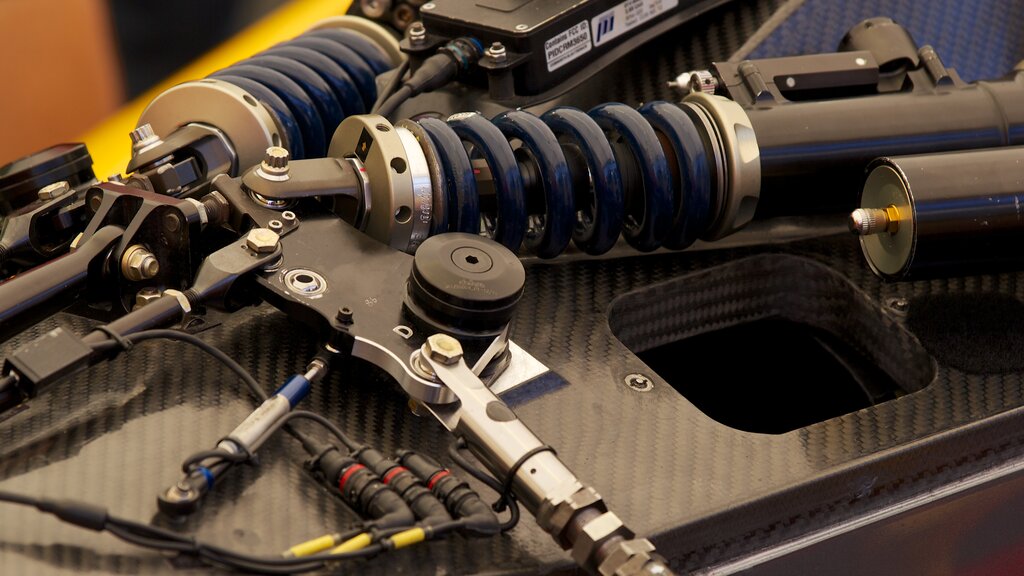
Think of a car not as a solid block, but as a body with its weight balanced on four springs. Every time you accelerate, brake, or turn, that weight shifts around. This is called weight transfer, and it's the key to understanding how a car behaves at speed.
When you hit the accelerator, you feel pushed back in your seat. The car's weight does the same, shifting toward the rear tires. This is called longitudinal weight transfer, or 'pitch'. The opposite happens when you brake; the weight shifts forward, compressing the front suspension.
When you steer into a corner, the weight shifts to the outside tires. This is lateral weight transfer, or 'roll'. Mastering a car on a track is about managing this constant dance of weight from one tire to another.
Why does this matter? Because the amount of grip a tire has is directly related to how much weight is pushing down on it. More weight equals more potential grip.
Where Rubber Meets Road
Each tire connects to the road through a patch of rubber about the size of your hand. This 'contact patch' is where all the magic happens. It's responsible for accelerating, braking, and turning. But it can't do everything at once with maximum force.
A tire has a finite amount of grip. You can use 100% of it for braking, 100% for turning, or some combination of the two, like 70% braking and 30% turning. But you can never ask for more than 100%.
This concept is often visualized as a 'Traction Circle'. Imagine a circle drawn around your car. The edge of the circle represents the limit of your tires' grip. Pure acceleration or braking moves you forward or backward along the circle. Pure cornering moves you side to side. Any combination of forces keeps you within the circle. If you try to brake too hard while turning, for example, you're asking for more than 100% grip. The tires will lose traction, and the car will skid.
Smooth Inputs, Stable Car
Your steering wheel, throttle, and brake pedal are the tools you use to manage weight transfer and grip. Sudden, jerky inputs violently shift the car's weight, which can easily overwhelm the tires and upset the car's balance. Smoothness is everything.
Smooth braking gradually shifts weight to the front tires, increasing their contact patch and grip right when you need it most—at the start of a corner. A smooth steering input uses that grip to turn the car, transferring weight laterally in a predictable way. Gently applying the throttle as you exit the corner shifts the weight back again, giving the rear tires more traction to accelerate without spinning.
Every input should flow into the next. The goal is to keep the car stable and balanced, never shocking the suspension or tires with abrupt demands. A stable car is a predictable car, and a predictable car is a fast car.
Imagine you have an egg between your foot and each pedal. Your goal is to drive a full lap without breaking any of them. That's the level of smoothness to aim for.
Let's check your understanding of these core principles.
What is the primary effect of accelerating in a straight line on a car's weight distribution?
According to the 'Traction Circle' concept, what happens if a driver attempts to use 100% of the tire's grip for cornering and 50% for braking at the same time?
Understanding how your inputs affect the car's balance is the first major step toward driving quickly and safely on a track. It's a physical conversation between you, the car, and the pavement.