Quiz Creation and Administration
Quiz Basics
What Is a Quiz?
At its core, a quiz is a tool for checking knowledge. It's a series of questions designed to measure what someone has learned. But quizzes do more than just test you. They're a powerful way to reinforce information, making it stick in your memory. They can also make learning more interactive and engaging.
For learners, a quick quiz can highlight what you know well and what you need to review. It turns passive reading into an active process of recall. For educators, quizzes provide a snapshot of understanding, showing whether key concepts are landing or if a different approach is needed.
Quizzes play a crucial role in education by reinforcing students' understanding of key concepts and encouraging self-directed exploration.
Types of Questions
Quiz questions come in several common formats. Each type tests knowledge in a slightly different way. Choosing the right format depends on what you want to assess.
| Question Type | Description |
|---|---|
| Multiple-Choice | Presents a question with several possible answers. The test-taker selects the best one. |
| True/False | A statement is presented, and the test-taker must determine if it is correct or incorrect. |
| Short Answer | Requires the test-taker to write a brief, specific answer to a question. |
| Fill-in-the-Blank | A sentence is provided with a word or phrase missing, which the test-taker must supply. |
Multiple-choice is great for quickly assessing understanding of facts or concepts. Short answer questions, on the other hand, require the learner to recall information without any clues.
The Building Blocks of a Quiz
Every quiz is built from a few fundamental components. Understanding these parts is the first step to creating or analyzing any quiz.
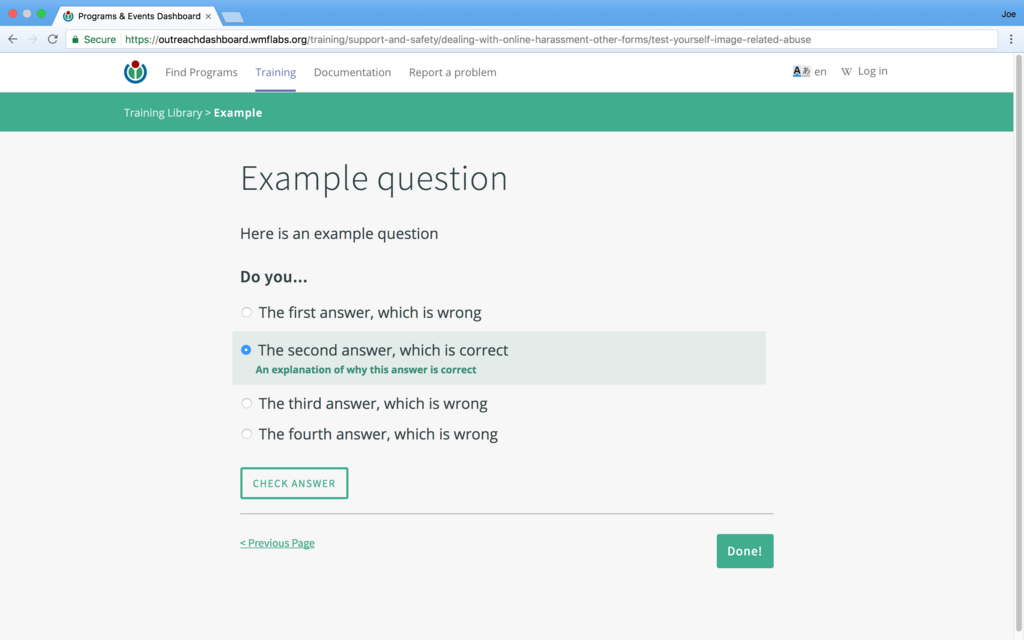
The three key components are: Questions, which probe knowledge; Answers, which provide the correct information; and Feedback, which explains why an answer is right or wrong.
Good questions are clear and unambiguous. They target a specific piece of information. The answers should be straightforward and accurate. But feedback is where the real learning happens. It closes the loop by clarifying misconceptions and reinforcing the correct concepts.
Start with a Goal
A good quiz never starts with the questions. It starts with the objective. What should the learner know or be able to do after completing this quiz? This is the learning objective.
Every question should directly relate to a learning objective. If the goal is for a student to identify the capitals of European countries, a question about the population of Paris is off-topic. This alignment ensures that the quiz is a fair and accurate measure of the intended knowledge.
Let's see what you've learned about the basics of quizzes.
What is the very first step one should take when designing a good quiz?
Besides simply testing knowledge, what is a primary benefit of quizzes for learners?
With these fundamentals in mind, you have a solid foundation for understanding how quizzes work and why they are a valuable part of learning.