Quantum Wave Function Essentials
Wave Particle Duality
Particles That Behave Like Waves
In the world we see, things are either particles or waves. A baseball is a particle; you can track its exact path. The ripples in a pond are waves; they spread out and interfere with each other. But in the quantum realm, this distinction breaks down. Tiny objects like electrons refuse to be neatly categorized. They act like both.
Objects classically thought of as particles can exhibit properties of waves.
This idea, known as wave-particle duality, is a cornerstone of quantum mechanics. It began as a bold hypothesis. In 1924, a young physicist named Louis de Broglie proposed that if light waves could act like particles (photons), then maybe particles like electrons could act like waves. He suggested that every moving particle has a wavelength associated with it.
According to this equation, the more momentum a particle has, the shorter its wavelength. For large objects like a baseball, the wavelength is so incredibly tiny that it's completely undetectable. But for a lightweight, fast-moving electron, the wavelength becomes significant enough to be observed through experiments.
The Double-Slit Experiment
The most famous demonstration of this dual nature is the double-slit experiment. Imagine firing tiny particles, like paintballs, at a wall with two narrow vertical slits in it. Behind this wall is a detector screen that records where each paintball hits. You'd expect to see two distinct bands on the screen, right behind each slit. That's how classical particles behave.
Now, let's repeat the experiment with waves, like water waves in a tank. When the waves pass through the two slits, they spread out on the other side and interfere with each other. Where the crest of one wave meets the crest of another, they combine to make a bigger wave (constructive interference). Where a crest meets a trough, they cancel each other out (destructive interference). The result on the detector screen is an interference pattern: a series of bright and dark bands, not just two.
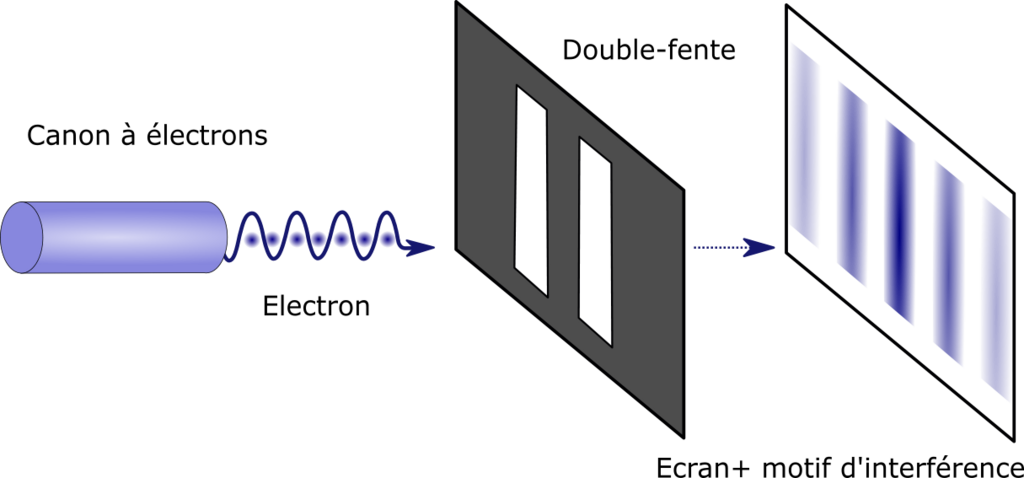
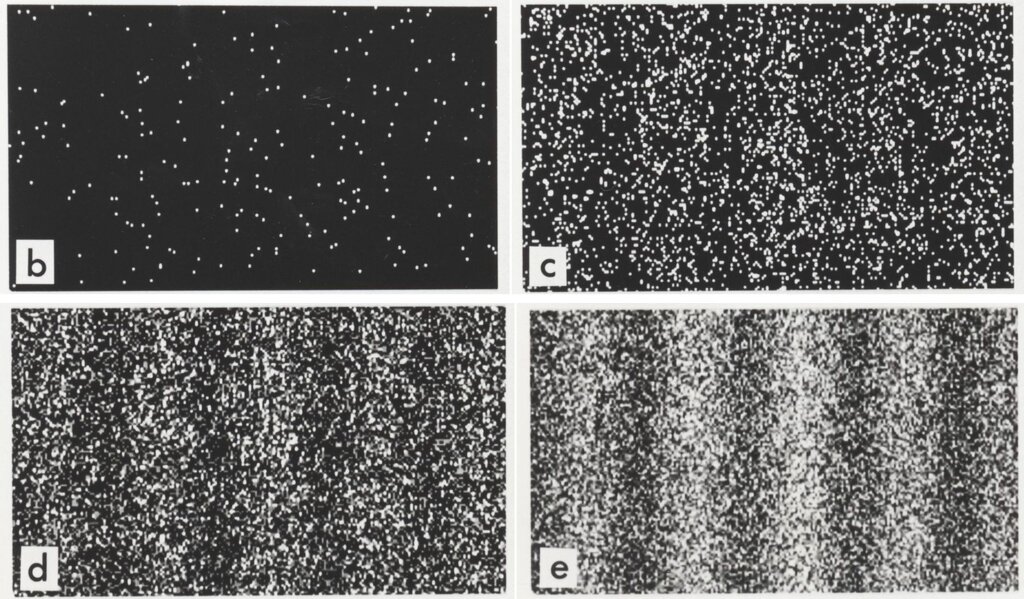
Here's the mind-bending part. When scientists performed this experiment with electrons, firing them one at a time, they didn't get two simple bands. Over time, as individual electrons hit the screen one by one, the pattern that emerged was an interference pattern, just like the one made by waves. It was as if each electron, traveling by itself, somehow passed through both slits at once and interfered with itself.
A Wave of Information
This result forces us to rethink what an electron is. It isn't a tiny billiard ball following a single path. Instead, we describe it with a wave function, a mathematical object that represents all the possible paths it could take. The wave function spreads out and passes through both slits, creating the interference pattern. But it's not a physical wave like a ripple in water. You can't surf on an electron wave.
The wave function is a wave of probability. Its height at any given point tells you the likelihood of finding the particle there if you were to look.
Where the wave function's interference is constructive, there is a high probability of detecting an electron. Where it's destructive, the probability is zero. The electron itself is detected as a particle at a single point, but the probability of where it will land is governed by this underlying wave. This wave of information, or probability, is the key to understanding the strange rules of the quantum world.
This dual nature is not just a theoretical curiosity. It's a fundamental property of matter that has profound implications for how we understand reality and build technologies like lasers and quantum computers.
What is the central concept explaining that objects in the quantum realm, like electrons, exhibit properties of both particles and waves?
In the famous double-slit experiment, when electrons are fired one at a time, what pattern eventually emerges on the detector screen?