Quantum vs Classical Physics
Classical Mechanics
The Universe's Instruction Manual
At the scale we live our lives, the universe seems to follow a reliable set of rules. If you push a cart, it moves. If you drop a ball, it falls. For centuries, these predictable interactions were captured in a field of physics known as classical mechanics. It’s the physics of planets, cannonballs, and cars—things much larger than an atom and moving much slower than the speed of light.
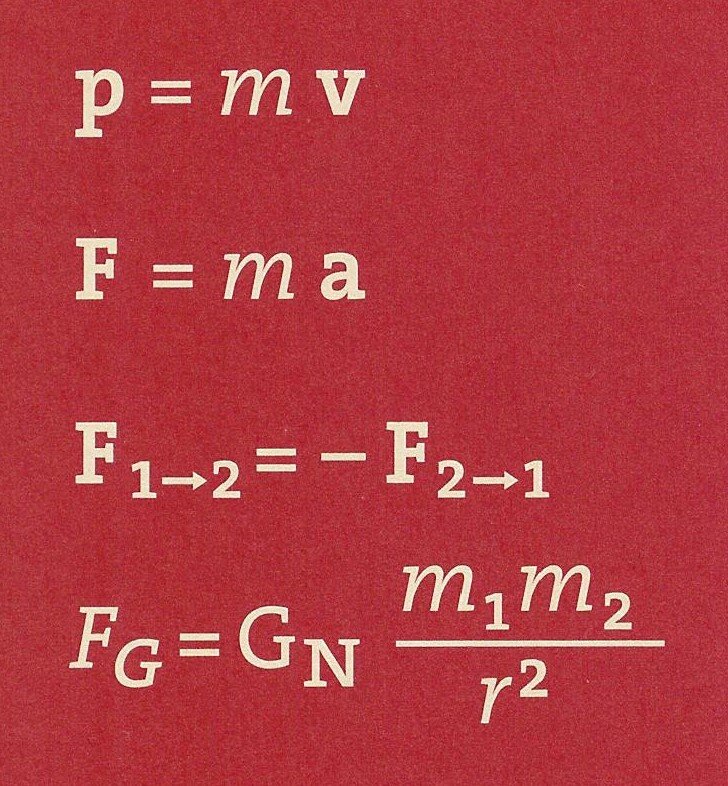
The foundation of this field rests on three simple but powerful laws of motion, formulated by Isaac Newton. These aren't just abstract ideas; they describe the relationship between an object and the forces acting upon it.
- Inertia: An object stays at rest or in uniform motion unless a force acts on it.
- Acceleration: The force on an object is equal to its mass times its acceleration ().
- Action-Reaction: For every action, there is an equal and opposite reaction.
Together, these laws create a complete framework for understanding motion. The first law tells us what happens when there's no force. The second gives us a precise mathematical way to calculate what happens when there is a force. And the third explains how objects interact with each other.
A Predictable World
A powerful consequence of Newton's laws is the idea of determinism. This principle states that if you know the exact position and momentum of every particle in a system at one moment, you can predict its future behavior with perfect accuracy. It paints a picture of the universe as a giant, intricate clockwork mechanism.
Imagine a game of pool. If you knew the precise position of every ball, the exact speed and angle of the cue ball, and accounted for factors like friction and air resistance, you could theoretically predict the outcome of the break shot down to the final resting place of every ball. In the world of classical mechanics, there's no room for randomness or uncertainty. The past completely determines the future.
In a classical system, if you know the starting conditions, you know the ending. There are no surprises.
What Stays the Same
While objects move and forces cause change, some quantities in a physical system remain constant. These are governed by conservation laws, which are fundamental principles that provide powerful shortcuts for analyzing complex systems.
Conservation
noun
The principle that a particular measurable property of an isolated physical system does not change as the system evolves over time.
Three of the most important conservation laws in classical mechanics are:
-
Conservation of Energy: Energy cannot be created or destroyed, only transformed from one form to another. A rollercoaster car at the top of a hill has potential energy. As it rolls down, that potential energy converts into kinetic energy (the energy of motion), but the total amount of energy stays the same (ignoring friction).
-
Conservation of Momentum: In a closed system, the total momentum remains constant. Momentum is essentially an object's "quantity of motion," a product of its mass and velocity. This is why when one billiard ball hits another, the momentum is transferred between them.

- Conservation of Angular Momentum: This is the rotational equivalent of linear momentum. It explains why a spinning ice skater can speed up their spin by pulling their arms in. By bringing their mass closer to the axis of rotation, their rate of rotation must increase to keep their angular momentum constant.
These principles of motion, determinism, and conservation form the bedrock of classical mechanics. They provide an elegant and incredibly accurate way to describe the world we see around us every day. Understanding them is the first step toward appreciating the very different, and often counterintuitive, rules that govern the universe at the atomic scale.