Quantum Thermodynamics Explained
Quantum Mechanics Basics
The Quantum Realm
At the heart of the universe, on the tiniest scales, the rules of physics get weird. Things don't behave like the familiar objects we see every day. This is the world of quantum mechanics, a place where particles can be in multiple places at once and act like waves. Let's explore the core ideas that make this world so strange and fascinating.
Waves or Particles?
Imagine throwing tiny marbles through two parallel slits in a wall. You'd expect to see two lines of marbles on the screen behind it. Simple enough. But when scientists fire electrons, one by one, at two slits, something different happens. Instead of two lines, an interference pattern emerges, just like you’d see if waves of water passed through the slits and interfered with each other.
This is wave-particle duality. A single electron, which we think of as a particle, seems to pass through both slits at once, like a wave, and interfere with itself. This bizarre behavior isn't just for electrons; light, which we often think of as a wave, also comes in particle-like packets called photons.
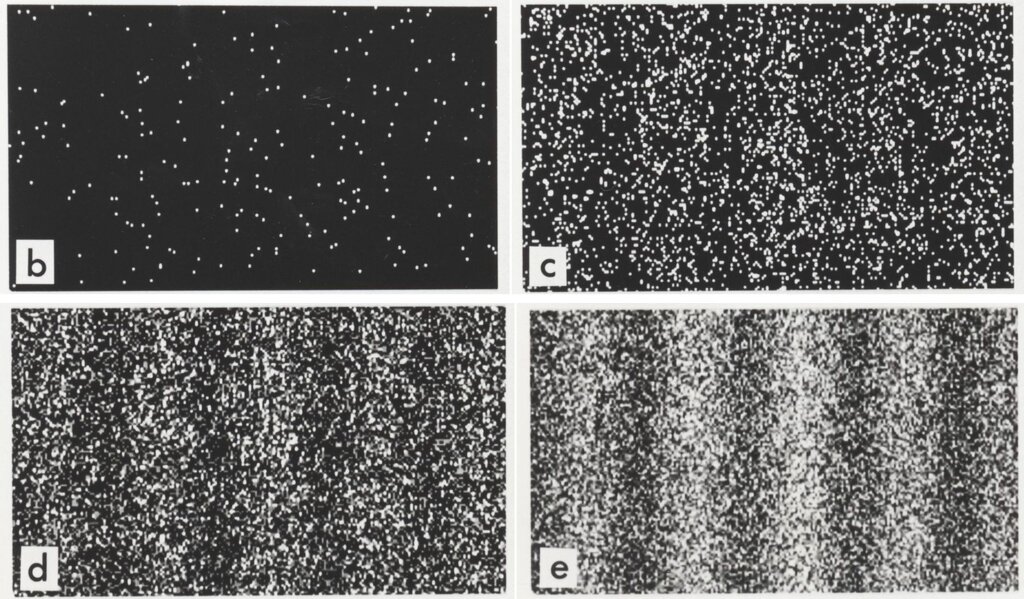
In the quantum world, objects don't have to choose between being a particle or a wave. They can be both.
Quantum States and Superposition
So how do we describe these strange quantum objects? We use something called a quantum state. A quantum state contains all the information about a system, like an electron's position, momentum, or spin. This information is encoded in a mathematical object called a wave function, often represented by the Greek letter psi ($ \Psi $).
Here’s where it gets even stranger. Before we measure it, a quantum system can exist in a combination of multiple states at the same time. This is called superposition. Think of a spinning coin. While it's in the air, it isn't heads or tails; it's in a state that's a blend of both. A quantum particle is similar. An electron's spin can be both "up" and "down" simultaneously until we look at it.
Superposition is the ability of a quantum system to be in multiple states at the same time until it is measured.
The Rulebook: Schrödinger's Equation
If a particle's state is just a cloud of possibilities, how can we predict anything? The answer lies in one of the most important equations in all of physics: the Schrödinger equation. Developed by Erwin Schrödinger, this equation governs how the wave function of a quantum system changes over time.
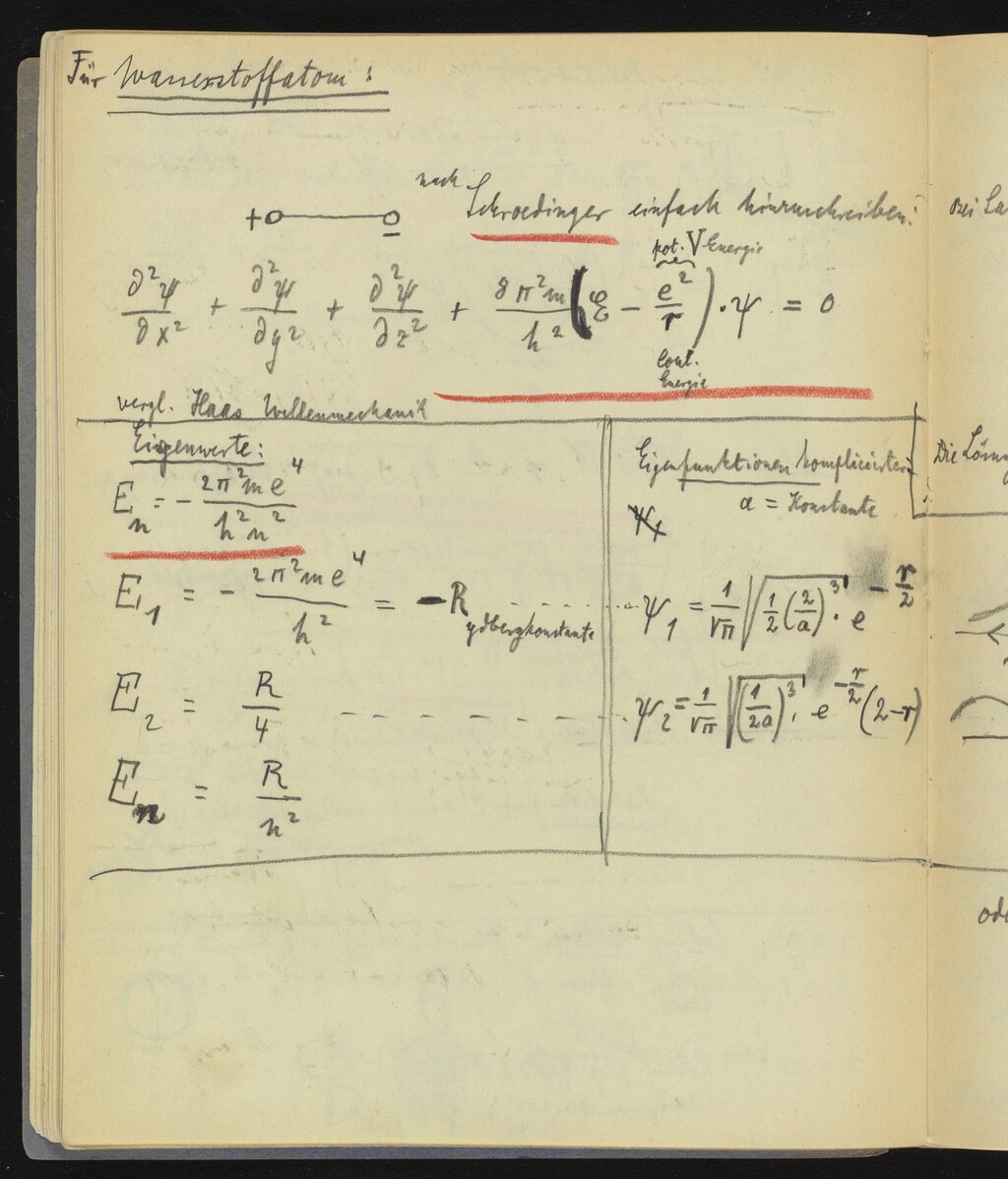
Just as Newton's laws of motion predict the path of a baseball, the Schrödinger equation predicts the evolution of the wave function. It tells us how the probabilities of finding a particle in different states will shift and change. It's the fundamental rulebook for the quantum world.
This equation connects the change in the wave function over time (left side) to the particle's kinetic and potential energy (right side).
The Act of Measurement
Quantum mechanics describes a world of probabilities, not certainties. The wave function tells us the probability of finding a particle in a particular state, but it doesn't tell us what the state will be. So what happens when we actually try to look?
The moment we perform a measurement, the superposition collapses. The spinning coin lands, and it's either heads or tails. The electron's spin is suddenly either "up" or "down." The act of observation forces the system to "choose" one definite state out of all its possibilities. The outcome is random, but the probability of each outcome is determined by the wave function just before the measurement.
This "measurement problem" is one of the deepest mysteries in quantum physics. Why does looking at something fundamentally change its reality? Physicists have debated this for nearly a century, and it highlights the profound gap between the quantum world and our everyday experience.
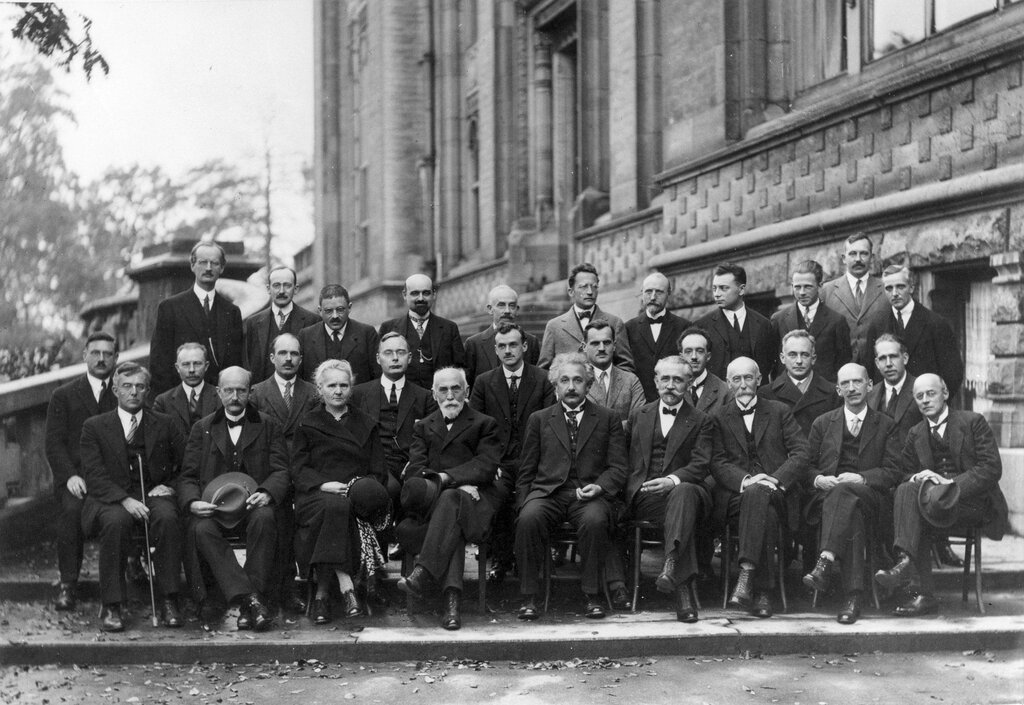
These core ideas—wave-particle duality, superposition, and the role of measurement—form the foundation of quantum mechanics. They challenge our intuition but are essential for understanding how the universe works at its most fundamental level.
When electrons are fired one by one through two parallel slits, what pattern appears on the screen behind them, demonstrating wave-particle duality?
The principle that a quantum system can exist in a combination of multiple states simultaneously before being measured is known as ________.