Quantum Theory and Quantum Fields Explained
Introduction to Quantum Mechanics
A Crack in Classical Physics
By the end of the 19th century, physicists felt they had a solid grip on the universe. Newton's laws described the motion of planets and projectiles, and Maxwell's equations elegantly explained light, electricity, and magnetism. These ideas, now called classical physics, worked beautifully for the world we can see and touch.
But small cracks began to appear. One glaring problem was the "ultraviolet catastrophe." According to classical physics, a hot object, like a glowing piece of metal, should emit an infinite amount of energy in the form of high-frequency ultraviolet light. This clearly doesn't happen. The theories that worked so well for large objects were failing at the atomic scale.
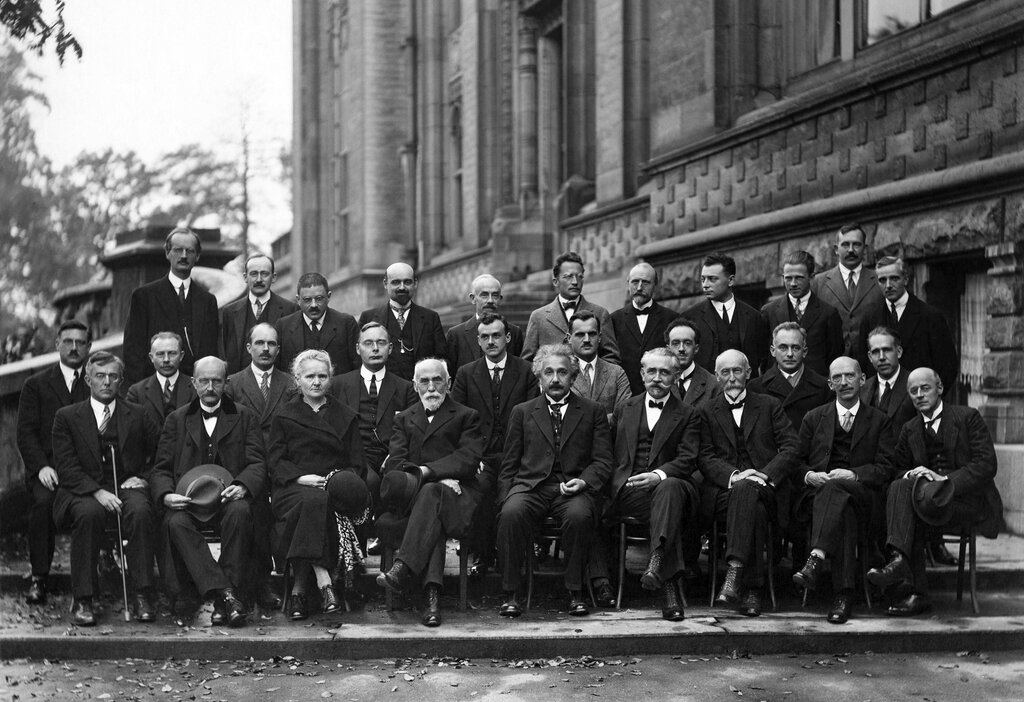
In 1900, Max Planck proposed a radical solution. He suggested that energy isn't continuous like a smooth ramp. Instead, it can only be emitted or absorbed in tiny, discrete packets he called "quanta." This idea perfectly explained the radiation from hot objects and marked the birth of quantum mechanics.
Wave-Particle Duality
Planck’s idea was just the beginning. The quantum world turned out to be far stranger than anyone imagined. For centuries, scientists debated whether light was a wave or a stream of particles. Experiments showed it behaved like a wave, bending around corners and creating interference patterns. But Albert Einstein's work on the photoelectric effect showed that light also acts like a particle, a "photon," that can knock an electron out of an atom.
So which is it? In the quantum realm, the answer is both. Light is both a wave and a particle.
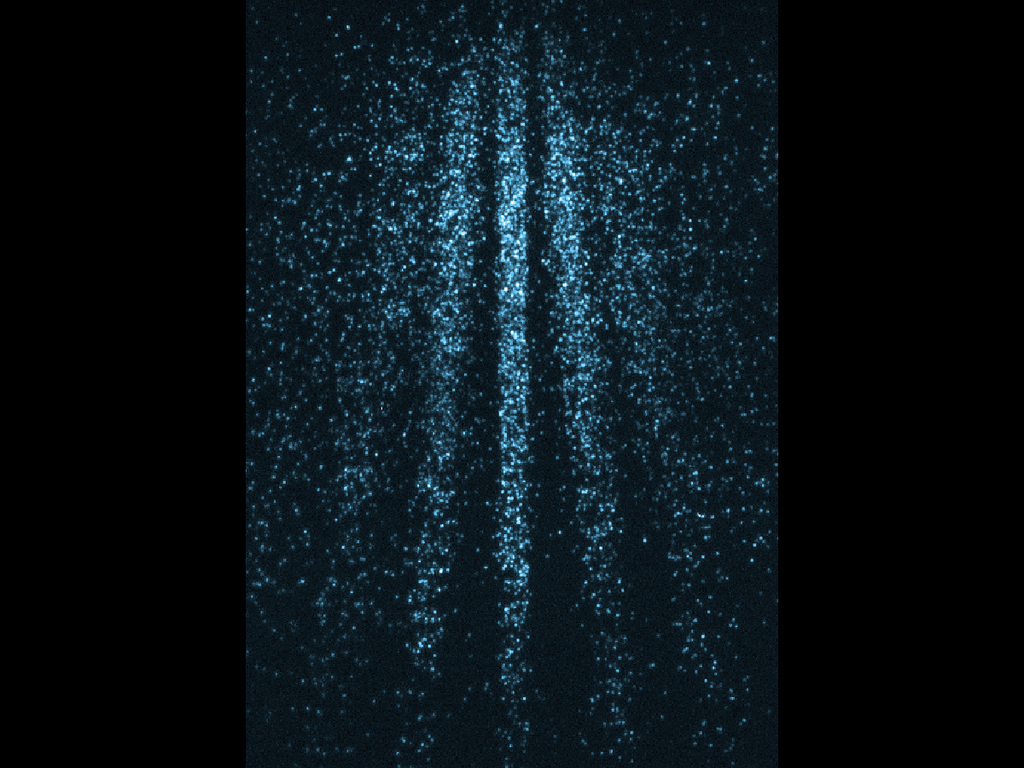
In 1924, physicist Louis de Broglie took this a step further. He proposed that if waves could act like particles, then particles like electrons should also act like waves. This wasn't just a thought experiment. It was soon confirmed that beams of electrons could create interference patterns, just like light waves. This concept, known as wave-particle duality, is a cornerstone of quantum mechanics. Everything has both particle-like and wave-like properties.
The Math of the Quantum World
Describing this strange new reality required a new mathematical language. The familiar math of classical physics, which deals with definite positions and velocities, was not up to the task. To describe a system where a particle is also a wave, physicists turned to more abstract tools.
Quantum mechanics doesn't tell you where a particle is. It tells you the probability of finding it in any given place.
This probability is calculated from an object's wave function, often represented by the Greek letter psi (). A key feature of these wave functions is that they require complex numbers. These are numbers that have both a "real" part and an "imaginary" part, which are essential for describing the wave's phase and how it interferes with itself.
Furthermore, quantum states are described using linear algebra. A particle's state, such as its spin or energy level, can be represented as a vector. Operations, like measuring that property, are represented by matrices. This framework allows for one of the most powerful quantum concepts: superposition, where a particle can be in multiple states at once, just as a vector can be a combination of other vectors.
All of these mathematical objects—the vectors representing states and the operators representing measurements—live in an abstract mathematical playground called a Hilbert space. You can think of it as the complete map of all possible states a quantum system can be in. It's the stage on which the strange rules of quantum mechanics play out.
What was the "ultraviolet catastrophe" that classical physics could not explain?
Who first proposed that if light waves could act like particles, then particles like electrons should also act like waves?