Quantum Scattering Born Approximation
Quantum Mechanics Basics
The Quantum Rulebook
In classical physics, Newton's second law () tells you everything you need to know about how an object will move. Give it a push, and you can predict its path perfectly. Quantum mechanics has its own master equation, and it's called the Schrödinger equation. It's the fundamental rulebook for how quantum systems behave.
This equation describes how the state of a quantum system changes over time. That 'state' is captured by something called a wave function, which we'll explore next. The most general form of the equation looks like this:
Here, is the wave function, is the imaginary unit, and is a tiny fundamental constant of nature called the reduced Planck constant. The term on the right, , is the Hamiltonian operator, which represents the total energy of the system. In essence, the equation says that the total energy of a system dictates how its wave function evolves in time.
For many situations, especially in scattering problems where the total energy is constant, we can use a simpler, time-independent version:
This version says that when the Hamiltonian operator acts on the wave function, it just gives back the wave function multiplied by the total energy, . This is a special kind of equation called an eigenvalue equation, and it's central to quantum mechanics.
Describing Quantum States
So, what is this wave function, ? It's a mathematical function that contains all the information you can possibly know about a quantum particle. It's the complete description of the particle's state. But it's not a physical wave like a ripple in a pond. It's a wave of probability.
A quantum particle, like an electron, doesn't have a definite position until you measure it. Before that, it exists in a cloud of possibilities. The wave function describes this cloud. Specifically, the square of its magnitude, , gives you the probability density of finding the particle at position at time .
The wave function doesn't tell you where a particle is. It tells you where it is likely to be.
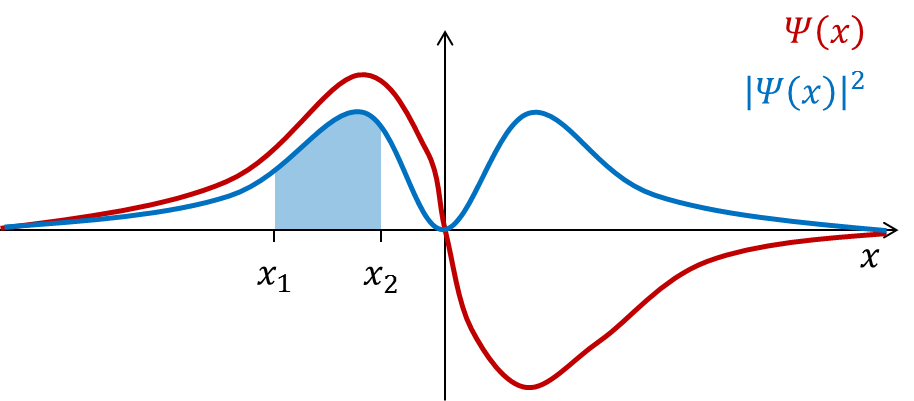
The higher the value of at a certain point, the more likely you are to find the particle there if you were to look. To find the probability of finding the particle within a certain range, say between two points and , you integrate this probability density over that range.
Because the particle must be somewhere, the total probability of finding it anywhere in space must be 1. This is called the normalization condition:
This requirement ensures that the probabilistic interpretation of the wave function makes sense.
Quantum Operators
In classical physics, properties like position, momentum, and energy are just numbers. In quantum mechanics, they are represented by mathematical objects called operators. An operator is an instruction to do something to a function. For example, the derivative is an operator that tells you to take the derivative of whatever function follows it.
Every measurable quantity (or 'observable') in quantum mechanics has a corresponding operator. The operator for momentum, for instance, is:
To find the value of an observable, you let its operator 'act' on the wave function. The result of this operation gives you information about that property. The most important operator is the Hamiltonian, , which we saw earlier. It represents the total energy of the system and is the sum of the kinetic and potential energy operators.
Here, is the kinetic energy operator and is the potential energy operator. Notice that in quantum mechanics, potential energy, , is also an operator, but it often just involves multiplying by the potential energy function.
Potential Energy Landscapes
The potential energy, , is crucial because it defines the 'environment' a particle is in. It describes the forces acting on the particle at every point in space. Is the particle trapped in a box? Is it attracted to another particle? Is it being scattered by a barrier? The potential energy function tells this story.
By specifying the potential and plugging it into the Schrödinger equation, we can solve for the wave function . This tells us how a particle will behave in that specific environment. For a free particle with no forces acting on it, . For a particle trapped in a box, the potential is zero inside the box and infinite outside. For scattering problems, the potential might describe a bump or a dip that an incoming particle interacts with.
Understanding how to describe these potentials is the first step in predicting how quantum particles interact and scatter. It sets the stage for the entire problem you want to solve.
Let's check your understanding of these foundational concepts.
What is the fundamental role of the Schrödinger equation in quantum mechanics?
The quantity is known as the probability density. What does this value directly represent?
These four concepts—the Schrödinger equation, the wave function, operators, and potential energy—are the pillars of quantum mechanics. With them, we can begin to describe the strange and fascinating behavior of the subatomic world.