Quantum Realms of the Double Slit
Wave-Particle Duality
Beyond the Slits
The double-slit experiment reveals a strange truth: particles like electrons can act like waves. When we don't watch which slit an electron passes through, it behaves like a wave, creating an interference pattern. When we do watch, it behaves like a particle, and the pattern vanishes. This isn't a trick of the experiment. It's a fundamental aspect of reality.
Duality
noun
The quality or state of having two different or opposite parts or elements.
This concept is called wave-particle duality. It's the idea that every quantum object exhibits the properties of not only particles, but also of waves. A photon can be a discrete packet of energy, like a tiny bullet. It can also be a ripple in the electromagnetic field. It's not one or the other; it's both, at the same time. The behavior we observe depends entirely on how we measure it.
Wave-particle duality exists in nature: Under some experimental conditions, a particle acts as a particle; under other experimental conditions, a particle acts as a wave.
This idea was so strange that for a long time, it was just a hypothesis. The double-slit experiment worked for light, but would it work for matter? Would a particle with mass, like an electron, really behave like a wave? Confirmation came from an unexpected source: a study of nickel crystals.
Proof in a Crystal
In 1927, physicists Clinton Davisson and Lester Germer were investigating how electrons scatter off the surface of a piece of nickel. Their experiment wasn't initially designed to test wave-particle duality. It was a happy accident.
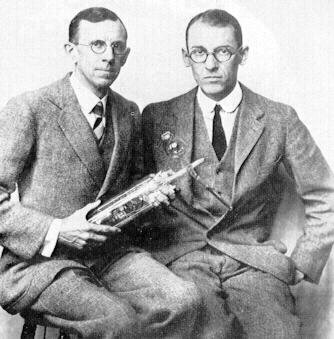
During their work, a container of liquid air exploded in the lab, and the hot nickel sample was exposed to oxygen. This created a crystalline oxide layer on the surface. To clean it, they heated the nickel. The heating process caused the small nickel crystals to merge into a few large ones.
When they resumed the experiment, the results were completely different. Instead of scattering randomly, the electrons were reflecting at specific, predictable angles. They were diffracting. Davisson and Germer realized the regularly spaced atoms in the nickel crystal were acting like the slits in a diffraction grating. The electrons were behaving like waves, interfering with each other just as light waves would.
This experiment provided the first direct evidence that matter, like energy, has a dual nature. The wavelength they observed for the electrons matched the prediction made by Louis de Broglie a few years earlier. De Broglie had proposed that any particle with momentum has an associated wavelength.
This equation is profound. It connects a wave property, wavelength (), to a particle property, momentum (). Everything has a de Broglie wavelength, from an electron to a baseball. However, because Planck's constant is so incredibly small ( J·s), the wavelength of macroscopic objects is too tiny to ever be detected. For quantum particles, it's a different story.
What It Means
Wave-particle duality isn't just a curiosity. It's the foundation upon which much of quantum mechanics is built. It forces us to abandon our classical intuitions about how the world works. An electron isn't a tiny ball orbiting a nucleus, nor is it a smeared-out wave. It is a quantum entity described by a wave function, which tells us the probability of finding it at any given point.
When we aren't looking, a particle exists in a state of superposition, a combination of all its possible states, like a wave spread out in space. The act of measurement forces it to "choose" one state, and we see a particle.
This duality resolves old paradoxes, like how light could travel through a vacuum like a wave but also knock electrons off a metal plate in the photoelectric effect, which requires discrete packets of energy (photons). It also opens the door to technologies like electron microscopes, which use the wave nature of electrons to see things far smaller than is possible with light.
The quantum world operates by a different set of rules. It is a world of probabilities and potentials, where particles are also waves, and observation changes reality. Let's test your understanding of these strange but fundamental concepts.
In the double-slit experiment, what happens to the interference pattern when scientists observe which slit an electron passes through?
Which statement best describes the concept of wave-particle duality?
Understanding this duality is the first step toward grasping the deeper, often counterintuitive, truths of the quantum realm.