Quantum Physics vs General Relativity
Introduction to Quantum Mechanics
The Quantum Realm
Classical physics, the world of Isaac Newton, does a great job of explaining the world we see every day. It describes how planets orbit the sun and how a ball flies through the air. But when we zoom in to the level of atoms and the particles within them, these familiar rules break down. This is the realm of quantum mechanics, a place where the rules are strange, counterintuitive, and fascinating.
Particles That Are Also Waves
In our everyday world, things are either particles (like a grain of sand) or waves (like a ripple in a pond). A particle has a specific location, while a wave is spread out. Quantum mechanics tells us that fundamental particles, like electrons and photons, are both. This is called wave-particle duality.
Imagine firing single electrons at a screen with two narrow slits. If electrons were just tiny balls, we'd expect to see two distinct lines on a detector behind the slits. But that's not what happens. Instead, we see an interference pattern, a series of bright and dark bands, which is a hallmark of wave behavior. It’s as if each electron passes through both slits at once, like a wave, and interferes with itself.
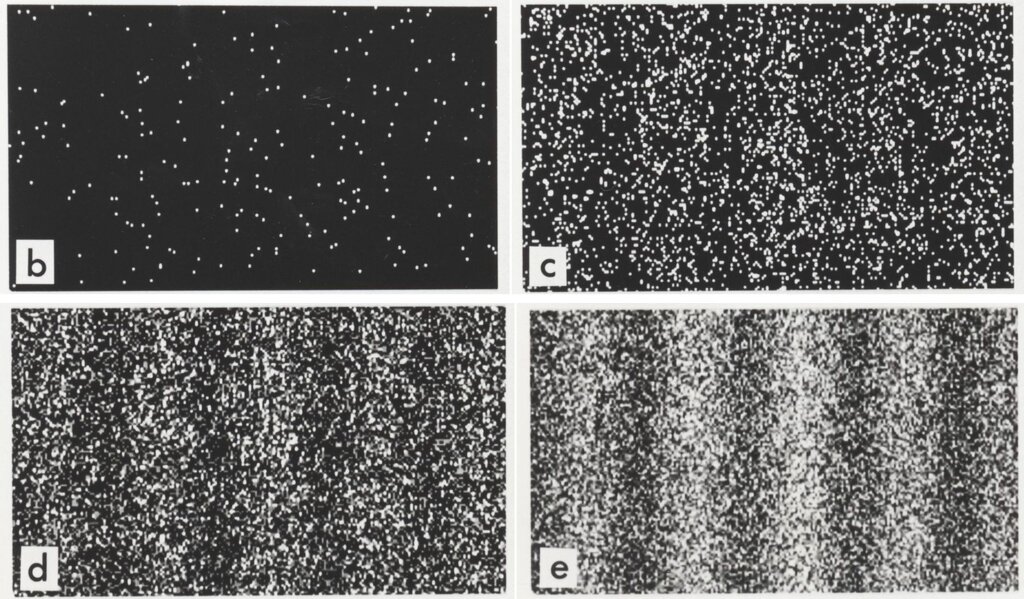
This experiment reveals a core truth of the quantum world: particles exist as waves of probability until we measure them. The interference pattern shows where the electron is likely to be found, not where it definitively is.
Superposition and Entanglement
Because particles can act like waves, they can be in multiple states at once. Think of a spinning coin. While it's in the air, it's not heads or tails; it's a blend of both possibilities. Quantum particles do something similar, a state called superposition. A particle might have a superposition of different positions, energies, or spins.
When we measure the particle, this cloud of possibilities collapses into a single, definite outcome. The spinning coin lands, and it's either heads or tails. The act of observation forces the quantum system to "choose" a state.
Superposition is the ability of a quantum system to be in multiple states at the same time until it is measured.
Things get even stranger with entanglement. When two particles are created in a certain way, their fates become linked, no matter how far apart they are. If you measure a property of one particle, you instantly know the corresponding property of the other. It's like having two coins that are guaranteed to land on opposite sides. If you flip them and one lands heads, you know the other, even if it's across the galaxy, must be tails. Albert Einstein famously called this "spooky action at a distance."
Fundamental Limits
Quantum mechanics also places fundamental limits on what we can know. Heisenberg's Uncertainty Principle states that there's a trade-off when measuring certain pairs of properties. The classic example is position and momentum.
The more precisely you measure a particle's position, the less precisely you can know its momentum, and vice versa. It’s not a limitation of our measuring instruments; it's a fundamental property of nature. The act of pinning down a particle's location makes its momentum inherently fuzzy.
Here, is the uncertainty in position, is the uncertainty in momentum, and is a tiny physical constant. This equation mathematically captures the essential trade-off.
The Equation of Everything (Small)
The engine that drives all of these quantum phenomena is the Schrödinger equation. It's the quantum equivalent of Newton's second law of motion (). But instead of predicting a definite trajectory, the Schrödinger equation describes the evolution of a particle's wave function.
The wave function, usually represented by the Greek letter psi (), is a mathematical object that contains all the information about a quantum system. Its value at a particular point in space and time is related to the probability of finding the particle there.
This equation tells us how the wave function of a particle changes over time. By solving it, physicists can calculate the probable outcomes of experiments and predict the behavior of atoms, molecules, and the subatomic world with incredible accuracy.
These principles—duality, superposition, uncertainty, and the probabilistic nature of reality—form the bedrock of our understanding of the universe at its most fundamental level. They challenge our classical intuition but are essential for the science that powers everything from lasers to computers.
The double-slit experiment is a cornerstone of quantum mechanics. When single electrons are fired one at a time at two slits, what pattern appears on the detector screen behind them?
In quantum mechanics, the concept that a particle can exist in multiple states (e.g., different positions or energy levels) at the same time is known as: