Quantum Physics Unveiled
Wave-Particle Duality
A Double Identity
In our everyday world, things are either particles or waves. A baseball is a particle. The ripples in a pond are waves. It’s a simple distinction. But in the quantum realm, the rules are different. Tiny entities like electrons and photons don't stick to one identity. They can act like a particle one moment and a wave the next.
This strange but fundamental concept is called wave-particle duality. It means quantum objects have two sides to their nature, and the side they show depends entirely on how we look at them.
Think of it like this. Is water a liquid or a solid? It depends on the temperature. Below freezing, it's solid ice. Above, it's liquid water. It's the same H₂O, but the conditions determine its properties. Wave-particle duality is similar. The experimental setup determines whether an electron behaves like a tiny, localized ball or a spread-out, interfering wave.
The Famous Experiment
The most famous demonstration of this idea is the double-slit experiment. It’s a simple setup that reveals the deepest mystery of quantum mechanics. Let's break it down.
First, imagine firing tiny particles, like marbles, at a wall with two vertical slits. Most marbles will be blocked, but some will pass through one slit or the other. On a detector screen behind the wall, you'll find two distinct bands corresponding to where the marbles hit. This is common sense.
Now, let’s do the same thing with waves, like ripples in water. When waves pass through two slits, they interfere with each other. Where two wave crests meet, they create a bigger wave (constructive interference). Where a crest meets a trough, they cancel out (destructive interference). The result on the detector screen is a distinct pattern of many bright and dark stripes, not just two.
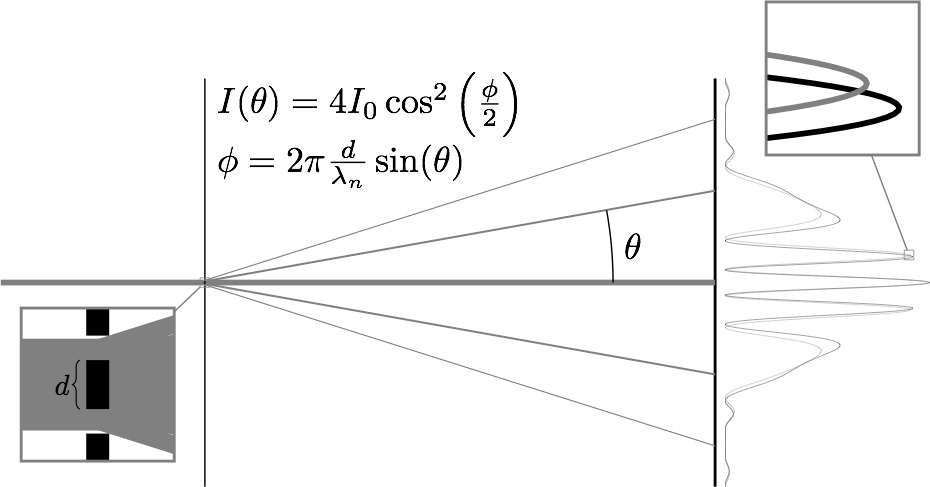
Here's the quantum twist. What happens if we fire electrons—which we think of as tiny particles—one by one through the slits? If each electron is a particle, it should go through one slit or the other, creating two simple bands just like the marbles.
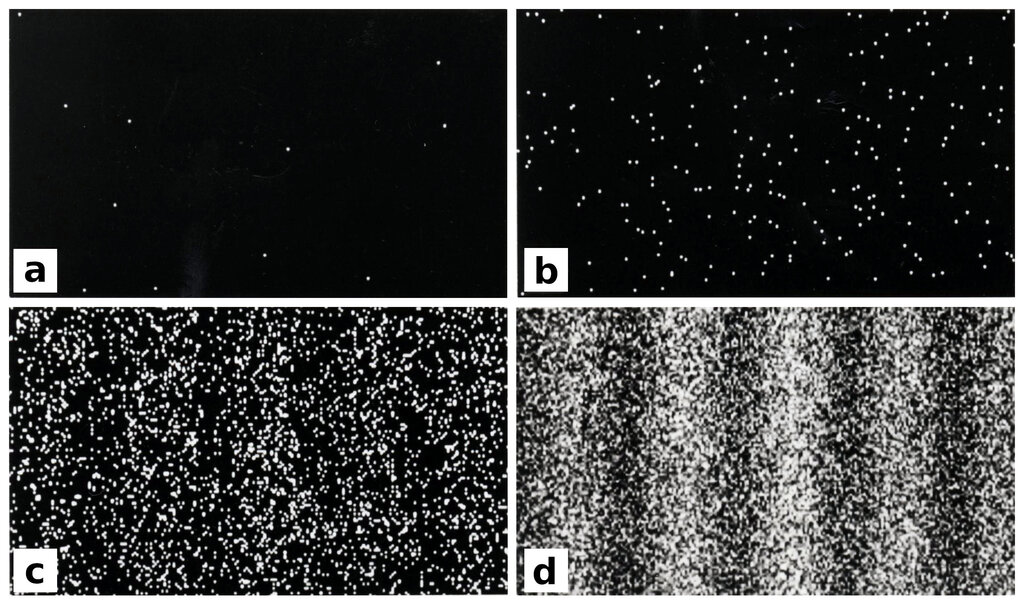
But that’s not what happens. At first, the electrons seem to land randomly. But as more and more electrons hit the screen, an interference pattern emerges, just like the waves. It seems each individual electron behaves like a wave, passing through both slits simultaneously and interfering with itself.
The strangest part is what happens when we try to watch. If we place a detector at the slits to see which one each electron goes through, the interference pattern vanishes. The very act of observing which path the electron takes forces it to behave like a particle, and we get two simple bands again. The wave behavior is gone.
This experiment beautifully shows the core of wave-particle duality: an electron is neither just a wave nor just a particle. It is a quantum entity that reveals one aspect of its nature depending on how it's measured.
What It All Means
Wave-particle duality isn't just a weird quirk; it's a cornerstone of how the universe works at the smallest scales. It applies to all fundamental particles, including photons (particles of light) and the quarks and leptons that make up matter. The discovery of matter waves by Louis de Broglie in 1924 was revolutionary. He proposed that if waves could act like particles, then particles should also be able to act like waves.
This means that even large objects like baseballs and people have a wavelength, but because their momentum is so large, their wavelength is incredibly tiny—far too small to ever be detected. It's only for subatomic particles, with their tiny momentum, that this wave nature becomes noticeable and significant.
This duality forces us to abandon our classical, everyday intuition. At the quantum level, reality is not a simple picture of tiny billiard balls bouncing around. Instead, it's a world described by probabilities and waves, where particles have a fuzzy, undefined nature until they are measured.
Wave-particle duality is a fundamental fact of the Universe.
Understanding this concept is the first step into the strange and fascinating world of quantum mechanics, where the neat dividing lines of our macroscopic world dissolve into a much richer and more complex reality.