Quantum Physics Superposition and Entanglement
Classical Mechanics
The Rules of Everyday Motion
Physics often gets a reputation for being strange and abstract, dealing with bizarre particles and warped spacetime. But its foundation is surprisingly down-to-earth. The branch of physics that describes the world we see and interact with every day—a ball flying through the air, a car accelerating down the road—is called classical mechanics.
It’s the physics of the visible world. To understand it, we split the study of motion into two parts. Kinematics is the language of motion. It describes how things move using concepts like position, velocity (how fast and in what direction), and acceleration (how quickly velocity changes). It's the 'what' of movement.
Dynamics, on the other hand, asks why things move. It explores the causes of motion: forces. This is where we get to the core principles that govern everything from a thrown baseball to the orbit of the moon.
Newton's Three Laws
The bedrock of dynamics comes from three simple yet profound laws formulated by Isaac Newton in the 17th century.
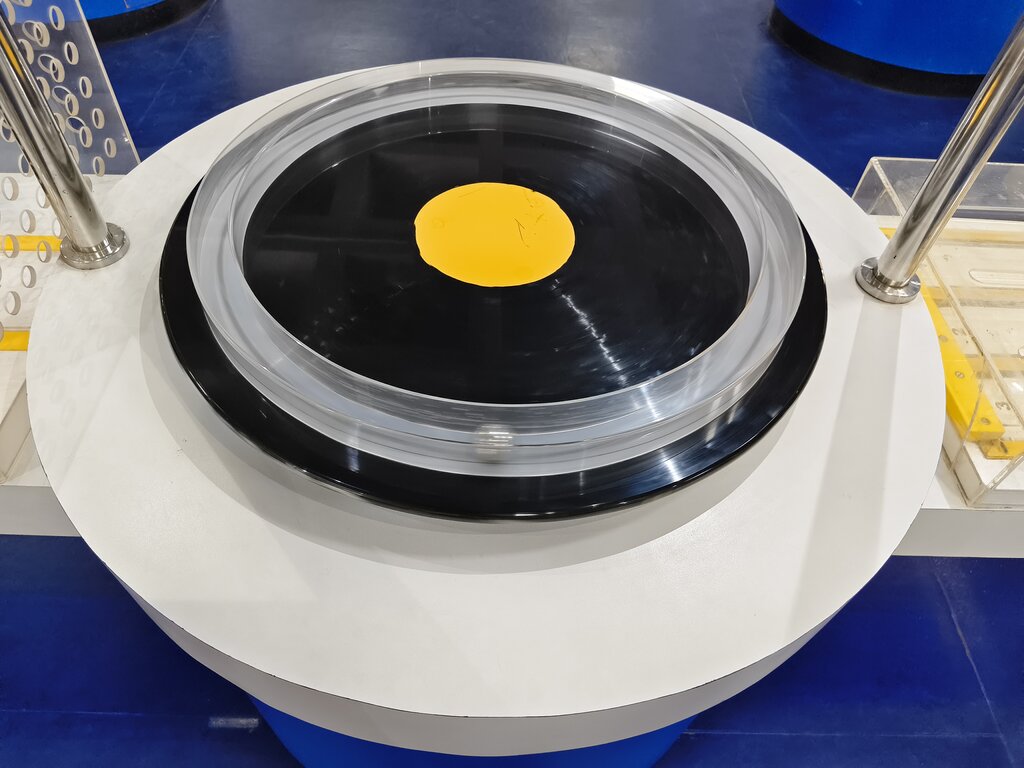
The First Law: The Law of Inertia This law states that an object at rest will stay at rest, and an object in motion will stay in motion with the same speed and in the same direction unless acted upon by an external force. In short, objects like to keep doing what they're already doing. This tendency to resist changes in motion is called inertia.
A hockey puck sliding on frictionless ice will keep going in a straight line at a constant speed. The only reason it stops on a real rink is because of the force of friction.
The Second Law: Force, Mass, and Acceleration This is the most famous of the three, and it’s a formula. It tells us that the force () needed to move an object is equal to its mass () multiplied by its acceleration ().
This equation elegantly connects force, mass, and acceleration. A bigger force produces more acceleration. A heavier object (more mass) requires more force to achieve the same acceleration. It’s why you have to push a car much harder than a shopping cart to get it moving.
The Third Law: Action and Reaction This law states that for every action, there is an equal and opposite reaction. Forces always come in pairs. When you push on a wall, the wall pushes back on you with the exact same force. A rocket expels gas downwards (the action), and the gas pushes the rocket upwards (the reaction).
The Great Conservation Laws
Beyond Newton's laws, classical mechanics is built on two powerful principles of conservation. A conserved quantity is something that remains constant in a closed system, meaning no external forces are interfering. It can change form or be transferred between objects, but its total amount never changes.
Conservation of Momentum
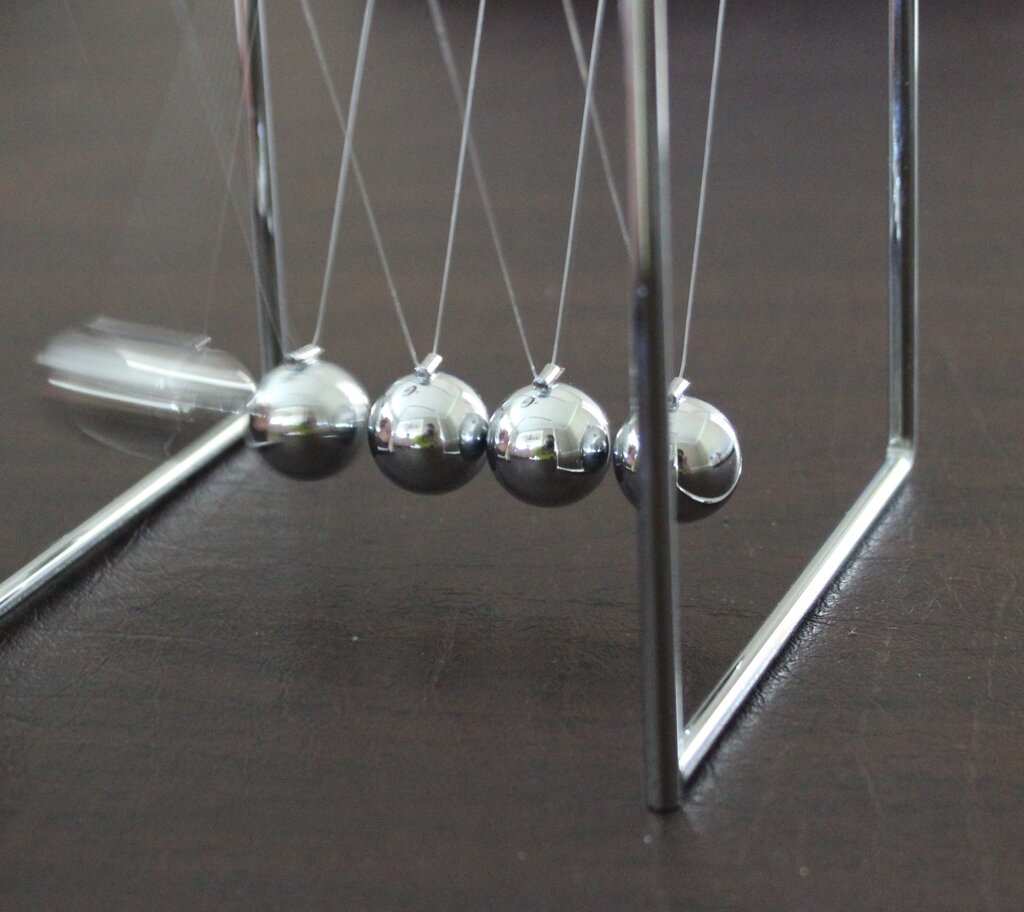
Momentum is often described as "mass in motion." It’s a measure of how much stuff is moving and how fast it’s going. The formula is simple: momentum () is mass () times velocity ().
The law of conservation of momentum says that the total momentum of a closed system before a collision is equal to the total momentum after the collision. Think of a game of pool. When the cue ball hits another ball, it transfers some or all of its momentum. The cue ball slows down, and the other ball speeds up. The total momentum of the two balls combined remains the same.
Conservation of Energy
Energy is the ability to do work. Like momentum, the total energy in a closed system is always conserved. It can't be created or destroyed, only transformed from one type to another.
The two main types in mechanics are:
- Kinetic Energy: The energy of motion. A fast-moving object has more kinetic energy than a slow one.
- Potential Energy: Stored energy. A book held high above the ground has gravitational potential energy. If you let it go, that potential energy converts into kinetic energy as the book falls and speeds up.
Imagine a roller coaster. At the top of the highest hill, it's moving slowly, so it has low kinetic energy but maximum potential energy. As it dives down the track, its potential energy converts into kinetic energy, and it reaches its top speed at the bottom. The total energy—the sum of kinetic and potential—remains constant throughout the ride (ignoring friction).
Let's check your understanding of these core concepts.
Which branch of classical mechanics focuses on describing motion using concepts like velocity and acceleration, without considering the forces that cause it?
According to Newton's First Law of Motion, a hockey puck sliding on perfectly frictionless ice will continue moving at a constant velocity forever.
These principles of classical mechanics provide a powerful and accurate framework for understanding the motion of everyday objects. They are the essential foundation for nearly all of physics and engineering.