Quantum Physics Fundamentals
Classical Physics Limitations
The Cracks in Classical Physics
By the end of the 19th century, physics seemed to be nearly complete. The laws of motion and gravity laid out by Isaac Newton could predict the paths of planets. James Clerk Maxwell's equations masterfully described electricity, magnetism, and light as electromagnetic waves. This framework, now called classical physics, worked beautifully for the large-scale world we see every day.
But when scientists began to probe the universe at the atomic level, they found phenomena that classical physics simply couldn't explain. It was like using a perfect map of a country, only to find it was completely wrong at the street level. A few key experiments revealed deep cracks in the foundation of physics, forcing a revolution in thought.
The Glow of a Hot Object
Think about what happens when a blacksmith heats a piece of iron. It starts to glow dull red, then bright orange, and eventually white-hot. All objects emit thermal radiation when heated. Scientists wanted to understand the exact relationship between an object's temperature and the spectrum of light it emits.
To simplify this, they studied an idealized object called a blackbody, which perfectly absorbs and emits all frequencies of radiation. A good real-world approximation is a hollow oven with a tiny pinhole. The light coming out of the pinhole is a pure sample of the radiation inside.
When they measured the intensity of radiation at different wavelengths, they found a consistent pattern. At any given temperature, the intensity peaks at a certain wavelength and then falls off. As the object gets hotter, this peak shifts to shorter, more energetic wavelengths. This is why the color of a hot object changes.
Classical physics tried to explain these curves using wave theory. The result was the Rayleigh-Jeans law, which worked well for long wavelengths. But for short wavelengths, like ultraviolet light, it failed spectacularly. The classical formula predicted that as the wavelength got shorter, the intensity of the radiation would shoot up to infinity. This was a physical impossibility, dubbed the ultraviolet catastrophe.
Physics was at an impasse. The established laws gave a nonsensical answer.
The ultraviolet catastrophe showed that something was fundamentally wrong with the classical understanding of how matter and light interact.
In 1900, German physicist Max Planck found a solution, but it was a strange one. He proposed that energy could not be emitted or absorbed continuously, but only in discrete packets, or quanta. He suggested that the energy of one quantum of radiation was directly proportional to its frequency.
quantum
noun
The minimum amount of any physical entity (physical property) involved in an interaction.
This idea of quantized energy was radical. It meant that the energy in a light wave is not smooth and continuous but lumpy, like sugar cubes instead of flowing water. When Planck used this idea in his calculations, his new formula perfectly matched the experimental blackbody curves and completely avoided the ultraviolet catastrophe. He didn't know why energy was quantized, only that assuming it was so gave the right answer.
Light's Mysterious Knockout Punch
Another puzzle was the photoelectric effect, discovered in 1887. When light is shone on a metal surface, it can knock electrons loose. According to classical wave theory, light is a continuous wave of energy. A brighter light has a more intense wave, carrying more energy. This led to a few simple predictions:
- A very bright light of any color should be able to eject electrons.
- The brighter the light, the more kinetic energy the ejected electrons should have.
- If the light is very dim, there should be a time delay as the electrons absorb enough energy to escape.
But experiments showed that none of these predictions were correct.
Here’s what really happens:
-
Threshold Frequency: For a given metal, electrons are only ejected if the light's frequency is above a certain minimum threshold. Below this frequency, no electrons are ejected, no matter how bright the light is. For example, bright red light might do nothing, while even very dim violet light ejects electrons instantly.
-
Energy Depends on Frequency: The maximum kinetic energy of the ejected electrons depends only on the frequency of the light, not its brightness. Brighter light just ejects more electrons, but each one has the same maximum energy.
-
No Time Delay: Electrons are ejected the moment the light hits the surface, with no measurable delay, even for extremely faint light.
Classical wave theory was completely unable to explain these observations. Light was behaving in a way that made no sense.
In 1905, Albert Einstein took Planck's idea of quanta a step further. He proposed that light itself is not a continuous wave but is composed of discrete particles of energy, which we now call photons. The energy of each photon is given by Planck's formula, .
This simple idea explained the photoelectric effect perfectly:
-
An electron is knocked out by absorbing a single photon. To escape the metal, the electron needs a certain minimum amount of energy (the work function). If the photon's energy () is less than this, the electron can't escape. This explains the threshold frequency.
-
If the photon's energy is greater than the work function, the electron escapes, and any leftover energy becomes the electron's kinetic energy. Since each photon of a certain frequency has the same energy, the maximum kinetic energy of the electrons is fixed. More brightness means more photons, which means more ejected electrons, but not more energetic ones.
-
Since the energy transfer happens in a single collision with a photon, there is no time delay. It's an all-or-nothing interaction.
Einstein's explanation was revolutionary. It showed that Planck's quanta were not just a mathematical trick but a fundamental property of light itself.
The Barcode of the Elements
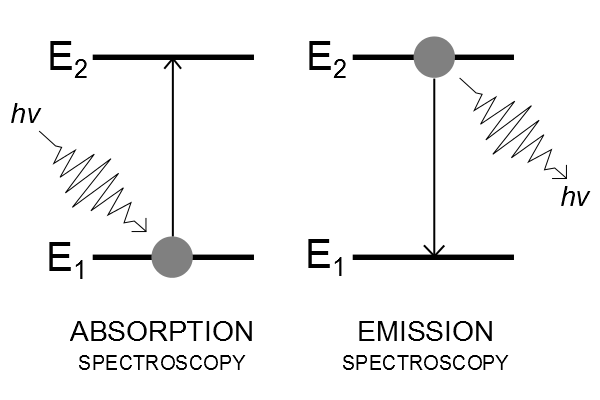
A third major failure of classical physics came from studying atoms. When a gas of a particular element, like hydrogen or neon, is heated or has an electric current passed through it, it emits light. But unlike the continuous rainbow spectrum from a hot solid, the light from a gas is composed of very specific, discrete lines of color. This is called an atomic spectrum, and it acts like a unique barcode for each element.
According to the classical model of the atom at the time (the Rutherford model), electrons orbited the nucleus like planets around the sun. But this model had a fatal flaw. According to Maxwell's equations, an accelerating charged particle, like an orbiting electron, should constantly radiate energy. As it radiates, it would lose energy and spiral into the nucleus in a fraction of a second. This means atoms shouldn't be stable, yet they obviously are. Furthermore, this spiraling electron should emit a continuous smear of radiation, not the sharp, distinct lines that were observed.
Classical physics had no explanation for why atoms were stable or why they produced these specific barcodes of light.
These three problems, blackbody radiation, the photoelectric effect, and atomic spectra, were impossible mountains for classical physics to climb. They signaled that the old rules, which worked so well for planets and billiard balls, were simply not the complete story. A new, and much stranger, kind of physics was needed to describe the world of the very small.
What was the 'ultraviolet catastrophe'?
To solve the blackbody radiation problem, Max Planck proposed that energy is...