Quantum Physics Fundamentals
Introduction to Quantum Mechanics
A Crack in Classical Physics
By the late 1800s, many physicists felt their work was nearly done. They had Newton's laws for motion and Maxwell's equations for light and electricity. These theories, now called classical physics, could explain almost everything from the orbit of planets to the workings of a generator. But a few stubborn problems remained, like cracks in a beautiful facade.
One of the most glaring issues was the “ultraviolet catastrophe.” According to classical physics, an ideal object that absorbs and emits all frequencies of light, called a blackbody, should radiate an infinite amount of energy as the light's frequency increases into the ultraviolet range. This was a theoretical disaster. If it were true, every warm object, including you, would be blasting out lethal amounts of radiation. But experiments showed something completely different. The energy peaked at a certain frequency and then dropped off. Classical physics had no answer.
Planck's Revolutionary Idea
In 1900, German physicist Max Planck tackled the blackbody problem. After months of work, he found a mathematical trick that perfectly matched the experimental data. But to make it work, he had to make a wild assumption: what if energy wasn't continuous? What if it could only be emitted or absorbed in discrete packets, or chunks?
He called these packets "quanta."
quantum
noun
The minimum amount of any physical entity, such as energy or matter, involved in an interaction.
Planck proposed that the energy of a single quantum was directly proportional to the frequency of the radiation.
Here, is energy, is frequency, and is a new fundamental constant of the universe, now known as Planck's constant. This simple equation marked the birth of quantum mechanics. It suggested that at the smallest scales, energy behaves less like a smooth, continuous ramp and more like a set of stairs. You can stand on one step or the next, but never in between.
Atoms and Light
Another puzzle was the mystery of atomic spectra. When a pure gas like hydrogen is heated, it doesn't glow with a continuous rainbow of light. Instead, it emits light only at very specific frequencies, creating a pattern of distinct colored lines. Classical physics, which allowed electrons to orbit an atom's nucleus at any distance, couldn't explain why only certain colors appeared.
In 1913, Niels Bohr applied Planck's quantum idea to the atom. He proposed that electrons could only occupy specific, fixed energy levels, or shells, around the nucleus. They couldn't exist in the spaces between these levels.
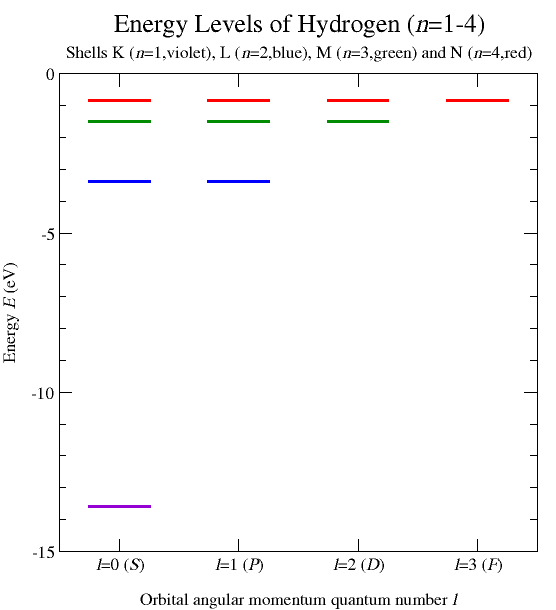
When an electron absorbed energy, it could jump up to a higher, unoccupied shell. When it fell back down to a lower shell, it released the extra energy as a single quantum of light, a photon. The energy difference between the two shells determined the photon's exact frequency, and therefore its color. This model perfectly explained the unique line spectra for different elements and was another major victory for the new quantum theory.
The Probabilistic Universe
The early quantum ideas were revolutionary, but the next step was even stranger. Physicists like Werner Heisenberg and Erwin Schrödinger developed a complete mathematical framework for quantum mechanics. Their work revealed that at the quantum level, we can't know everything with absolute certainty.
Imagine trying to measure the exact position and the exact momentum of an electron at the same time. Heisenberg's famous uncertainty principle states that this is impossible. The more precisely you measure one property, the less precisely you can know the other.
This isn't a limitation of our measuring instruments. It's a fundamental property of nature. The universe itself has a built-in fuzziness.
This led to a radical new interpretation of reality. In quantum mechanics, we can't predict the exact outcome of an event, only the probability of each possible outcome. We describe a particle not with a definite position, but with a mathematical tool called a wave function. The wave function doesn't tell us where the particle is; it tells us where the particle is likely to be found when we look for it.
When we make a measurement, the particle is observed in one specific state. But before the measurement, the particle exists in a state of probabilities, governed by its wave function. This shift from a deterministic, clockwork universe to a probabilistic one was one of the most profound changes in the history of science.
What problem in classical physics, related to the radiation from an ideal object, predicted an infinite amount of energy in the high-frequency range?
To solve the blackbody radiation problem, Max Planck made a radical assumption. What was it?
These foundational ideas—quantization and probability—set the stage for all the strange and wonderful phenomena of the quantum world.