Quantum Physics Fundamentals
Introduction to Quantum Mechanics
Cracks in the Foundation
At the end of the 19th century, many physicists felt their work was nearly complete. The laws of motion and gravity described the planets, while the theory of electromagnetism explained light and radio waves. It seemed only a few minor details were left to iron out. But these 'details' turned out to be clues to a completely new and bizarre reality.
One of these problems was called the black-body radiation problem. A 'black body' is a theoretical object that absorbs all radiation that hits it. When heated, it glows, emitting radiation of its own. Think of a hot piece of metal glowing red, then orange, then white as it gets hotter.
The problem was that classical physics couldn't predict the color spectrum of this glow correctly. Its equations predicted that a hot object should emit an infinite amount of high-frequency light, like ultraviolet rays. This was dubbed the 'ultraviolet catastrophe' because it was obviously wrong. If it were true, a simple campfire would blast you with deadly radiation.
Energy in Packets
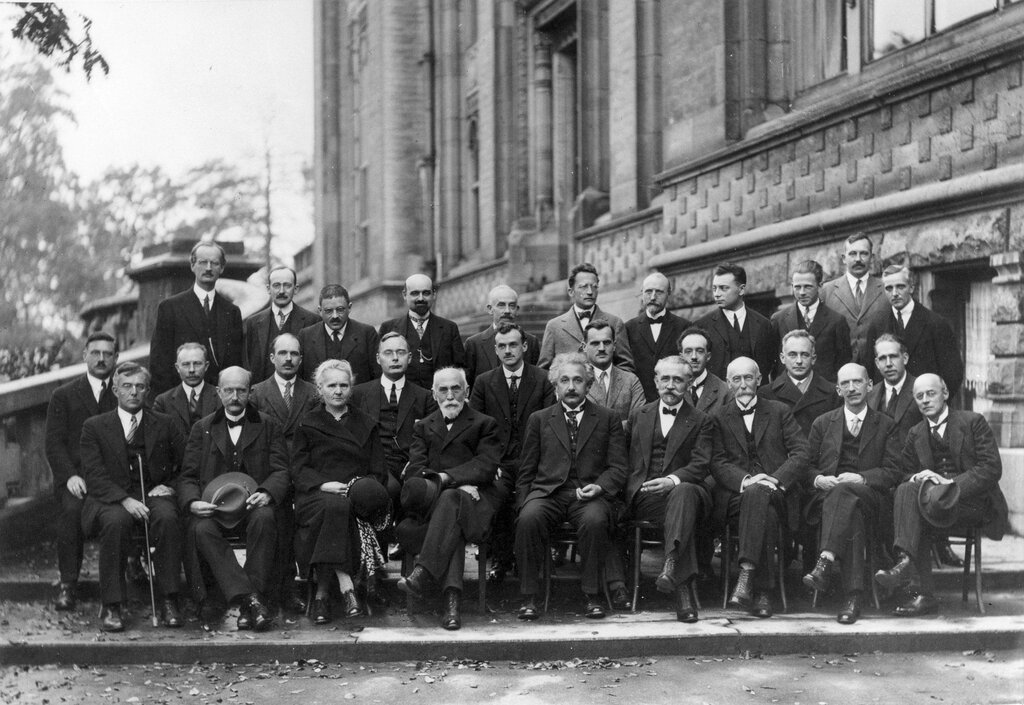
In 1900, German physicist Max Planck came up with a radical solution. He suggested that energy isn't a continuous flow, like water from a tap. Instead, it comes in tiny, discrete packets called 'quanta'. He proposed that an object could only absorb or emit energy in whole-number multiples of these packets.
This is the principle of quantization. It means that at the atomic level, certain properties can only have specific, set values, like steps on a staircase rather than a smooth ramp.
Planck's idea perfectly explained the black-body spectrum. The high-frequency ultraviolet light required such a large packet of energy that it was very unlikely for an atom to emit one. This breakthrough marked the birth of quantum mechanics, and the constant 'h' in his equation is now known as Planck's constant.
Here, is the energy of a single quantum, is the frequency of the radiation, and is Planck's constant, a fundamental number in nature.
Wave-Particle Duality
Planck's idea was just the beginning. Another puzzle was the photoelectric effect. When you shine light on a metal surface, it can knock electrons loose. The old wave theory of light predicted that a brighter light should give the electrons more energy. But experiments showed something different.
The energy of the ejected electrons depended only on the color (or frequency) of the light, not its brightness. A brighter light just knocked out more electrons. In 1905, Albert Einstein took Planck's idea a step further. He proposed that light itself is made of particles, which we now call photons.
Each photon carries a quantum of energy, . A single photon hits a single electron. If the photon has enough energy (high enough frequency), it knocks the electron out. A brighter light is just a stream of more photons.
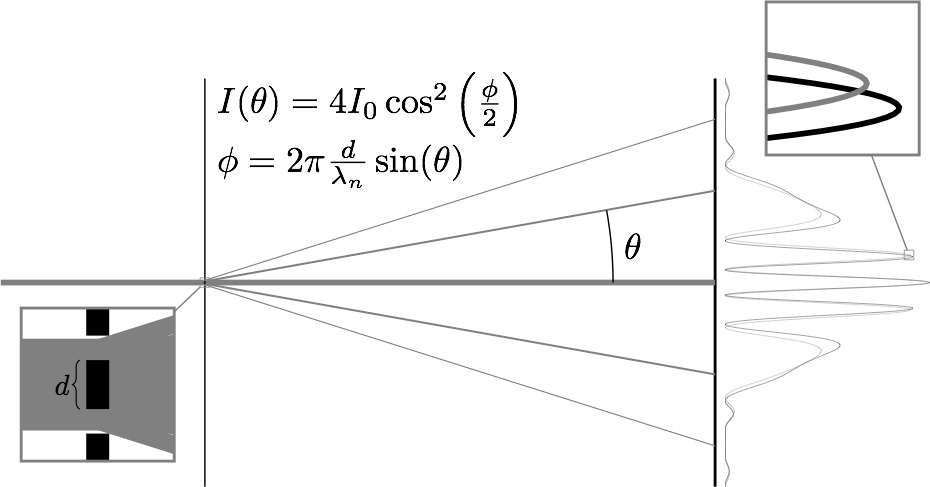
This revealed a startling truth: light acts like both a wave and a particle. But the weirdness didn't stop there. In 1924, a young physicist named Louis de Broglie asked a bold question: If waves can act like particles, can particles act like waves?
He proposed that all matter, from electrons to baseballs, has a wave-like nature. The wavelength of an object is inversely proportional to its momentum. For a large object like a baseball, the wavelength is so incredibly small that it's impossible to detect. But for a tiny particle like an electron, the wavelength is significant enough to be measured, a prediction that was later confirmed by experiment.
duality
noun
The property of matter and energy having both particle-like and wave-like characteristics.
This concept of wave-particle duality is a cornerstone of quantum mechanics. It tells us that at the smallest scales, reality doesn't fit into our neat, everyday categories. An electron isn't a tiny billiard ball or a tiny ripple in a pond—it's something else entirely, an entity that can show one face or the other depending on how we look at it.
Let's review what we've learned.
What was the "ultraviolet catastrophe"?
How did Max Planck's concept of 'quanta' solve the black-body radiation problem?
These early discoveries shattered the classical view of the universe and laid the groundwork for understanding the strange and wonderful rules that govern the quantum realm.