Quantum Physics Explained
Introduction to Quantum Mechanics
A Different Kind of Reality
The world you see around you, the world of chairs, trees, and planets, follows predictable rules. If you push a book off a table, it falls. These are the rules of classical physics. But if you shrink down to the size of an atom, the rules change completely. Welcome to the world of quantum mechanics.
Down at this tiny scale, particles like electrons and photons don't behave like tiny billiard balls. They follow a strange and wonderful new set of principles that defy our everyday intuition. The three core ideas that form the foundation of this world are wave-particle duality, superposition, and entanglement.
Particles and Waves
Is light a wave or a particle? For centuries, scientists debated this. It turns out, the answer is both. This is the essence of wave-particle duality. A single entity, like a photon of light or an electron, can behave like a spread-out wave in some situations and a single, localized particle in others. It's not that it's one or the other; it's somehow both at once.
The most famous demonstration of this is the double-slit experiment. Imagine a wall with two thin, parallel slits in it. If you shoot tiny particles, like paintballs, at the wall, you'd expect to find two distinct lines of paint on a screen behind it, one for each slit.
But when scientists fired individual electrons, one by one, at a double-slit setup, something bizarre happened. Instead of two lines, they got an interference pattern, a series of alternating light and dark bands. This is a hallmark of waves. It's the same pattern you'd see if you sent water waves through the two slits. The only way to explain it is that each single electron somehow acted like a wave, passed through both slits simultaneously, and then interfered with itself before hitting the screen as a single particle.
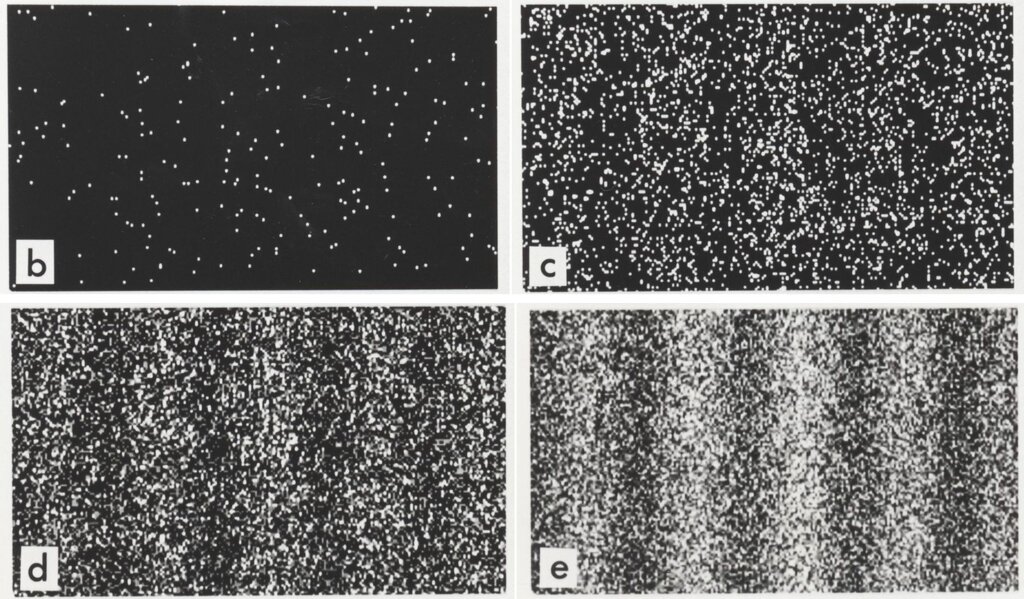
The act of observing which slit the electron goes through forces it to behave like a particle, and the interference pattern vanishes. The very act of measurement changes the outcome.
All States at Once
The idea of an electron going through both slits at once leads directly to our next quantum principle: superposition.
superposition
noun
The principle that a quantum system can exist in multiple states at the same time. It is a combination of all possible states, weighted by probabilities.
Before it's measured, a quantum particle exists in a cloud of possibilities. Think of a spinning coin. While it's in the air, it's neither heads nor tails. Superposition is a bit like that, but more profound. A quantum particle, like an electron, can have its spin be both "up" and "down" simultaneously. It isn't one or the other; it's in a superposition of both states.
When we measure the particle—when we "look" at the spinning coin—this cloud of possibilities collapses into a single, definite state. We'll find the spin is either up or down, never both. But until that moment of measurement, the particle truly embodies all its potential outcomes at once.
Spooky Connections
Perhaps the strangest quantum idea of all is entanglement. It describes a situation where two or more particles become linked in such a way that their fates are intertwined, no matter how far apart they are. Albert Einstein famously called it "spooky action at a distance."
Imagine you have two entangled particles. Let's say one must have an "up" spin and the other a "down" spin. Because they are in a superposition, you don't know which is which until you measure them. You could take one particle to the other side of the galaxy. The instant you measure your particle and find its spin is "up," you know with absolute certainty that the other particle, light-years away, has instantly collapsed into a "down" spin state.
This information seems to travel faster than the speed of light, but it doesn't violate relativity. You can't use entanglement to send a message because the outcome of your measurement is random. You don't get to choose whether your particle is spin up or spin down.
These three concepts—duality, superposition, and entanglement—form the bedrock of quantum mechanics. They describe a universe that is probabilistic, interconnected, and fundamentally different from the one we experience every day.
Time to see how well you've grasped these strange new rules.
In the double-slit experiment, when individual electrons are fired one by one at two slits, what pattern appears on the screen behind them?
The principle that a quantum particle can exist in multiple states at the same time (e.g., an electron's spin being both 'up' and 'down' simultaneously) is known as:
Understanding these principles is the first step into a larger, more complex, and fascinating quantum world.