Quantum Physics Essentials
Introduction to Quantum Mechanics
A Crack in the Foundation
By the late 1800s, physicists felt they had nearly solved the universe. The laws of motion laid out by Isaac Newton perfectly described everything from a falling apple to the orbits of planets. James Clerk Maxwell's equations masterfully explained electricity, magnetism, and light as a single phenomenon: electromagnetism. Together, these ideas formed the bedrock of what we now call classical physics. It was a tidy, deterministic world where if you knew the position and momentum of every particle, you could predict the future with perfect accuracy.
But a few stubborn problems refused to fit into this neat picture. One of the most glaring was the puzzle of black-body radiation.
A black body is a theoretical object that absorbs all radiation that hits it. When heated, it glows, emitting radiation across the entire electromagnetic spectrum. Think of a blacksmith's forge heating a piece of iron—it glows red, then orange, then white-hot as its temperature increases.
When physicists used the laws of classical physics to predict the spectrum of light a black body should emit, their theories broke down spectacularly. The equations predicted that as the frequency of light increased into the ultraviolet range, the energy emitted should skyrocket towards infinity. This was dubbed the "ultraviolet catastrophe." If this were true, simply turning on your toaster would unleash a deadly blast of infinite-energy radiation. Clearly, something was deeply wrong with the laws of physics as they were understood.
Planck's Revolutionary Idea
In 1900, the German physicist Max Planck proposed a radical solution. He suggested that energy was not a continuous fluid, but that it could only be emitted or absorbed in discrete packets, which he called "quanta." This idea of quantization was a complete break from classical physics.
Imagine a ramp versus a staircase. In classical physics, an object can have any amount of energy, like being at any point on a smooth ramp. Planck's idea was that energy levels are like a staircase—you can be on one step or the next, but never in between. The size of these energy steps, he proposed, depended on the frequency of the radiation.
Here, is the energy of a single quantum, is the frequency of the radiation, and is a new fundamental constant of nature, now known as Planck's constant. By introducing this concept, Planck created a formula that perfectly matched the experimental data for black-body radiation, avoiding the ultraviolet catastrophe entirely. At high frequencies, the energy
cost of a single quantum was too high, so very few were emitted.
The Photoelectric Effect
Planck himself was uneasy about his idea, viewing it as a mathematical trick rather than a physical reality. But five years later, a young Albert Einstein took it seriously. He used Planck's quanta to explain another physics mystery: the photoelectric effect.
photoelectric effect
noun
The emission of electrons from a material when light shines on it.
Classical wave theory of light made a few predictions about this effect that turned out to be wrong:
- It predicted that any frequency of light, if intense enough, should be able to knock electrons out.
- It also suggested there should be a time delay as the low-intensity light wave gradually transfers enough energy to an electron.
Experiments showed the opposite. For a given metal, only light above a certain threshold frequency would work, no matter how bright the light was. And when it did work, the electrons were ejected instantly. There was no time lag.
Einstein's explanation was brilliant. He proposed that light itself is quantized, existing as particles we now call photons. The energy of each photon is given by Planck's formula, . An electron can only be knocked out if it's hit by a single photon with enough energy. Increasing the brightness of the light just means sending more photons, but if none of them has the required energy, nothing happens. This explained both the frequency threshold and the lack of a time delay. It was a powerful confirmation that quantization wasn't just a trick—it was a fundamental feature of our universe.
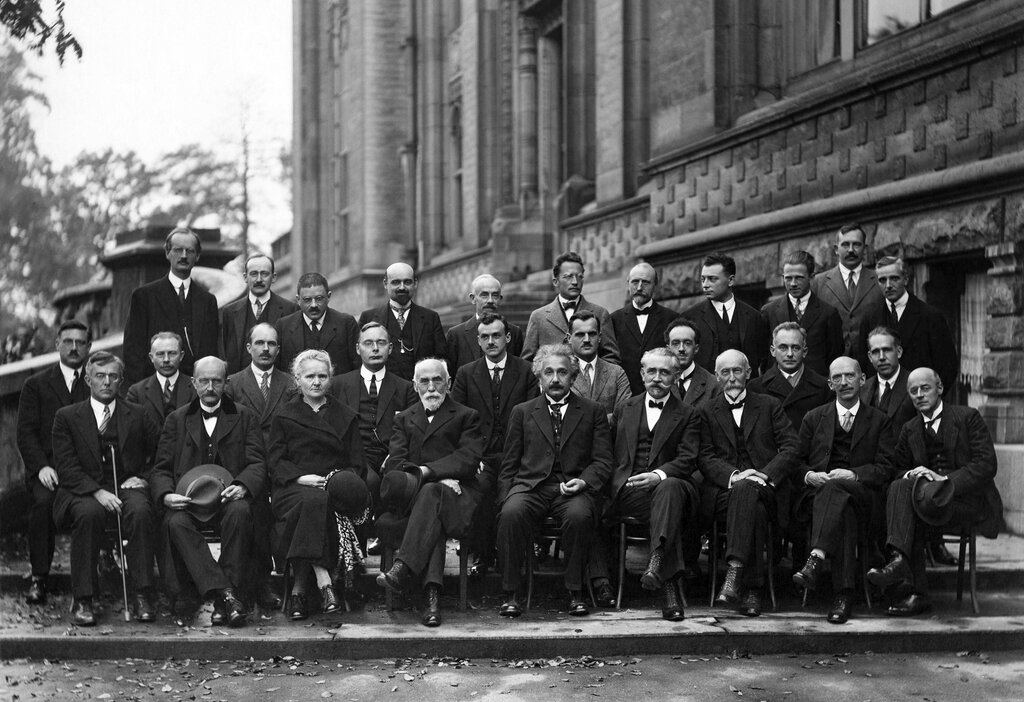
These early discoveries by Planck and Einstein cracked the foundation of classical physics and opened the door to a strange new reality. They showed that at the microscopic level, energy is not smooth and continuous but chunky and discrete. This is the first and most fundamental principle of quantum mechanics. The old rules no longer applied, and a new set of principles was needed to describe the world of atoms and particles.
In the late 19th century, how did many physicists view the state of their field before the discovery of quantum phenomena?
The "ultraviolet catastrophe" was a major crisis in classical physics because it...