Quantum Physics Beyond Calculus
Quantum Mechanics Basics
A Weird New World
For centuries, we thought the universe worked like a giant clock. If you knew the position and speed of every gear, you could predict the future perfectly. This is the world of classical mechanics, described by Isaac Newton. It works beautifully for things we can see and touch, like planets, baseballs, and cars.
But when scientists started looking at the tiny world of atoms and electrons, the clockwork universe fell apart. The rules that govern the very small are strange and counterintuitive. This is the realm of quantum mechanics.
In the quantum world, particles don't have definite properties until we measure them. Before that, they exist in a cloud of possibilities.
Particles That Behave Like Waves
One of the first quantum surprises was wave-particle duality. In our everyday world, things are either particles (like a grain of sand) or waves (like a ripple in a pond). They can't be both. But in the quantum realm, they are.
Imagine firing single electrons, one by one, at a barrier with two thin slits in it. Behind the barrier is a detector screen. If electrons were just tiny balls, you’d expect to see two bands on the screen, right behind the slits. But that's not what happens.
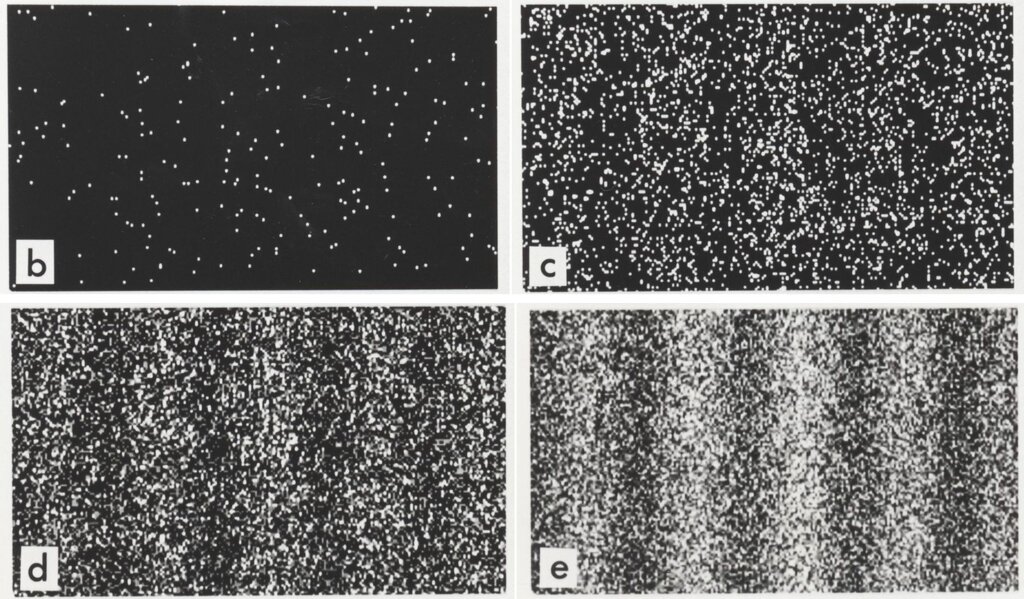
Instead, an interference pattern emerges, just like you’d see if a water wave had passed through both slits at once. It seems each electron, traveling on its own, somehow passes through both slits simultaneously as a wave, and then interferes with itself before hitting the screen as a particle.
Weirdly, if you place a detector at the slits to see which one the electron goes through, the wave behavior vanishes. The interference pattern disappears, and you get the two simple bands you’d expect from tiny balls. The act of measuring forces the electron to “choose” a path and act like a particle.
Can't Know Everything
This leads to another core concept: the Heisenberg Uncertainty Principle. It states that there's a fundamental limit to how much you can know about a particle's properties at the same time. Specifically, you can't simultaneously know both the exact position and the exact momentum (which is mass times velocity) of a particle.
The more precisely you measure a particle's position, the less precisely you can know its momentum, and vice versa. It’s not about having clumsy measuring tools; it’s a fundamental property of nature. The very act of pinning down one property introduces uncertainty in the other.
Think of it like trying to take a picture of a speeding car. A short exposure gives you a sharp image of the car's position, but you can't tell how fast it's moving. A long exposure creates a blurry streak that tells you its speed and direction, but you can't pinpoint its exact location at any instant.
A Cloud of Possibilities
So if a particle doesn't have a definite position before we measure it, where is it? The quantum answer is superposition. A particle exists in all of its possible states at once. It’s a combination, or superposition, of every possible outcome.
Imagine a spinning coin. While it's in the air, it's not heads and it's not tails. In a way, it's both simultaneously. Only when it lands (the moment of measurement) does it settle into one definite state. An unmeasured electron is like that spinning coin—it’s a cloud of potential positions, speeds, and spins.
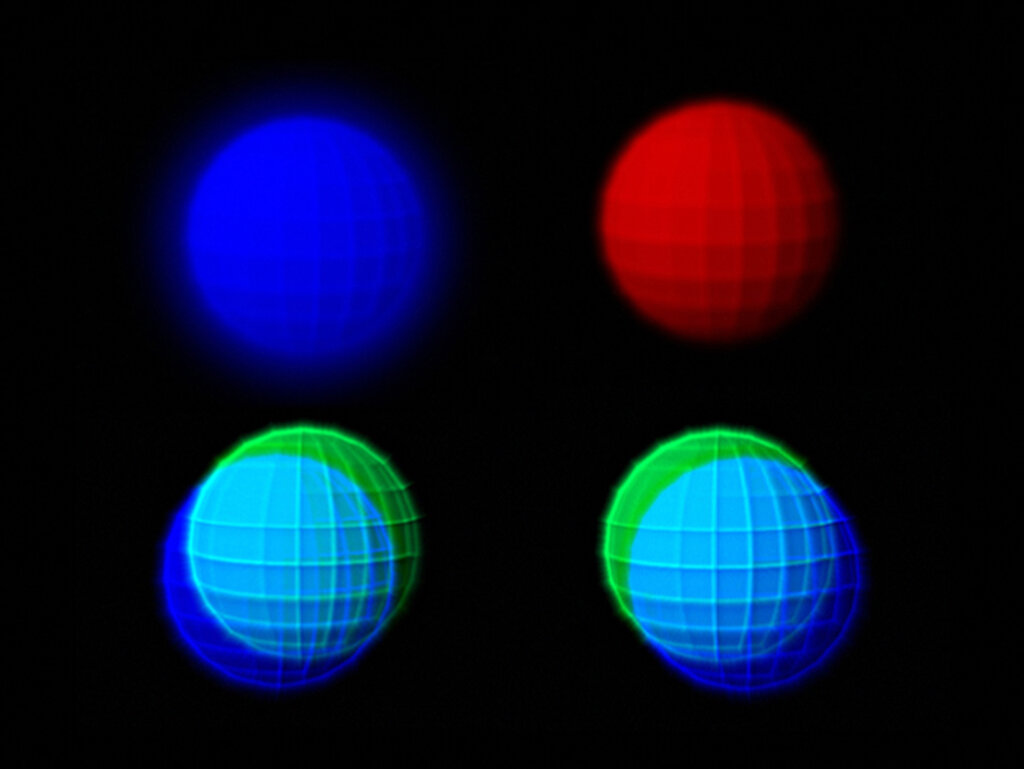
This cloud of possibilities is described by a mathematical tool called a wave function. The wave function doesn't tell you where the particle is, but it tells you the probability of finding it in any given place when you look. When you make a measurement, the wave function “collapses,” and the particle snaps into a single, definite state.
| Feature | Classical System (e.g., Baseball) | Quantum System (e.g., Electron) |
|---|---|---|
| State | Has definite properties (position, speed) at all times. | Exists in a superposition of all possible states. |
| Behavior | Acts as either a particle or a wave, never both. | Exhibits wave-particle duality. |
| Measurement | Reveals pre-existing properties without changing them. | Forces the system out of superposition into a single state. |
| Certainty | Its future can be predicted exactly if you know its current state. | Fundamentally probabilistic; outcomes are not certain. |
Welcome to the strange, probabilistic, and fascinating world of quantum mechanics. The rules are different here, but they describe the true nature of reality at its most fundamental level.