Quantum Physics and Spirituality
Introduction to Quantum Mechanics
The Quantum Realm
In our everyday world, things are predictable. A baseball is either here or there. It has a definite speed and a definite location. But when we zoom in to the scale of atoms and electrons, the rules of this familiar world break down. Welcome to quantum mechanics, the physics of the very small, where things get strange.
Two Things at Once
One of the first puzzles of the quantum world is that tiny particles, like electrons, don't behave like tiny baseballs. Sometimes they act like particles, little points of matter. Other times, they act like waves, spreading out like ripples in a pond. This is called wave-particle duality.
The most famous demonstration of this is the double-slit experiment. If you shoot electrons one by one at a barrier with two slits, you might expect them to pile up in two lines behind the slits, like sand passing through two holes. Instead, they create an interference pattern on the screen behind the barrier, a pattern of many stripes that could only be made by a wave passing through both slits at once. It seems each electron, traveling as a wave, interferes with itself.
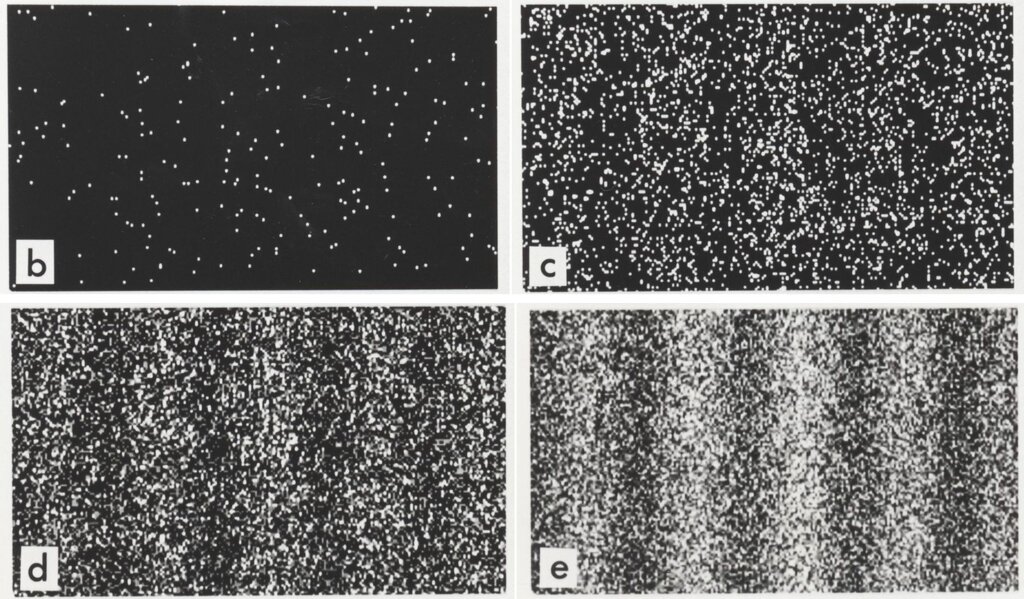
This wave-like behavior leads to another core concept: superposition. Because a quantum particle can act like a wave, it can be in multiple states at the same time. Think of a spinning coin. While it's in the air, it's not heads or tails; it's a blend of both possibilities. A quantum particle exists in a similar state of multiple possibilities until it's measured. When you measure it, the wave of possibilities “collapses” into a single, definite state.
Spooky Connections
Things get even stranger with entanglement. Imagine you have two particles linked in a special way. If you measure a property of one particle, say its spin, you instantly know the spin of the other, no matter how far apart they are. If one is “spin up,” its entangled partner must be “spin down.”
Albert Einstein famously called this “spooky action at a distance.” It’s like having two coins that are magically linked. If you flip one in New York and it lands on heads, you know its partner in Tokyo instantly landed on tails, without any signal traveling between them. The connection is instantaneous and independent of distance.
Entangled particles behave as a single system, even when separated by vast distances. Their fates are intertwined.
A Fundamental Limit
Finally, there's a built-in fuzziness to the quantum world, described by the Heisenberg Uncertainty Principle. This principle states that there's a fundamental limit to how precisely we can know certain pairs of properties of a particle at the same time.
The most common example is position and momentum (which is related to speed). The more precisely you measure a particle’s position, the less precisely you can know its momentum, and vice versa. It’s not about having imperfect measuring tools; it's a fundamental property of nature. Knowing a particle's exact location makes its momentum inherently uncertain.
Here, is the uncertainty in position, is the uncertainty in momentum, and is a tiny constant. This equation shows that as the uncertainty of one value () gets smaller, the other () must get larger to keep the product above the constant value.
These principles form the bedrock of quantum mechanics, describing a world that operates on probability and uncertainty, a stark contrast to the deterministic world we experience every day.