Quantum Physics and Computing Refresh
Quantum Mechanics Refresher
The Quantum Dance
In the world we see, things are either particles or waves. A baseball is a particle. The ripples in a pond are waves. But in the quantum realm, this distinction blurs. Tiny entities like electrons and photons can act like both, a concept called wave-particle duality.
The most famous example is the double-slit experiment. If you fire individual electrons at a screen with two narrow slits, you might expect two corresponding bands to appear on the detector behind it, just like firing paintballs. Instead, an interference pattern emerges, a hallmark of waves that have passed through both slits simultaneously and interfered with each other.
It’s as if each electron, traveling as a wave, explores every possible path at once. Only when it hits the detector does it “decide” on a single location, behaving like a particle again.
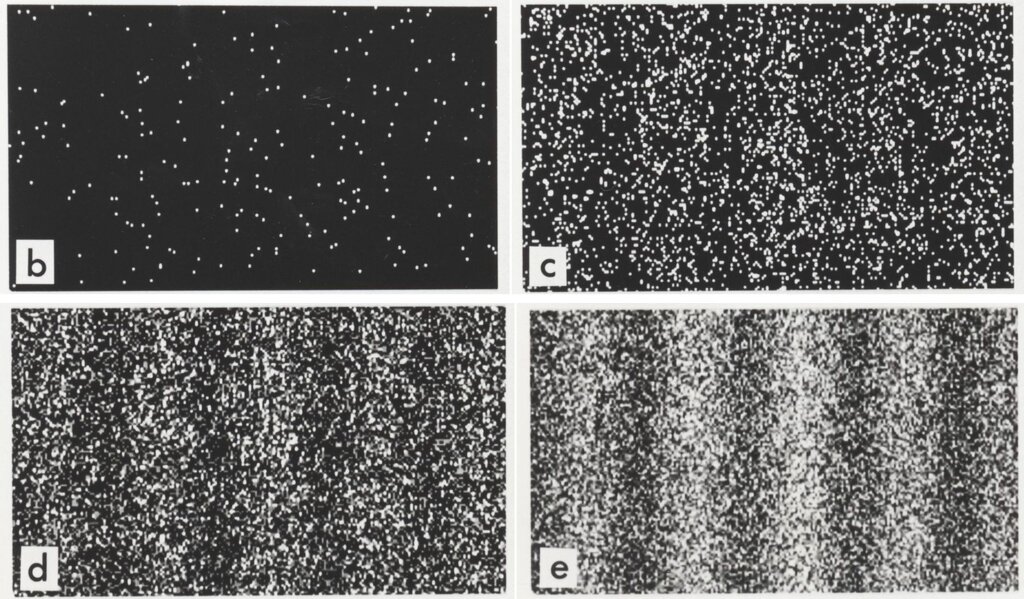
A quantum object exists in a haze of probabilities, like a wave, until it's measured. The act of measurement forces it to commit to a single state, like a particle.
The Rulebook for Waves
If quantum objects behave like waves, there must be a rulebook that describes how these waves move and change. That rulebook is the Schrödinger equation. It's the quantum equivalent of Newton's laws of motion, predicting the future of a quantum system.
The equation describes the evolution of the system's wave function, which contains all the information about the particle's probable properties, like its position and momentum.
wave function
noun
A mathematical description of the quantum state of an isolated system. The probability of finding the particle at a given point is proportional to the square of the magnitude of the wave function at that point.
The time-dependent Schrödinger equation looks like this:
Let's not get lost in the symbols. In essence, it says that the way a quantum state () changes over time () is determined by its total energy, represented by the Hamiltonian operator (). Solve this equation, and you can predict the wave function at any point in the future.
States of Being
In quantum mechanics, we use a special notation called a ket, which looks like , to represent a quantum state. For a quantum bit, or qubit, the two fundamental states are and . These are analogous to the 0 and 1 of a classical bit.
But here's where things get interesting. A qubit doesn't have to be just or just . It can exist in a combination of both states at the same time. This is called superposition.
Think of a spinning coin. While it's in the air, it's neither heads nor tails. It's in a combination of both possibilities. Only when it lands (when we measure it) does it settle into one definite state. A qubit in superposition is like that spinning coin.
Mathematically, we write a qubit's state as a linear combination of its basic states:
Here, and are complex numbers called probability amplitudes. They tell us the likelihood of finding the qubit in the or state upon measurement. Specifically, the probability of measuring 0 is , and the probability of measuring 1 is . Because these are the only two outcomes, the probabilities must add up to one.
The ability to exist in multiple states at once is what gives quantum computers their immense potential power.
The Decisive Moment
A quantum system can evolve in a smooth, wavelike superposition of many states. But the moment we try to measure it, everything changes. The act of measurement forces the system to "choose" one of its possible classical states. This is often called the collapse of the wave function.
If our qubit is in the state , a measurement will yield either 0 (with probability ) or 1 (with probability ). The outcome is fundamentally probabilistic; we can't know for certain what it will be beforehand. We can only know the odds.
Once measured, the superposition is gone. If the outcome was 0, the qubit's state is now simply . If we measure it again immediately, we'll get 0 with 100% certainty. The measurement not only reveals a state but also alters it.
Measurement in quantum mechanics is an active process. It's not just passive observation; it's an interaction that fundamentally changes the system being observed.
This principle is crucial. Quantum algorithms are designed to manipulate these probabilities, making the desired answer the most likely outcome when the final measurement is performed.
In the double-slit experiment, firing individual electrons at a screen with two slits results in an interference pattern. What fundamental concept of quantum mechanics does this demonstrate?
What is the primary function of the Schrödinger equation in quantum mechanics?
These core ideas—wave-particle duality, states governed by the Schrödinger equation, superposition, and the probabilistic nature of measurement—are the foundation upon which all of quantum computing is built.