Quantum Optical Communication Fundamentals
Quantum Optics Basics
The Quantum Nature of Light
In classical physics, we think of light as a continuous electromagnetic wave, like ripples spreading across a pond. This model works beautifully for many things, from designing lenses to understanding radio waves. But when we zoom way down to the scale of single atoms and particles, this picture starts to break down. At the quantum level, the electromagnetic field isn't a smooth, continuous entity. It's quantized.
Quantization means that a physical property can only have certain discrete values, rather than any value within a continuous range. Think of it as the difference between a ramp (continuous) and a staircase (discrete).
For light, this means the energy of an electromagnetic field can't be just any amount. It comes in discrete packets, or quanta. These packets of light are what we call photons.
Photon
noun
The elementary particle of light and all other forms of electromagnetic radiation. It is the quantum of the electromagnetic field.
The energy of a light field with a specific frequency, , isn't arbitrary. It's restricted to specific energy levels, much like the steps on a staircase. The total energy in the field is determined by the number of photons, , present. The energy of each level is given by a simple formula.
In this equation, is the number of photons (it can be 0, 1, 2, and so on), is the reduced Planck constant, and is the angular frequency of the light. The part is straightforward: more photons means more energy.
But what about the term? This is the zero-point energy. It implies that even in a complete vacuum, with zero photons (), there is still a minimum amount of energy present in the electromagnetic field. This
Counting Photons
Since light is made of individual photons, we can, in principle, count them. But how photons from a light source arrive at a detector over time is not always predictable. This randomness is described by photon statistics. Different types of light sources have different statistical 'personalities'.
| Light Source | Photon Arrival | Statistics Type |
|---|---|---|
| Laser (Coherent) | Random, independent | Poissonian |
| Light Bulb (Thermal) | Bunched together | Super-Poissonian |
| Single-Photon Source | Evenly spaced | Sub-Poissonian |
Coherent light, like from a laser, has photons that arrive independently of one another. The probability of detecting a photon is the same at any moment, leading to a Poissonian distribution. It's like raindrops falling on a pavement; they hit at random, uncorrelated times.
Thermal light, like that from a glowing filament in a light bulb, is different. Its photons tend to arrive in bunches. If you detect one photon, you're slightly more likely to detect another one right after. This is called photon bunching.
For quantum communication, the ideal is a single-photon source. It emits exactly one photon at a time, on command. The photons are 'anti-bunched'—if you detect one, you know you won't detect another one immediately after. This property is essential for building secure quantum networks.
When Light Meets Matter
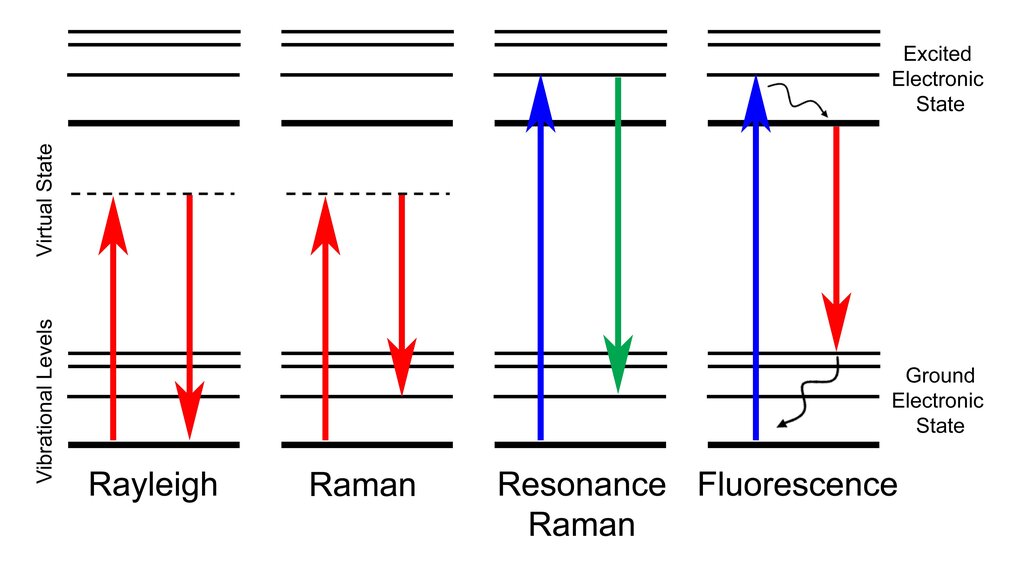
The final piece of our foundation is understanding how light interacts with matter. At the quantum level, this interaction is all about photons meeting atoms. Atoms, like light, have quantized energy levels. An electron in an atom can't have just any energy; it must occupy a specific orbital, or energy state.
There are three fundamental ways a photon and an atom can interact:
-
Absorption: If a photon's energy exactly matches the energy difference between two of an atom's energy levels, the atom can absorb the photon. An electron will jump to the higher energy level.
-
Spontaneous Emission: An atom in a high-energy (excited) state won't stay there forever. It can spontaneously drop to a lower energy level, releasing the excess energy by emitting a photon in a random direction.
-
Stimulated Emission: If an atom is already in an excited state, a passing photon with the right energy can 'stimulate' the atom to drop to a lower energy level and emit a second photon. This new photon will be a perfect clone of the first one, with the same frequency, phase, and direction. This is the principle that makes lasers work.
These three processes—absorption, spontaneous emission, and stimulated emission—form the basis of nearly all quantum optical technologies, from lasers to the components used in quantum communication systems.
Understanding these core principles—that light is made of photons, that photons from different sources have distinct statistical behaviors, and that they interact with atoms in specific, quantized ways—is the first step into the world of quantum optics.