Quantum Ontology: The Philosopher's Guide to the Standard Model
Quantum Field Ontology
The Universe as an Ocean
For centuries, our model of the universe was built on atomism: the idea that reality is made of tiny, indivisible particles, like an infinite game of billiards. This picture is intuitive but fundamentally wrong. The foundation of modern physics, , paints a very different scene. It tells us that the universe isn't filled with things, but with fields.
Imagine the universe as a vast, calm ocean. This ocean isn't made of water; it's made of fundamental fields that permeate every point in space and time. There's an electron field, an up-quark field, a down-quark field, and so on, for every fundamental particle. These fields are everywhere, all the time, layered on top of each other.
Particles as Ripples
So, where are the particles we see and measure? A particle is not a separate object moving through the field. It's a localised vibration or excitation of the field itself. Think back to the ocean analogy. A wave isn't an object distinct from the ocean; a wave is simply the ocean in a state of motion. The wave is the water.
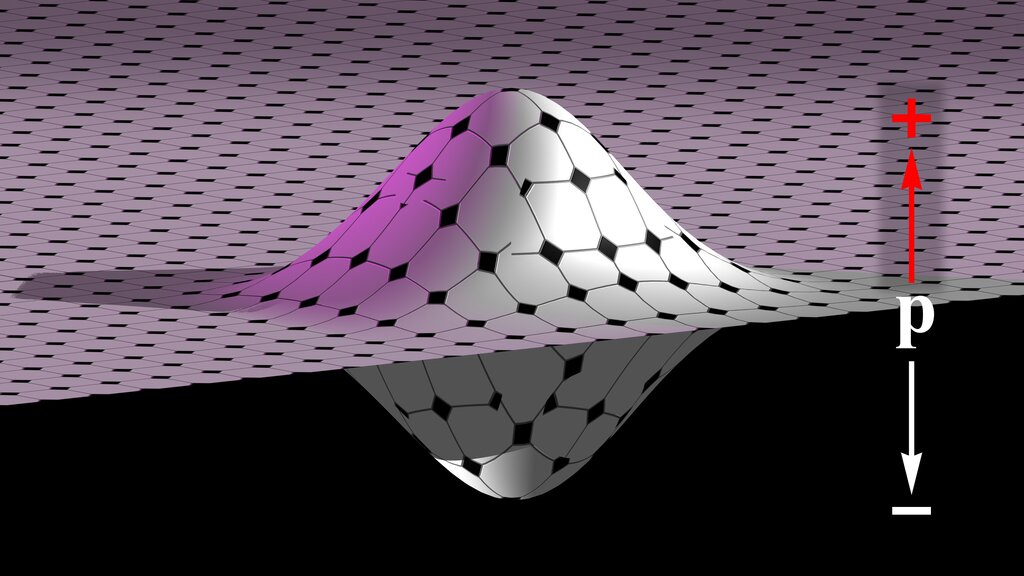
In the same way, an electron is just a quantised ripple in the electron field. A quark is a ripple in the quark field. The more energy you put into a field at a specific location, the more pronounced the ripple becomes. When we see a particle in a detector, we are witnessing a peak in the activity of its underlying field. The fields are the fundamental substance; the particles are just their temporary behaviour.
The Lively Emptiness
This raises a fascinating question: what is empty space? If these fields are everywhere, is anywhere truly empty? The answer is no. In QFT, what we call a vacuum is not a void. It is simply the lowest possible energy state of all the fields—the —where no ripples are present.
The vacuum is the perfectly calm ocean. It's not 'nothing'; it's the baseline from which everything arises. The fields are still present, quietly humming with potential energy. This view marks a profound philosophical shift. Instead of a universe of 'things', we have a universe of 'processes'. The fundamental reality is not static substance but dynamic, interconnected fields whose properties and excitations create the world we experience.
Let's check your understanding of this new reality.
According to Quantum Field Theory, what is the most fundamental constituent of the universe?
In the ocean analogy used to explain QFT, what does a particle like an electron correspond to?
This field-based perspective is the foundation upon which the entire Standard Model is built. The particles it describes are merely the alphabet; the fields are the language.