Quantum Mechanics in One Dimension
Introduction to Quantum Mechanics
Beyond the Clockwork Universe
For centuries, classical mechanics reigned supreme. Isaac Newton's laws of motion and gravity described the world with stunning accuracy, from the arc of a cannonball to the orbit of a planet. The universe seemed like a giant, predictable clock. If you knew the position and momentum of every piece, you could, in principle, calculate its entire past and future.
But as the 19th century turned into the 20th, strange cracks began to appear in this perfect clockwork model. Scientists studying the world of the very small, the realm of atoms and light, encountered phenomena that defied all classical explanation. Light, which was thought to be a wave, sometimes acted like a particle. Electrons, which were definitely particles, sometimes acted like waves. The old rules simply didn't work anymore.
A World of Waves and Particles
One of the most famous experiments in physics is the double-slit experiment. When you shine a beam of light through two narrow, parallel slits, it creates an interference pattern on a screen behind them, a series of bright and dark bands. This is classic wave behavior, just like ripples in a pond.
But then came the photoelectric effect. Scientists observed that shining light on a metal surface could knock electrons loose, but only if the light's frequency was above a certain threshold. This suggested that light wasn't a continuous wave, but a stream of discrete energy packets, which we now call photons. Light was behaving like a particle.
This puzzling situation led the physicist Louis de Broglie to ask a bold question: If waves can act like particles, can particles act like waves? He proposed that all matter, including electrons, has a wavelength. This wasn't just a philosophical idea. Experiments later confirmed it by firing electrons at a double slit. One by one, the electrons built up the exact same interference pattern that light waves produced.
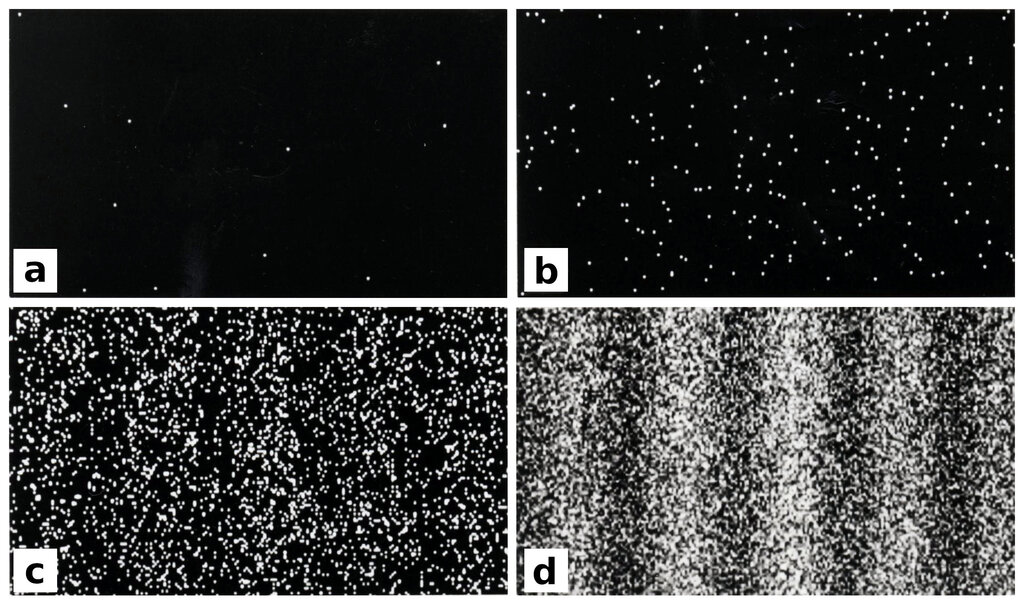
This is the core of wave-particle duality: every particle in the universe has both wave-like and particle-like properties. Which property you observe depends on how you measure it.
Describing the Quantum Wave
If an electron is a wave, how do you describe it? A particle's position is a simple number, but a wave is spread out. In the 1920s, physicist Erwin Schrödinger developed an equation that became a cornerstone of quantum mechanics. It describes the behavior of a quantum system using a mathematical object called the wave function, often represented by the Greek letter psi, .
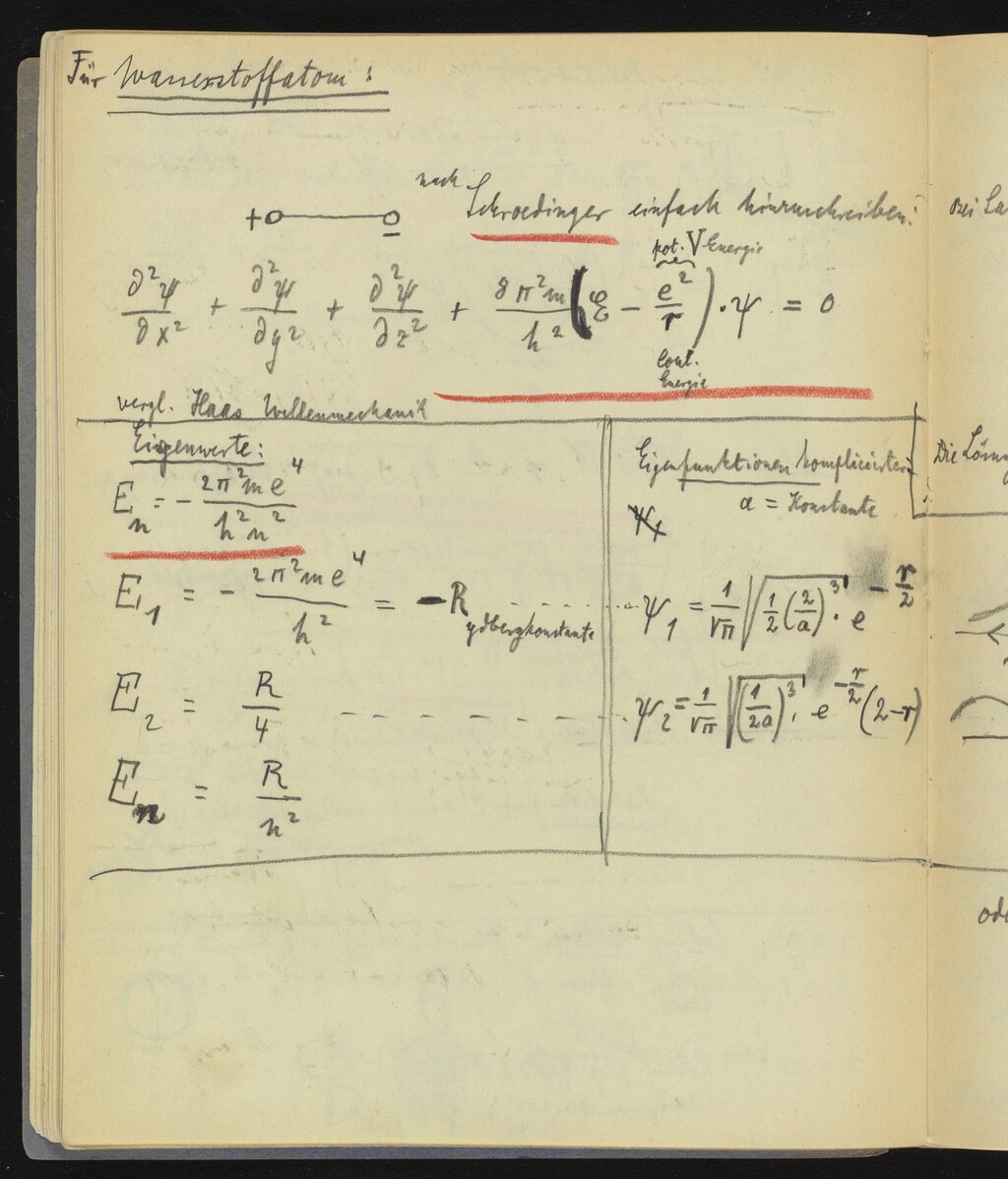
The Schrödinger equation is the quantum equivalent of Newton's second law (). Just as Newton's law lets us predict the future motion of a baseball, the Schrödinger equation lets us predict the future behavior of a wave function.
The Schrödinger equation tells us how the wave function, which contains all the information about a quantum system, evolves.
But what is the wave function, really? It's not a physical wave like a ripple in water. Instead, its meaning is tied to probability. The wave function itself can have positive, negative, or even complex values. The physically meaningful quantity is its magnitude squared, .
The square of the wave function, , gives the probability density of finding the particle at a particular point in space, .
This means that where the wave function's amplitude is large, there's a high probability of finding the particle. Where it's small, the probability is low. This shift from certainty to probability is a fundamental departure from classical mechanics. We can no longer say exactly where a particle is, only where it is likely to be.
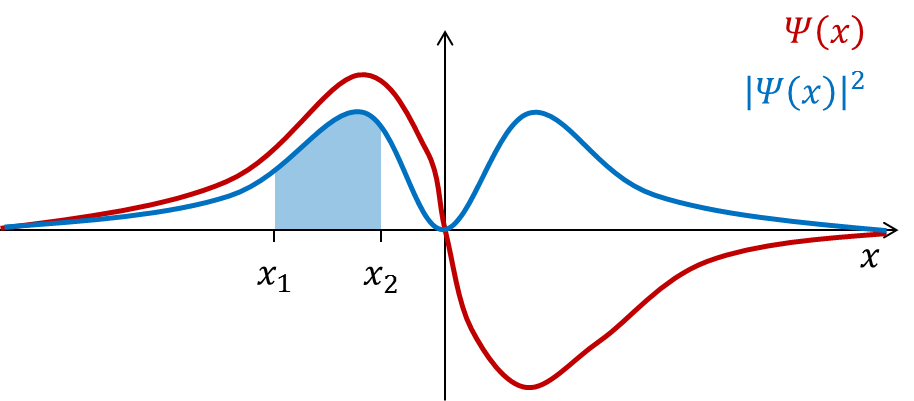
Since the particle must be somewhere, the total probability of finding it across all possible positions must be 100%, or 1. This common-sense requirement has a formal name: normalization. It means that if you add up the probabilities for every single point in space, the sum must equal 1.
This process ensures the wave function gives sensible, physical predictions. It connects the abstract mathematics of the wave function to the concrete probabilities of experimental outcomes, laying the foundation for all the predictions of quantum mechanics.
Which phenomenon most clearly demonstrated that light, previously considered a wave, also has particle-like properties?
In quantum mechanics, what does the magnitude squared of the wave function, , represent?
Quantum mechanics forced a radical rethinking of reality. It replaced the deterministic, clockwork universe with one based on probabilities and waves, setting the stage for understanding atoms, molecules, and the very fabric of the cosmos.