Quantum Mechanics Fundamentals
Introduction to Quantum Mechanics
A Whole New World
At the end of the 19th century, many physicists felt their work was nearly done. They had a powerful toolkit for describing the universe. Newton's laws of motion explained everything from a thrown ball to the orbit of planets. Maxwell's equations beautifully unified electricity, magnetism, and light. This framework, now called classical physics, was a towering achievement. It worked perfectly for the large-scale world we see and experience every day.
But as scientists began to probe the very small, strange new puzzles emerged. Their classical tools, so reliable for planets and pulleys, started to fail. The results of their experiments just didn't match the predictions. It became clear that the universe operates by a different set of rules at the atomic and subatomic levels.
Cracks in the Foundation
One of the first major cracks appeared with a seemingly simple problem: black-body radiation. This isn't as mysterious as it sounds. It's just the light that objects emit when they get hot. A blacksmith's glowing iron poker is an example of a black body radiating energy.
Classical physics tried to predict the color and intensity of this glow at different temperatures. But its predictions were bizarrely wrong. The classical equations suggested that a hot object should release an infinite amount of energy, especially in the ultraviolet part of the spectrum. This was nicknamed the "ultraviolet catastrophe." Since hot objects clearly don't obliterate us with infinite energy, something was deeply wrong with the theory.
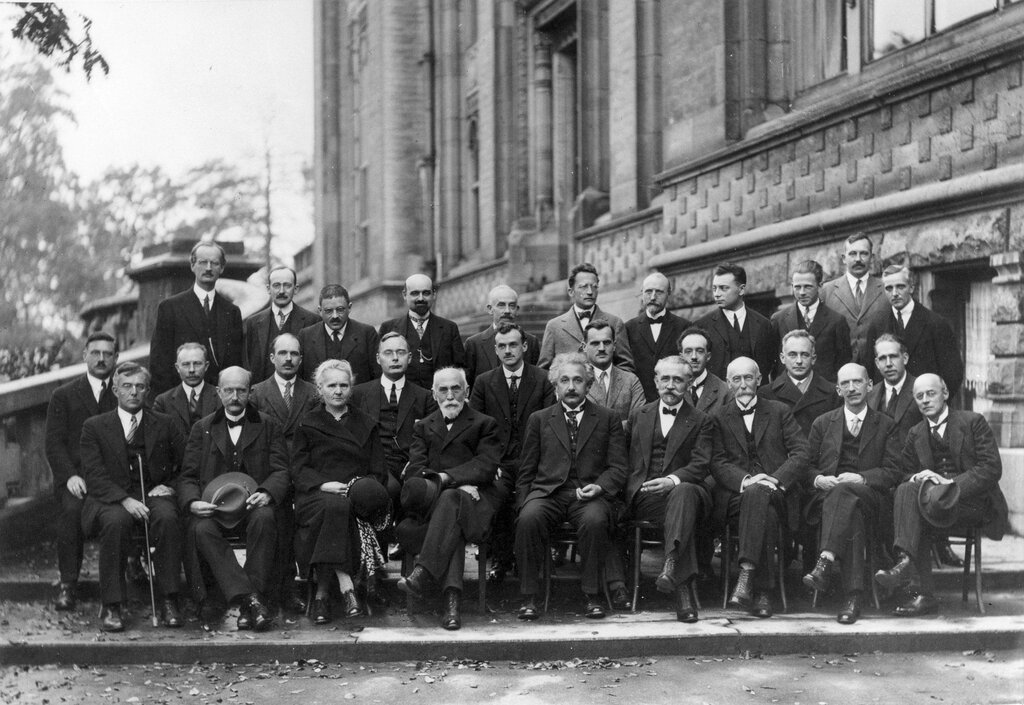
In 1900, the German physicist Max Planck took a radical step. He proposed that energy wasn't a continuous flow, like water from a tap. Instead, he suggested that energy is emitted or absorbed in discrete little packets, which he called "quanta." It was a desperate guess, but it worked. His new formula perfectly matched the experimental data for black-body radiation. This idea of energy packets was the first whisper of quantum mechanics.
This was the birth of a new idea: at the smallest scales, energy is quantized, meaning it comes in distinct, countable units.
Another puzzle was the photoelectric effect, where light shining on a metal plate could knock electrons loose. Classical physics, which treated light as a continuous wave, couldn't explain why only light above a certain frequency could do this, regardless of its brightness. In 1905, Albert Einstein extended Planck's idea, proposing that light itself is made of these quantized packets, later named photons. A single photon had to have enough energy to kick out an electron; a flood of low-energy photons wouldn't work. This insight helped solidify the quantum hypothesis and won Einstein the Nobel Prize.
Classical vs. Quantum
The world described by quantum mechanics is fundamentally different from the classical world we're used to. The distinctions go far beyond just energy packets.
| Feature | Classical Physics | Quantum Mechanics |
|---|---|---|
| Scale | Macroscopic (planets, baseballs) | Microscopic (atoms, electrons) |
| Determinism | If you know the starting conditions, you can predict the future exactly. | Outcomes are fundamentally probabilistic. You can only calculate the likelihood of different results. |
| Energy | Continuous. An object can have any amount of energy. | Quantized. Energy comes in discrete levels or packets. |
| Measurement | Observing a system doesn't fundamentally change it. | The act of measurement affects the system being observed. |
Think about a ramp versus a staircase. In classical physics, a ball can rest at any height on a smooth ramp. Its potential energy is continuous. In the quantum world, it's more like a staircase. The ball can only be on one step or another, never in between. The energy levels of an electron in an atom are discrete, like the steps on that staircase.
This shift from certainty to probability is one of the most profound changes. Classical physics is deterministic. If you know the exact position and momentum of a baseball, you can calculate its exact path. Quantum mechanics, on the other hand, is probabilistic. You can't know an electron's exact position and momentum simultaneously. Instead, the theory gives you the probabilities of finding the electron in various places. The universe, at its most fundamental level, plays with dice.
The Quantum Age
Quantum mechanics isn't just an esoteric theory for physicists. It's the foundation of much of modern technology. Without it, we wouldn't have been able to develop transistors, which are the building blocks of every computer, smartphone, and digital device. Lasers, used in everything from Blu-ray players to medical surgery, operate on quantum principles. So do medical imaging technologies like MRI.
Understanding the quantum world allowed us to manipulate matter at the atomic level, leading to new materials, new medicines, and new sources of energy. It is the most successful and precisely tested theory in the history of science. It describes the fundamental rules that govern all the matter and energy in the universe, and we are just beginning to unlock its full potential.
Now that we have a sense of why quantum mechanics was needed, let's test your understanding of these core ideas.
What problem in classical physics was known as the "ultraviolet catastrophe"?
Max Planck's revolutionary idea, which laid the groundwork for quantum mechanics, was that energy is...