Quantum Mechanics Fundamentals
Introduction to Quantum Mechanics
The Cracks in Classical Physics
For centuries, classical physics—the laws laid down by Isaac Newton and others—did a fantastic job of explaining the world. From the orbit of a planet to the arc of a cannonball, these rules worked perfectly for the big, visible things we interact with every day.
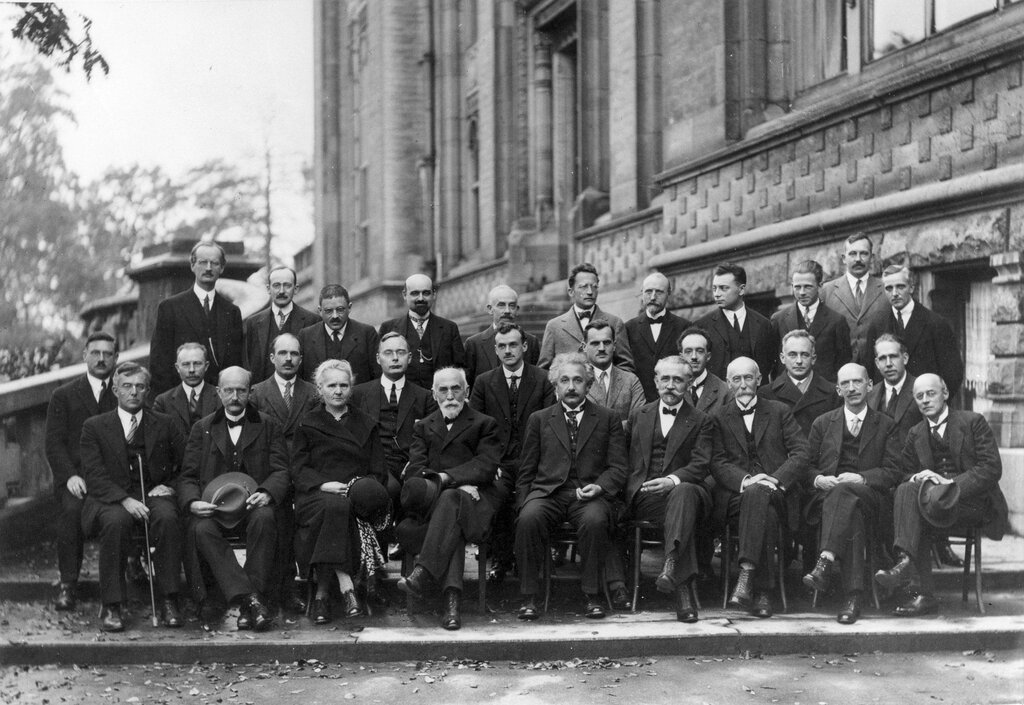
But as the 19th century ended, strange new experimental results began to appear. Scientists studying the light emitted by hot objects, known as black-body radiation, ran into a major problem. According to classical physics, these objects should have radiated an infinite amount of energy at high frequencies, like ultraviolet light. This was obviously wrong, and it became known as the “ultraviolet catastrophe.”
In 1900, physicist Max Planck proposed a radical solution. He suggested that energy wasn't a continuous flow, but was instead emitted in discrete packets, which he called “quanta.” It was a strange idea that didn't seem to fit with anything else, but it perfectly matched the experimental data. Physics had its first clue that the rules were different at the atomic scale.
Quantum
noun
The minimum amount of any physical entity, like energy or matter, involved in an interaction.
Light's Double Life
Another puzzle was the photoelectric effect. When you shine light on a piece of metal, it can knock electrons loose. Classical wave theory predicted that any frequency of light should work, as long as it was bright enough. But experiments showed something different: only light above a certain frequency could eject electrons, no matter how bright it was.
In 1905, Albert Einstein extended Planck's idea. He proposed that light itself is made of particle-like packets of energy called photons. A photon’s energy is determined by its frequency, not its brightness. An electron needs a certain amount of energy to be knocked free, and only a photon with a high enough frequency has the required punch. This idea was revolutionary, suggesting light was not just a wave, but also a particle.
This led to the most famous experiment in quantum mechanics: the double-slit experiment. If you fire particles, like tiny pellets, at a screen with two slits, you expect to see two bands on the detector behind it. If you send waves, like in water, they create an interference pattern of many bands as the waves from each slit interact. When scientists performed this experiment with single electrons, something astonishing happened.
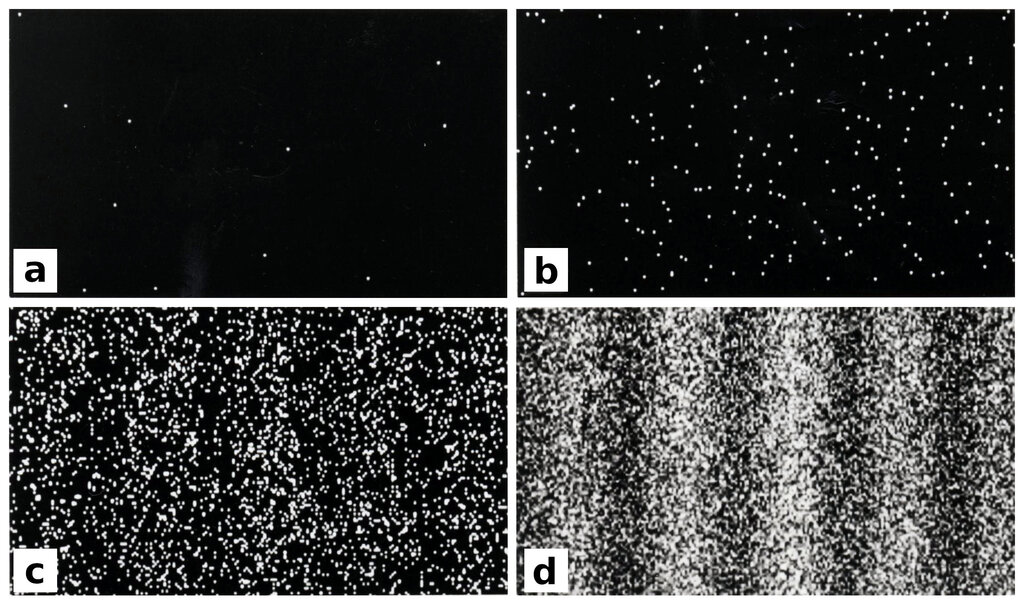
Each electron landed as a single dot, like a particle. But over time, the collection of dots formed an interference pattern, as if each electron had passed through both slits at once and interfered with itself, like a wave. This phenomenon, known as wave-particle duality, is a core concept of quantum mechanics. It revealed that at the subatomic level, things don't behave as either particles or waves; they have properties of both.
Wave-particle duality: Quantum objects like electrons and photons exhibit both wave-like and particle-like properties, depending on how they are measured.
Uncertainty and Probability
Wave-particle duality forced physicists to abandon the comfortable certainty of classical mechanics. If an electron is a spread-out wave before it's measured, where exactly is it? Werner Heisenberg answered this with his famous uncertainty principle. It states that there’s a fundamental limit to how precisely you can know certain pairs of properties, like a particle's position and its momentum, at the same time. The more accurately you measure one, the less accurately you know the other. This isn't a limitation of our instruments; it's a fundamental property of nature.
Heisenberg's Uncertainty Principle: It is impossible to simultaneously know both the exact position and the exact momentum of a particle.
Because of this inherent uncertainty, quantum mechanics is fundamentally probabilistic. It can't tell you exactly what will happen, but it can predict the odds. A particle’s state is described by a wave function, a mathematical object that contains all the information about it. The wave function allows you to calculate the probability of finding the particle in a certain place or with a certain momentum when you measure it. When a measurement is made, the wave of possibilities “collapses” into a single, definite outcome.
This new way of thinking was strange and counterintuitive, but it worked. Quantum mechanics successfully explained the structure of atoms, the nature of chemical bonds, and the behavior of matter and energy at the smallest scales, laying the foundation for much of modern technology.