Quantum Mechanics Fundamentals
Introduction to Quantum Mechanics
A Crack in Classical Physics
By the end of the 19th century, many physicists felt their work was nearly done. The laws of motion and gravity described by Isaac Newton could predict the path of a planet or a cannonball with stunning accuracy. James Clerk Maxwell's equations beautifully unified electricity, magnetism, and light. It seemed that the fundamental rules of the universe were known.
But a few stubborn problems remained. When objects are heated, they glow, emitting light in a way that classical physics couldn't explain. This was called the "black-body radiation" problem. Another puzzle was the "photoelectric effect," where shining light on a piece of metal could knock electrons loose. Classical wave theory predicted that any color of light, if bright enough, should work. But experiments showed that only light above a certain frequency, regardless of its brightness, could do the trick.
These weren't just minor details. They were cracks in the very foundation of physics. The old rules worked perfectly for large objects but failed completely at the scale of atoms and light. A new way of thinking was needed.
Everything is a Wave and a Particle
The first major breakthrough came from a radical idea: what if energy wasn't continuous, but came in discrete packets? This concept led to the most famous and mind-bending principle of quantum mechanics: wave-particle duality.
In our everyday world, things are either particles (like a baseball) or waves (like ripples in a pond). A baseball has a definite location. A wave is spread out. They seem to be complete opposites. Yet in the quantum realm, everything has properties of both.
Consider the classic double-slit experiment. If you fire tiny particles, like electrons, one by one at a barrier with two slits, you'd expect to find two corresponding lines on the detector screen behind it. But that's not what happens. Instead, an interference pattern emerges, a series of alternating bright and dark bands. This is hallmark behavior of waves interfering with each other.
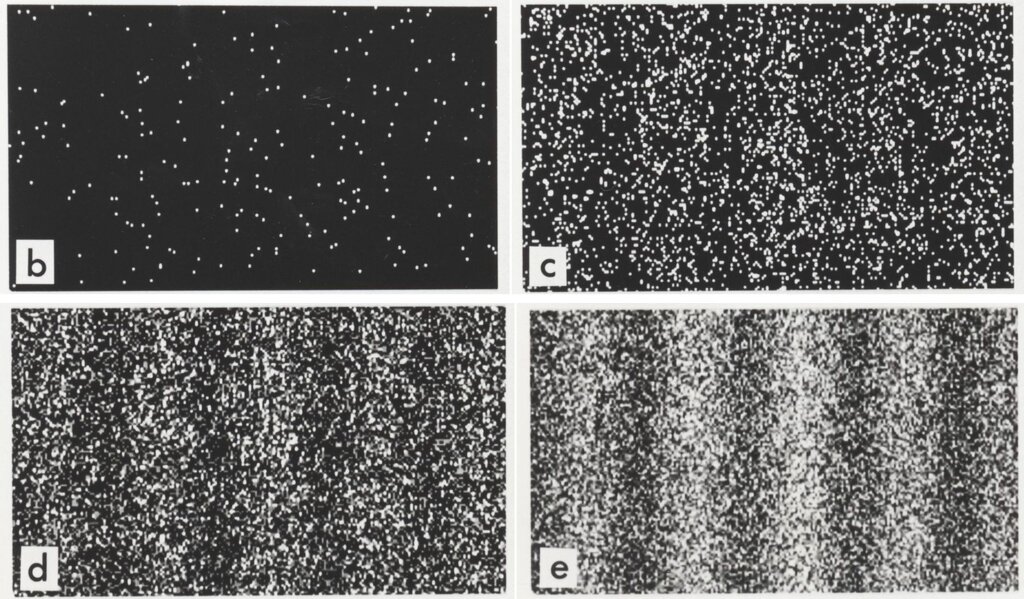
Somehow, each individual electron seems to pass through both slits at once, like a wave, and interfere with itself. But when it hits the detector, it arrives as a single, localized particle. This duality isn't a trick or a metaphor; it's the fundamental nature of matter. Particles like electrons and photons behave like waves when we're not looking, and like particles when we are.
Describing the Quantum World
If particles are also waves, how can we describe them? We can no longer just list a particle's position and momentum. We need a new tool. This tool is the wave function, often represented by the Greek letter psi ($ \Psi $).
The wave function describes the quantum state of a particle. A quantum state is a complete description of a quantum system, containing all the information that can be known about it. The wave function itself doesn't tell you where the particle is, but rather the probability of finding it at any given point. Where the wave's amplitude is large, the probability is high. Where it's small, the probability is low.
To figure out how this wave function changes over time, we use a central equation in quantum mechanics, developed by Erwin Schrödinger in 1926.
This is the Schrödinger equation. It plays a role similar to Newton's second law ($ F = ma $) in classical physics. While Newton's law tells you how the position and momentum of an object will evolve, the Schrödinger equation tells you how a particle's wave function evolves. It's the master recipe for predicting the future behavior of a quantum system.
The Limit of Knowledge
The probabilistic nature of the wave function leads to another strange conclusion. In classical mechanics, if you know the exact position and momentum of a baseball, you can predict its entire future path. In quantum mechanics, this is impossible.
Werner Heisenberg formulated this limitation in his famous uncertainty principle. It states that there's a fundamental trade-off in how precisely you can know certain pairs of properties at the same time. The most well-known pair is position and momentum.
The more precisely you measure the position of a particle, the less precisely you can know its momentum. Conversely, the more precisely you measure its momentum, the less precisely you can know its position.
Here, $ \Delta x $ is the uncertainty in position, $ \Delta p $ is the uncertainty in momentum, and $ \hbar $ is a tiny physical constant. This isn't a limit of our measuring instruments; it's a fundamental property of the universe. A particle simply doesn't have a perfectly defined position and momentum simultaneously. Trying to measure one perfectly blurs the other out of focus.
These concepts—wave-particle duality, quantum states, and the uncertainty principle—form the bedrock of quantum mechanics. They force us to abandon our classical intuition and embrace a world governed by probability and fundamental limits.
Ready to test your understanding of these foundational ideas?
What were two key experimental results at the end of the 19th century that classical physics could not explain?
In the double-slit experiment, firing individual electrons at the slits results in an interference pattern on the screen. What does this demonstrate?
These ideas rewrote the rules of physics and paved the way for technologies we rely on today, from lasers to computer chips. They are the first step into a larger, stranger, and more fascinating quantum world.