Quantum Mechanics Fundamentals
Introduction to Quantum Mechanics
A Weird New World
For centuries, physics seemed sorted. If you knew the position and speed of a baseball, you could predict its path perfectly using Isaac Newton's laws. The universe felt like a giant clockwork machine: predictable, logical, and orderly. This is the realm of classical physics, and it works wonderfully for the big things we see every day, from falling apples to orbiting planets.
But as scientists in the late 19th and early 20th centuries began to probe the world of atoms and the tiny particles within them, the classical rules started to break. They found a world that was fuzzy, bizarre, and probabilistic. To explain it, they needed a completely new set of rules. They needed quantum mechanics.
Particles Are Waves, Waves Are Particles
One of the first and most shocking discoveries was that at the quantum level, the distinction between particles and waves blurs. In our everyday world, a baseball is a particle (a solid object) and a sound wave is a wave (a disturbance spreading through a medium). They are fundamentally different.
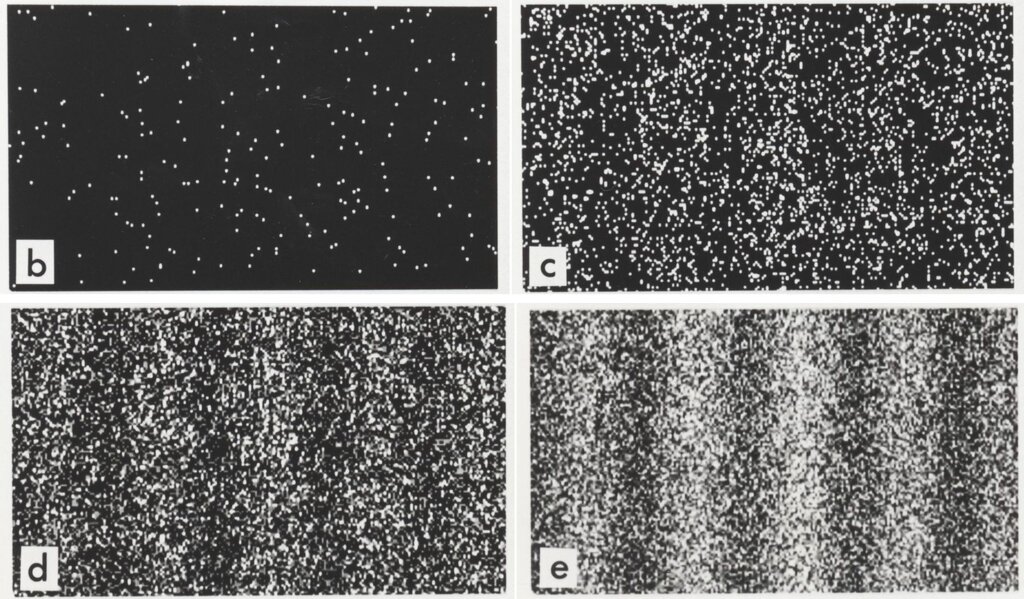
Not so in the quantum world. Consider an electron. We think of it as a tiny, solid speck. But if you shoot electrons one by one at a screen with two thin slits in it, something strange happens. You might expect to see two bands on the detector screen behind the slits, corresponding to where the electrons passed through. Instead, you get a complex pattern of many bands, a pattern of interference. This is classic wave behavior. Each electron, traveling alone, seems to pass through both slits at once, interfering with itself like a water wave would.
The reverse is also true. Light, which we've long known to behave as a wave, can also act like a particle. Albert Einstein showed that light energy comes in discrete packets called photons. It was this particle-like nature of light that explained the photoelectric effect, where light can knock electrons off a metal surface.
This concept is called wave-particle duality. It's a core principle of quantum mechanics: every quantum entity exhibits properties of both particles and waves, depending on how you measure it.
At the quantum scale, things aren't just one thing or the other. They are both, all at once.
Energy Comes in Packets
Another major departure from classical physics is the idea of quantization. Classically, energy is continuous. A car can have any speed, and therefore any amount of kinetic energy. It can move from 20 mph to 20.001 mph to 20.0011 mph. It’s a smooth, unbroken ramp of possibilities.
In 1900, Max Planck discovered that at the atomic level, energy is not continuous at all. It comes in discrete, countable packets called 'quanta'. An electron orbiting an atom can’t have just any energy level. It can only exist in specific, allowed energy states, like steps on a staircase. It can jump from step 2 to step 5, but it can never be found standing at step 3.7.
This quantization of energy explains why atoms emit and absorb light at very specific colors or frequencies. When an electron drops from a higher energy step to a lower one, it releases a quantum of light (a photon) with an energy exactly equal to the difference between the two steps. This gives each element a unique spectral 'fingerprint'.
The Principle of Uncertainty
Perhaps the most famous and mind-bending idea in quantum mechanics is the Heisenberg Uncertainty Principle. Werner Heisenberg realized that there's a fundamental limit to what we can know about a quantum particle at any given moment.
Specifically, you cannot simultaneously know both the exact position and the exact momentum (which is mass times velocity) of a particle. The more precisely you measure one, the less precisely you know the other. It's not a limitation of our instruments; it's a fundamental property of nature.
Imagine trying to find a tiny dust speck in a dark room by throwing a tennis ball at it. When the ball hits, you'll know where the speck was, but the impact will have sent it flying off in an unknown direction and speed. The act of measuring its position changed its momentum. At the quantum level, any act of observation fundamentally disturbs the system.
This principle demolishes the classical idea of a clockwork universe. If we can never know the precise state of the universe at one moment, we can never perfectly predict its future. Instead, quantum mechanics allows us to calculate only the probabilities of different outcomes.
Which concept is demonstrated when electrons, fired one by one at a double-slit barrier, create an interference pattern on a detector screen?
According to the principle of quantization, the energy of an electron in an atom is continuous, like a ramp.
These three ideas—wave-particle duality, quantization, and uncertainty—form the bedrock of quantum mechanics. They paint a picture of a universe that is fundamentally different from the one we experience, a world governed by probability and inherent fuzziness rather than deterministic certainty. It's a strange world, but it's the one we live in.