Quantum Mechanics Fundamentals
Introduction to Quantum Mechanics
A Crack in Classical Physics
At the end of the 19th century, physics seemed mostly figured out. Newton's laws described the motion of planets and billiard balls perfectly. Maxwell's equations did the same for light, magnetism, and electricity. This framework, now called classical physics, worked beautifully for the large-scale world we see and experience every day. But when scientists started looking at the very small, things got weird.
Two major problems emerged. First, there was the "ultraviolet catastrophe." Classical physics predicted that a hot object, like a glowing piece of iron, should emit an infinite amount of high-frequency ultraviolet light. This obviously doesn't happen. In 1900, Max Planck solved this by proposing something radical: energy isn't continuous. It comes in discrete packets, which he called "quanta."
Then came the photoelectric effect. When light shines on a metal plate, it can knock electrons loose. But strangely, the energy of the ejected electrons depended on the light's color (its frequency), not its brightness (its intensity). In 1905, Albert Einstein explained this by suggesting that light itself is made of these energy packets, later named photons. A brighter light means more photons, but the energy of each photon is fixed by its frequency.
These discoveries were the first signs that the smooth, predictable world of classical physics broke down at the atomic scale. Energy and light weren't continuous streams but collections of tiny, distinct units.
Waves or Particles?
The idea of light as a particle (a photon) was strange because for centuries, experiments had shown it behaving like a wave, with properties like interference and diffraction. So which is it, a wave or a particle? Quantum mechanics says it's both. This is called wave-particle duality.
In the 1920s, physicist Louis de Broglie proposed that if waves could act like particles, then maybe particles—like electrons—could act like waves. This wasn't just a philosophical idea; it was a testable hypothesis. The most famous demonstration is the double-slit experiment.
Imagine firing single electrons, one at a time, at a barrier with two thin slits. If electrons were just tiny balls, you'd expect to see two bands on the detector screen behind the barrier, corresponding to the two slits. But that's not what happens.
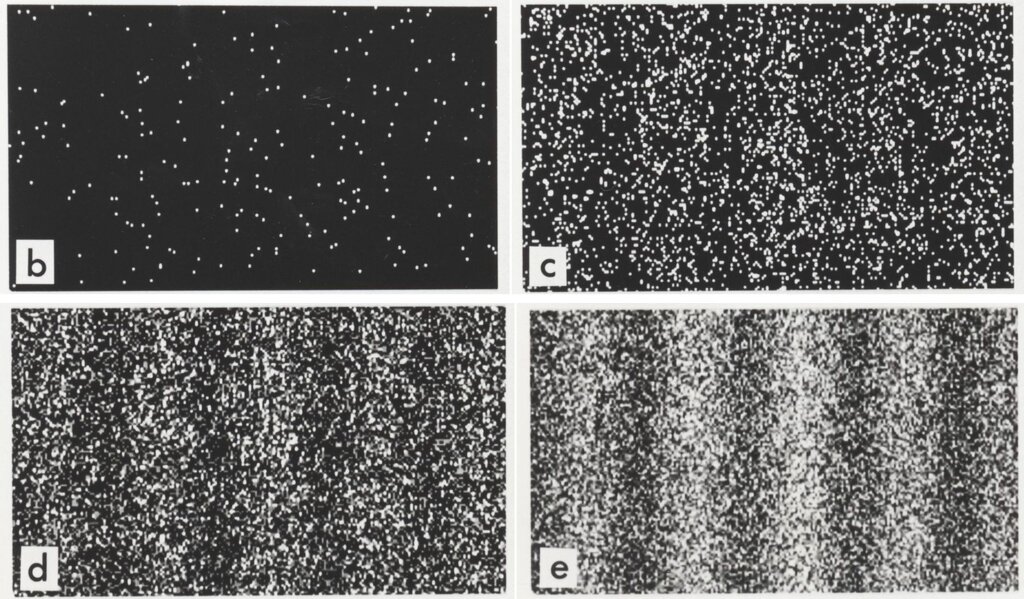
At first, the electrons seem to land randomly. But as more and more electrons are fired, a pattern of bright and dark bands emerges. This is an interference pattern, something you'd only expect to see from waves that pass through both slits at once, interfering with each other. Somehow, each individual electron seems to behave like a wave, pass through both slits, and interfere with itself before landing as a single particle on the screen. The act of observing which slit the electron goes through, however, makes the interference pattern disappear.
Quantization
noun
The principle that a physical property, such as energy or charge, can only have certain discrete values, rather than any value within a continuous range.
A Limit to Knowledge
This strange dual nature leads to another core concept: the Heisenberg Uncertainty Principle. In the classical world, you can know everything about an object. You can measure a car's exact position and its exact speed at the same moment. But in the quantum realm, that's impossible.
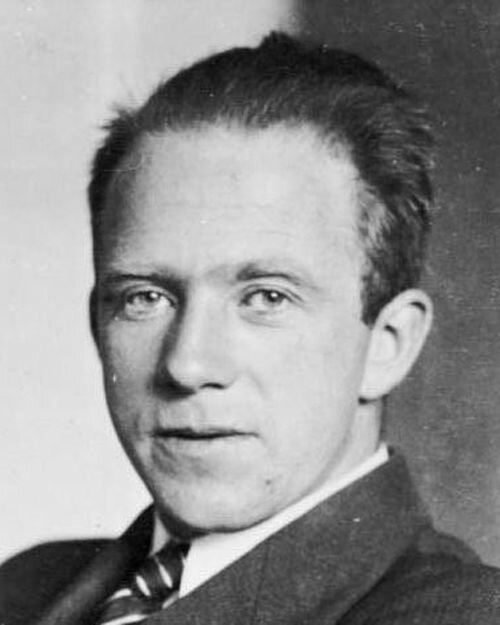
Werner Heisenberg realized there's a fundamental trade-off. The more precisely you measure a particle's position, the less precisely you can know its momentum (which is its mass times its velocity), and vice versa. It's not a limitation of our measuring instruments; it's a fundamental property of nature.
Think of trying to find an electron with a very powerful microscope. To see it, you have to bounce a photon of light off it. But this photon carries energy and will kick the electron, changing its momentum in an unpredictable way. The more precisely you want to pinpoint its location (which requires a high-energy photon), the bigger the kick you give it. This relationship is expressed mathematically as:
Here, is the uncertainty in position, is the uncertainty in momentum, and (h-bar) is a tiny fundamental constant. The formula shows that as the uncertainty in one value gets smaller, the other must become larger. Their product can never be zero.
Describing the Quantum World
So, if we can't know a particle's exact position and momentum, how do we describe its behavior? In 1926, Erwin Schrödinger developed a groundbreaking equation that serves as the quantum equivalent of Newton's laws of motion. It's one of the cornerstones of modern physics.
Instead of predicting definite outcomes, the Schrödinger equation describes the evolution of a "wave function," usually represented by the Greek letter psi ().
A particle's wave function contains all the information about its quantum state. It doesn't tell you where the particle is, but it allows you to calculate the probability of finding it at any given point in space. When you're not looking, the particle exists in a superposition of all its possible states at once, spread out like a wave of probability. When you make a measurement, this wave function "collapses," and the particle appears in one definite location.
This equation allows physicists to calculate the quantized energy levels of atoms and predict the outcomes of quantum experiments with incredible accuracy, even if the underlying reality remains probabilistic and uncertain.
Let's test your understanding of these foundational ideas.
What was the "ultraviolet catastrophe"?
In the double-slit experiment, firing individual electrons at a barrier with two slits results in an interference pattern on the screen behind it. What does this outcome demonstrate?
Quantum mechanics forced a radical shift in how we view the universe. It replaced the clockwork certainty of classical physics with a world of probabilities, dualities, and fundamental limits, opening the door to understanding the subatomic world.