Quantum Mechanics Fundamentals
Introduction to Quantum Mechanics
When the Old Rules Break
For centuries, classical physics seemed to have all the answers. With Newton's laws of motion and Maxwell's equations for electromagnetism, we could predict the path of a planet or the behavior of an electric circuit. These rules worked flawlessly for the big, everyday world. They described a universe that was predictable and deterministic. If you knew the position and momentum of a ball, you could calculate its exact trajectory.
But toward the end of the 19th century, physicists started exploring the world of the very small—the realm of atoms and light. And here, the classical rules began to fail spectacularly. Experiments produced results that made no sense. For example, when certain metals were hit with light, they ejected electrons in a way that classical wave theory couldn't explain. Another puzzle was black-body radiation—the light given off by hot objects. Classical physics predicted that these objects should radiate an infinite amount of energy at high frequencies, a result so wrong it was nicknamed the "ultraviolet catastrophe."
It became clear that the universe at the atomic scale operated under a completely different set of rules. The familiar, intuitive world of classical mechanics was just an approximation, valid only for large objects. A new theory was needed.
Energy in Packets
The first major breakthrough came in 1900 from German physicist Max Planck. While studying black-body radiation, he proposed a radical idea. What if energy wasn't continuous, but came in discrete little packets? He called these packets "quanta."
Think of it like the difference between a ramp and a staircase. On a ramp, you can stand at any height. Your position is continuous. On a staircase, you can only be on step one, step two, or step three. You can't be at step 2.5. Your position is discrete, or quantized.
Planck suggested that energy worked like a staircase. An atom could only emit or absorb energy in specific, fixed amounts. This idea perfectly explained the black-body radiation problem and marked the birth of quantum theory. At first, it was seen as just a mathematical trick, but it laid the foundation for everything to come.
In the quantum world, energy is not a continuous flow but comes in distinct, countable units called quanta.
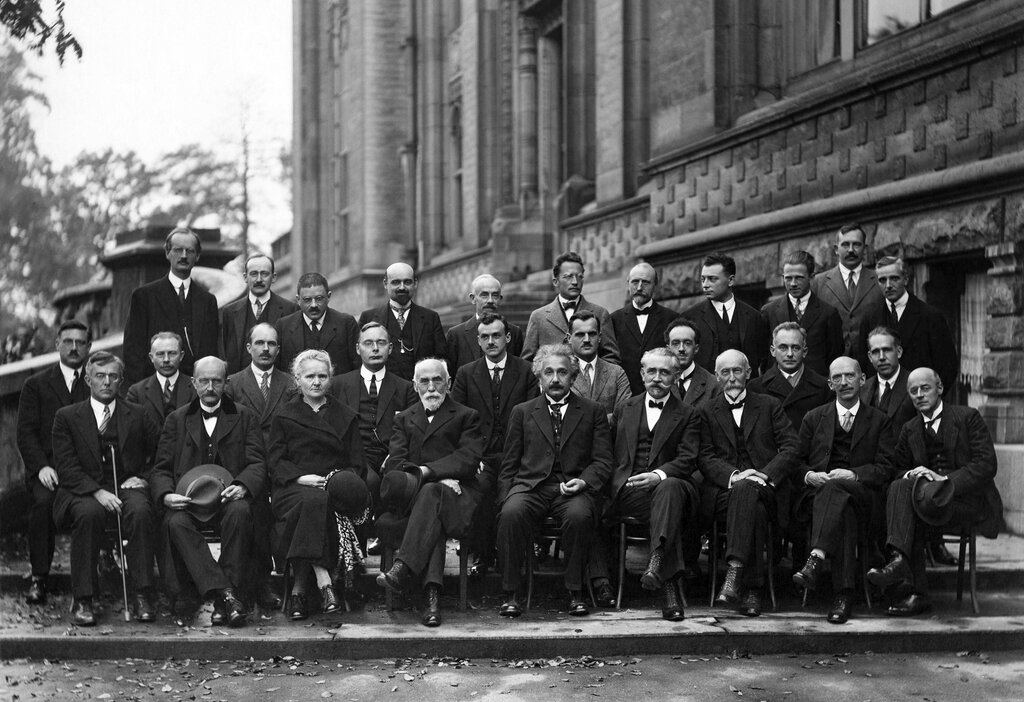
The Wave Function
If energy is quantized, what does that mean for matter? Building on Planck's work, Albert Einstein proposed that light itself is made of particles, called photons, each carrying a quantum of energy. This explained the photoelectric effect, but it created a new problem: decades of experiments had proven light behaves like a wave.
This puzzle led to the concept of wave-particle duality. In 1924, Louis de Broglie suggested that if waves could act like particles, then perhaps particles like electrons could act like waves. This wasn't a physical wave, like an ocean wave, but a more abstract "matter wave."
Erwin Schrödinger developed this idea into a central part of quantum mechanics: the wave function, represented by the Greek letter psi ($ \psi $). The wave function is a mathematical description that contains all the information about a quantum system, like an electron in an atom. Its evolution over time is described by the Schrödinger equation.
This equation is as fundamental to quantum mechanics as Newton's second law ($ F = ma $) is to classical mechanics. It governs how the wave function of a particle changes.
A World of Probabilities
So what does the wave function actually represent? This is where quantum mechanics truly departs from our everyday intuition. Physicist Max Born proposed that the wave function is related to probability.
Specifically, the square of the wave function's magnitude, , gives the probability of finding the particle at a certain position at a certain time. This was a revolutionary shift. Quantum mechanics doesn't tell us where a particle is; it only tells us where it might be. The universe, at its most fundamental level, is probabilistic, not deterministic.
Before we measure it, an electron doesn't have a definite position. It exists in a cloud of possibilities, a "superposition" of all potential locations described by its wave function. When we make a measurement, this wave function "collapses," and we find the electron at one specific spot. But we can never predict with certainty which spot it will be.
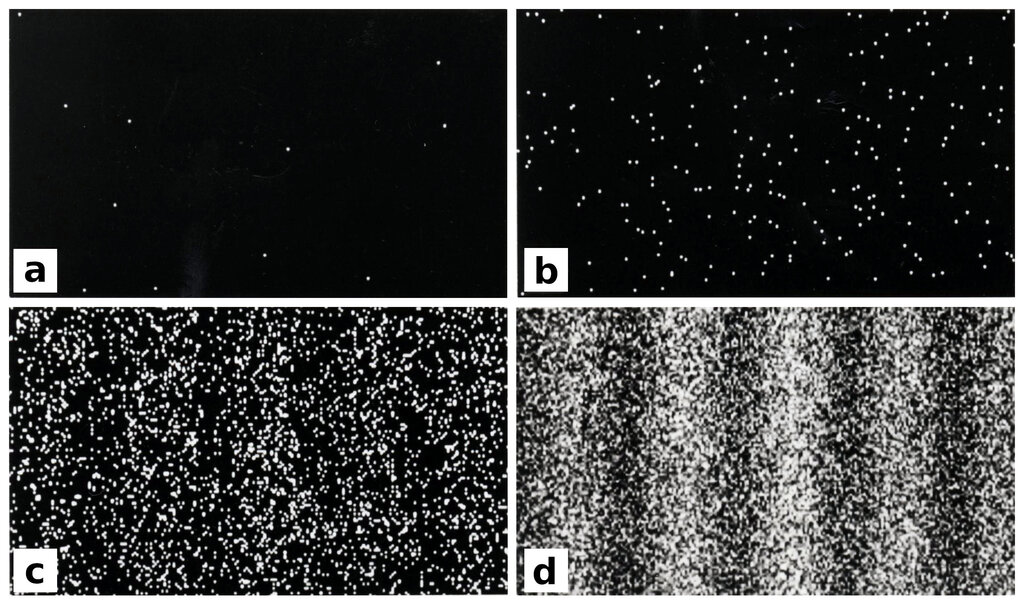
This probabilistic nature is not due to a lack of information. It's an inherent feature of the universe. The quantum world is fundamentally fuzzy and uncertain. This insight, born from the failures of classical physics, opened up a new and profoundly strange understanding of reality.
Time to check your understanding of these foundational ideas.
Classical physics failed to explain certain phenomena at the atomic scale, leading to the development of quantum mechanics. Which of these was a major failure known as the 'ultraviolet catastrophe'?
According to Max Planck's foundational idea, energy is not continuous but comes in discrete packets called ________.
These concepts challenged the greatest minds of the 20th century and continue to be the bedrock of modern physics, powering everything from lasers to computers.