Quantum Mechanics from Scratch
Quantum Foundations Revisited
The Cracks in Classical Physics
At the end of the 19th century, physics seemed nearly complete. Newton’s laws described the motion of planets, and Maxwell’s equations beautifully explained light as an electromagnetic wave. This classical framework was deterministic: if you knew the position and momentum of every particle, you could predict the future with perfect accuracy. But a few stubborn problems refused to fit this neat picture.
One of the most glaring was the problem of blackbody radiation. A blackbody is an idealized object that absorbs all radiation that falls on it. When heated, it glows, emitting thermal radiation. Think of a blacksmith's forge: as a piece of iron gets hotter, it glows red, then orange, then white. Classical physics tried to predict the spectrum of this light—how much light is emitted at each frequency—using the tools of thermodynamics.
The result was the Rayleigh-Jeans law, which worked well for low frequencies. But as the frequency of light increased into the ultraviolet range, the law predicted that the intensity of the emitted radiation would shoot off to infinity. This implied that any hot object should instantly radiate away all its energy as a blinding flash of ultraviolet light. This absurd prediction was dubbed the “ultraviolet catastrophe.” Clearly, something was deeply wrong.
The graph shows the problem vividly. The classical prediction soars uncontrollably at short wavelengths, while experimental data (which perfectly matches Planck's curve) shows the intensity peaking and then falling off. The universe obviously doesn't work the way the Rayleigh-Jeans law says it should.
Planck's Desperate Act
In 1900, German physicist proposed a radical solution. He suggested that energy was not continuous, but was emitted and absorbed in discrete packets, or “quanta.” He introduced a new fundamental constant, , now known as Planck's constant. The energy of a single quantum, he proposed, was directly proportional to its frequency, .
By incorporating this idea, Planck derived a new formula that matched the experimental data perfectly across all frequencies. At high frequencies, the energy required to create even one quantum () becomes very large. As a result, these high-energy modes are 'frozen out' and don't contribute much to the radiation, preventing the ultraviolet catastrophe.
This was a revolutionary idea. It meant energy levels in nature were not like a smooth ramp, but like a staircase. You can be on one step or another, but never in between.
Einstein and the Photoelectric Effect
Another puzzle tormenting physicists was the —the observation that shining light on a metal surface can knock electrons loose. Classical wave theory made a few predictions about this:
- Brighter light (higher intensity) should give the electrons more energy.
- The frequency of the light shouldn't matter, only its brightness.
- There should be a time delay as the electrons absorb enough energy from the wave to escape.
Experiments showed that all three predictions were wrong. The energy of the ejected electrons depended only on the light's frequency, not its intensity. Brighter light just knocked out more electrons, not more energetic ones. And below a certain threshold frequency, no electrons were ejected at all, no matter how bright the light. Finally, the electrons were ejected instantly.
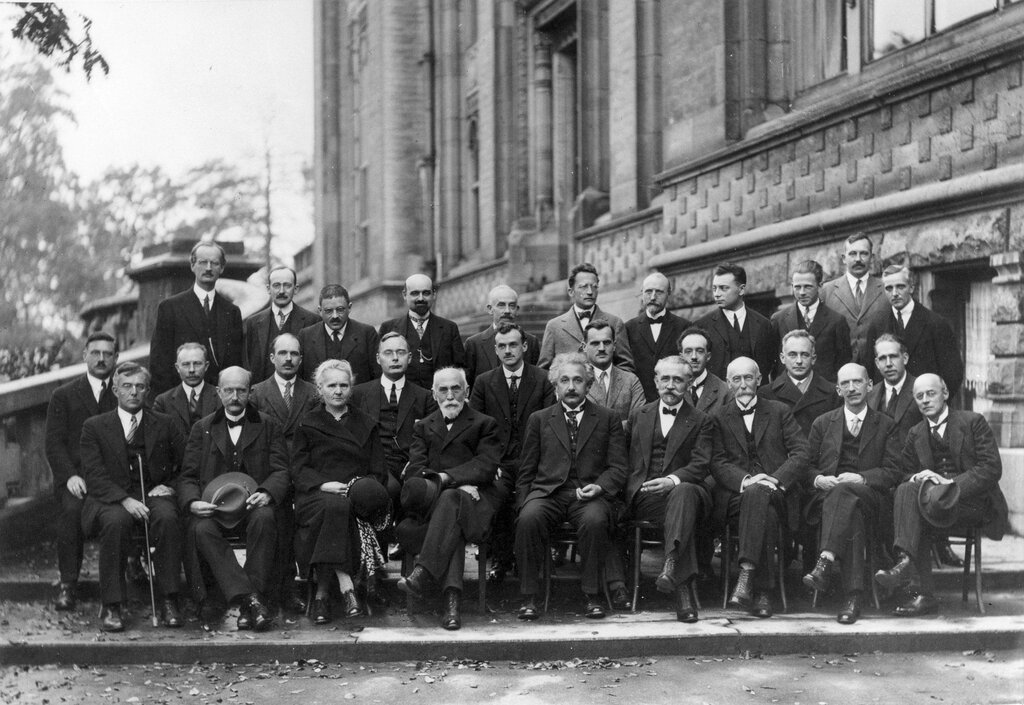
In 1905, Albert Einstein took Planck's quantum idea one step further. He proposed that light itself is not a continuous wave, but is composed of discrete particles of energy, which we now call photons. The energy of each photon is given by Planck's formula, .
This explained the photoelectric effect perfectly. An electron is knocked out by absorbing a single photon. A higher frequency photon has more energy, so it kicks the electron out with more kinetic energy. A brighter light just means more photons are hitting the metal per second, releasing more electrons. If the photon's energy () is less than the energy needed for an electron to escape the metal (the 'work function'), then nothing happens, explaining the frequency threshold.
These two phenomena—blackbody radiation and the photoelectric effect—were the first solid signs that the classical world of smooth, continuous waves and predictable paths was breaking down at the atomic scale. They forced physicists to accept that energy is quantized, setting the stage for a new, probabilistic view of the universe.
What was the "ultraviolet catastrophe"?
Max Planck's revolutionary solution to the blackbody radiation problem was the proposal that...
The transition from classical determinism to quantum probability was just beginning. These early discoveries laid the groundwork for understanding the strange and wonderful rules that govern the subatomic world.