Quantum Mechanics Foundations
Schrodinger Equation Dynamics
The Equation of Motion
In classical mechanics, Newton's second law, , dictates how an object's state (its position and momentum) evolves over time. Quantum mechanics has its own fundamental law of motion: the time-dependent Schrödinger equation. This equation governs the evolution of a quantum state vector, , which lives in a Hilbert space. The state vector contains all possible information about the physical system.
The Schrödinger equation describes how quantum systems evolve over time.
The equation itself is a masterpiece of concise power. It connects the change in the state over time to the total energy of the system, encapsulated by a special operator.
The central player here is the . Just as you've seen other operators acting on vectors in Hilbert space, the Hamiltonian acts on the state vector . Physically, it's the operator corresponding to the total energy of the system—the sum of its kinetic and potential energies. In this sense, the Schrödinger equation states that the energy operator generates the time evolution of the quantum state.
Stationary States
Solving the time-dependent equation directly can be difficult. A powerful technique is to look for special solutions called stationary states. These are states where the probability density, |\[\[Psi(x, t)\]|^2, does not change over time. The state itself evolves, but only by a complex phase factor, which disappears when we take the absolute square.
To find these states, we use the method of on the wave function , assuming it can be written as a product of a function of position, , and a function of time, .
Plugging this into the Schrödinger equation and rearranging terms yields two separate equations, one for time and one for space. The time-dependent part solves to . The spatial part gives us a new, fundamental equation.
Solving the TISE for a given potential tells us the allowed energy levels () and the corresponding wave functions (\[\[psi(x)\]) of the system. These are the building blocks we can use to construct any general solution to the full, time-dependent equation.
A Particle in a Box
Let's apply this to our first model system: a particle confined to a one-dimensional box of length . We can model this with a potential energy function that is zero inside the box (from to ) and infinite everywhere else. The particle is trapped.
Inside the box, where , the TISE simplifies significantly. The boundary conditions are crucial: since the particle cannot be outside the box, the wave function must be zero at the walls ( and ). The only solutions that satisfy these conditions are sine waves.
Crucially, only certain energies are allowed. The boundary conditions quantize the energy.
The Quantum Harmonic Oscillator
Another cornerstone model is the quantum harmonic oscillator. Its potential energy is parabolic, , just like a classical spring following Hooke's Law. This potential is incredibly useful because it can approximate many more complex systems near their equilibrium point, such as the vibrations of atoms in a molecule or the oscillations of the electromagnetic field.
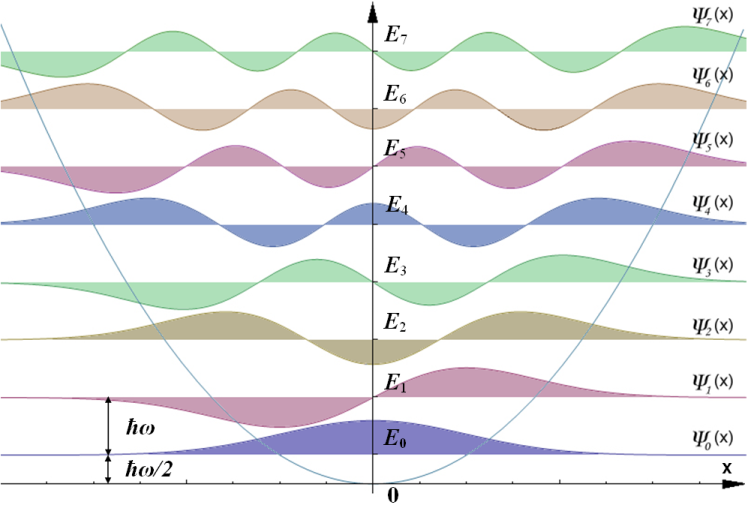
Solving the TISE for this potential is more involved, but the results are elegant and profound. The energy levels are evenly spaced.
Unlike the particle in a box, the lowest energy state for the harmonic oscillator corresponds to . This implies that even in its ground state, the oscillator has some energy and is never completely at rest. This is a direct consequence of the —if the oscillator were perfectly still at the bottom of the well (), its position and momentum would both be known with perfect certainty, which is forbidden.
These two examples, the infinite well and the harmonic oscillator, demonstrate how applying the Schrödinger equation to different physical potentials reveals the core feature of bound quantum systems: energy quantization.
In the context of the Schrödinger equation, what physical quantity does the Hamiltonian operator () represent?
A quantum state is described as a "stationary state" if its probability density does not change over time.