Quantum Mechanics for Everyone
Classical Mechanics Foundations
The Rules of Everyday Motion
Before we can explore the strange world of quantum physics, we first need to understand the rules that govern the world we see and interact with every day. This is the realm of classical mechanics. It explains why a thrown ball follows a curve, how a car accelerates, and why planets orbit the sun. These predictable, intuitive rules were famously laid out by Sir Isaac Newton over 300 years ago.
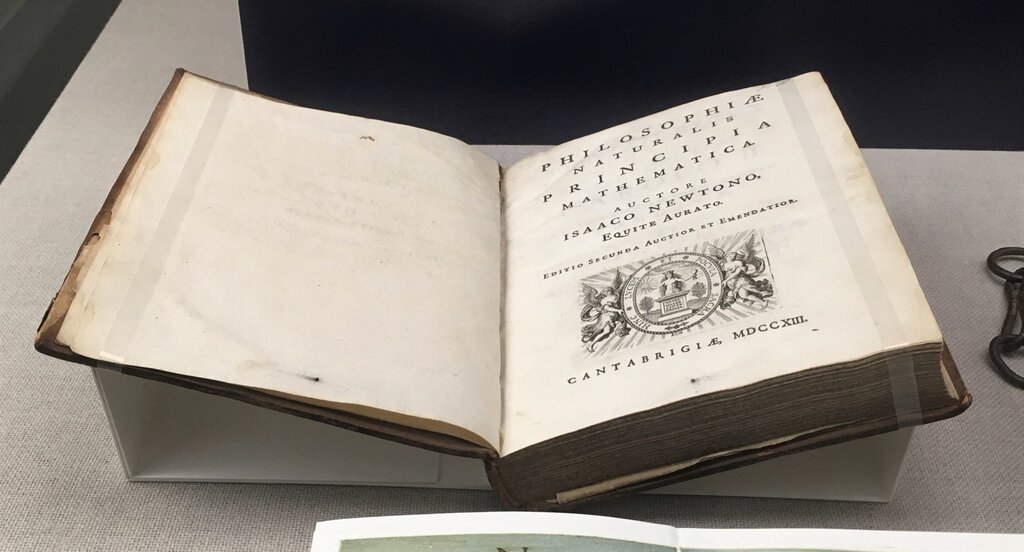
Newton's work gives us a reliable way to describe and predict the motion of objects, from tiny dust motes to massive galaxies. His three laws of motion are the foundation of this entire field.
Inertia and Force
Newton's first law is about inertia. It states that an object will stay at rest, and an object in motion will stay in motion at a constant speed and in a straight line, unless an outside force acts on it.
Think about a hockey puck gliding across the ice. It keeps moving in a straight line until it hits the wall or friction slows it down. A book on your desk won't suddenly fly into the air on its own. It stays put until you, or something else, provides a push or a pull.
inertia
noun
The tendency of an object to resist any change in its state of motion.
That brings us to the second law, which tells us what happens when a force is applied. It connects three key concepts: force, mass, and acceleration.
- Force: A push or a pull on an object.
- Mass: A measure of how much "stuff" is in an object. It's also a measure of inertia—more mass means more resistance to changing motion.
- Acceleration: Any change in an object's velocity (speeding up, slowing down, or changing direction).
The second law shows how these are all related.
Imagine pushing a shopping cart. Pushing an empty cart is easy; it accelerates quickly. Now, imagine that same cart is full of heavy groceries. You have to push much harder (apply more force) to get it to accelerate at the same rate.
Action and Reaction
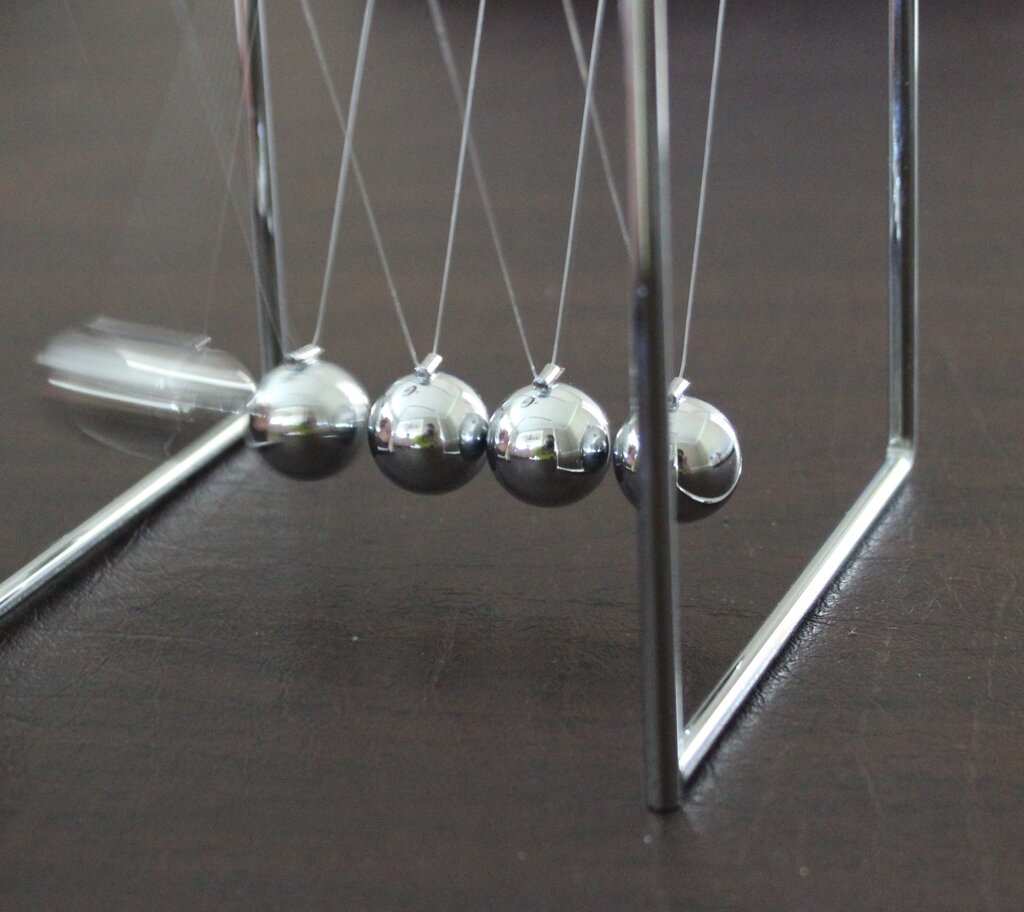
Newton's third law might be the most famous: For every action, there is an equal and opposite reaction. This means that forces always come in pairs. When you push on something, it pushes back on you with the exact same amount of force.
You can't touch something without it touching you back. When you're sitting in a chair, your body exerts a downward force (your weight) on the chair. At the same time, the chair exerts an equal upward force on you. That's why you don't fall through it.
A rocket launching into space is a powerful example. The rocket pushes hot gas downwards with immense force (the action). In return, the gas pushes the rocket upwards with an equal force (the reaction), lifting it off the ground.
Energy is Conserved
Another core idea in classical mechanics is the conservation of energy. This principle states that energy cannot be created or destroyed; it can only change from one form to another. The total amount of energy in an isolated system always remains the same.
Consider a roller coaster. At the top of the first big hill, it has a lot of potential energy—stored energy due to its height. As it rushes down the hill, that potential energy is converted into kinetic energy, the energy of motion. The speed of the coaster at the bottom of the hill is determined by how much potential energy it had at the top.
Although some energy might be lost to friction (as heat) or air resistance, the total amount of energy—potential plus kinetic plus heat—remains constant throughout the ride. These principles of motion, force, and energy provide a solid framework for understanding the physical world we experience. They are the baseline from which the very different rules of the quantum world will emerge.
A hockey puck is sliding across a perfectly frictionless sheet of ice. According to Newton's first law of motion (inertia), what will happen to the puck if no external forces act upon it?
According to Newton's second law, if you push two objects with the same amount of force, the object with less mass will...