Quantum Mechanics Essentials in 1D
Introduction to Quantum Mechanics
The Quantum Riddle
In our everyday world, things are either particles or waves. A baseball is a particle. You can pinpoint its location at any moment. The ripples on a pond are waves. They are spread out and don't have a single, precise location.
Classical physics, the physics of Newton, treats these two ideas as completely separate. But at the turn of the 20th century, scientists discovered something strange when they looked at the world of atoms and electrons. The rules changed. The most famous example of this is the double-slit experiment.
Imagine firing tiny particles, like electrons, one by one at a barrier with two thin, parallel slits. On the other side, there’s a detector screen that records where each electron lands. If electrons were just tiny baseballs, you’d expect to see two distinct bands on the screen, right behind each slit. But that's not what happens.
Instead, a pattern of many bands appears, similar to how waves of light or water would interfere with each other. The electrons seem to act like waves, passing through both slits at once and interfering with themselves.
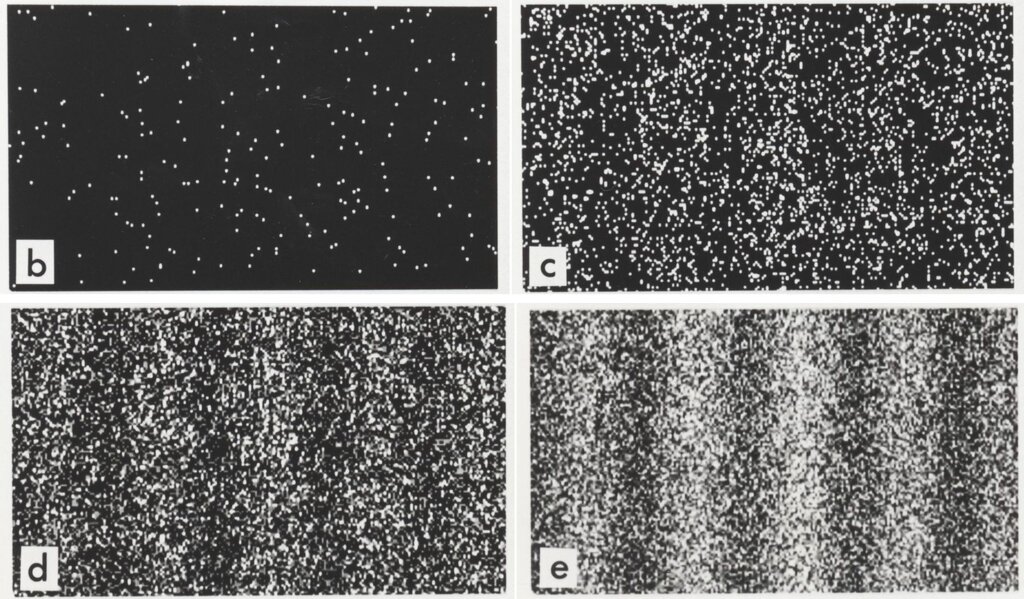
Here's the truly bizarre part: if you place a detector at the slits to see which one each electron goes through, the interference pattern vanishes. You get just two bands, as you'd expect from particles. The very act of observing changes the outcome.
This is wave-particle duality. At the quantum level, entities like electrons aren't strictly particles or waves. They are both, and they reveal one aspect or the other depending on how we interact with them.
A World of Probabilities
Classical physics is deterministic. If you know the position and momentum of a baseball and all the forces acting on it, you can calculate its exact trajectory. You can say with 100% certainty where it will be in the future.
Quantum mechanics is different. It's fundamentally probabilistic. You can never know with absolute certainty both the position and momentum of a particle like an electron. This is known as the Heisenberg Uncertainty Principle.
Instead of predicting exact outcomes, quantum mechanics predicts the probability of different outcomes.
Think back to the double-slit experiment. We can't say for sure where any single electron will land. But we can describe a 'probability wave' that tells us the likelihood of the electron landing at any particular spot. The bright bands in the interference pattern are areas of high probability, and the dark bands are areas of low probability. The math of quantum mechanics allows us to calculate this probability wave with incredible accuracy, even if the final position of any one electron is random.
The Rules of the Game
To work with this strange new reality, physicists developed a set of foundational rules, often called the postulates of quantum mechanics. These are the basic assumptions that underpin the theory. We don't need to dive deep into the math, but the core ideas are important.
| Postulate (Conceptual) | What it Means |
|---|---|
| 1. The State of a System | Everything you can possibly know about a quantum system (like an electron) is encoded in its state, represented by something called a wave function. |
| 2. Superposition | A quantum system can be in multiple states at once. An electron can be in a 'superposition' of different locations or energies until it is measured. |
| 3. Measurement | When you measure a property (like position), the system 'collapses' from its superposition into a single, definite state. The outcome is probabilistic. |
| 4. Evolution | Between measurements, the state of a system evolves over time in a perfectly predictable, deterministic way. The randomness only enters when a measurement is made. |
These postulates form the bedrock of quantum theory. They allow us to build mathematical models that predict the behavior of atoms, photons, and other subatomic particles with stunning success.
Wave-particle duality and the probabilistic nature of reality are counterintuitive concepts. They challenge our everyday experience, but they are the fundamental rules that govern the universe at its smallest scales. Understanding them is the first step into the fascinating world of quantum mechanics.