Quantum Mechanics and Systems
Schrodinger Wave Equation
The Quantum Rulebook
In classical physics, you can predict a baseball's path with a few key facts: its initial position, velocity, and the forces acting on it. Quantum mechanics isn't so straightforward. Since particles also behave like waves, we can't talk about precise trajectories. Instead, we talk about probabilities, and these are governed by a central rule: the Schrödinger equation.
This equation describes the evolution of a quantum system using a , represented by the Greek letter Psi (). Unlike the waves you see in the ocean, a wavefunction isn't a physical wave. It's a mathematical construct that lives in the realm of complex numbers, meaning it has both a real and an imaginary part. This complexity is essential. It allows the wave-like properties of particles, such as phase and interference, to be properly encoded.
Energy and Time
The most general form of the Schrödinger equation tells us how a particle's wavefunction changes over time. It connects the time evolution of to the system's total energy. In quantum mechanics, the total energy is represented by an operator called the Hamiltonian, denoted as .
The Hamiltonian is the quantum mechanical equivalent of the classical expression for total energy: the sum of kinetic energy (the energy of motion) and potential energy (the energy of position or configuration). The Schrödinger equation essentially states that the Hamiltonian operator acting on the wavefunction determines its future state.
The full form of the equation expands the Hamiltonian into its kinetic and potential energy parts.
Standing Waves and Stationary States
The time-dependent equation is powerful but often difficult to solve. Luckily, for many important physical systems, the potential energy doesn't change over time. Think of an electron in an atom, where the potential is set by the fixed nucleus. In these cases, we can use a powerful mathematical trick called to simplify the problem.
We assume the wavefunction can be split into two separate parts: one that only depends on position, , and another that only depends on time, . So, .
Plugging this into the full Schrödinger equation allows us to separate it into two simpler equations. The time part has a general solution, but the position part gives us something incredibly useful: the Time-Independent Schrödinger Equation.
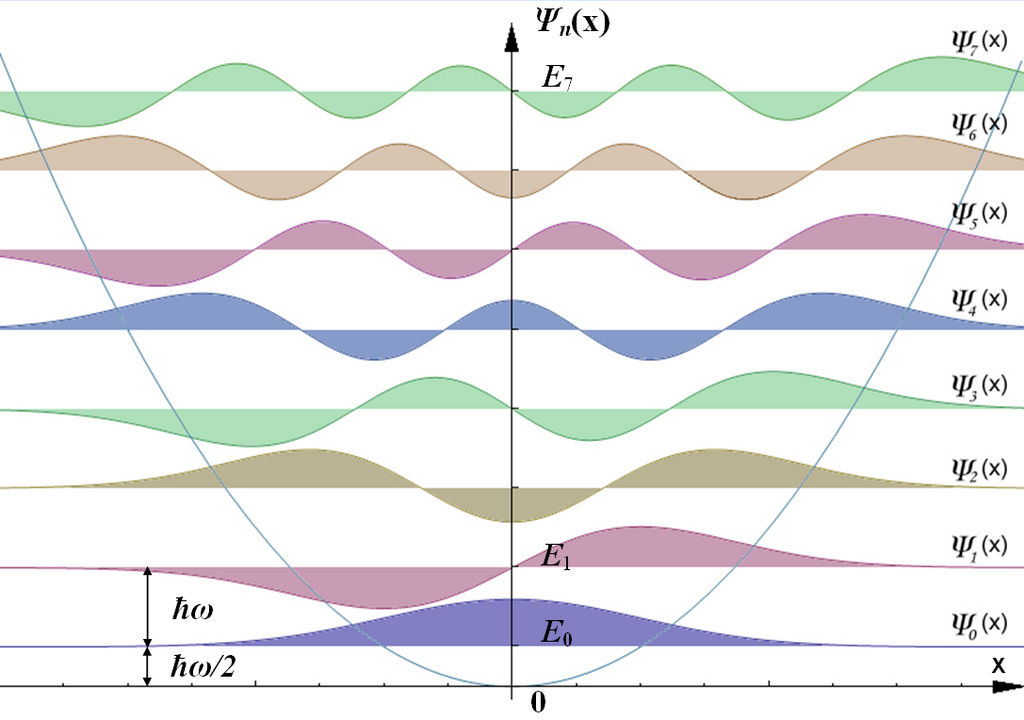
This new equation is an eigenvalue equation. It tells us that when the Hamiltonian operator acts on certain special wavefunctions, , it doesn't change the function's shape. It just multiplies it by a constant, . This constant represents the total energy of the system.
The crucial insight here is that for a given potential , only certain energy values, or eigenvalues, will lead to valid, physically realistic solutions for . This is the origin of energy quantization. A particle bound in a system, like an electron in an atom, can't have just any energy; it can only occupy discrete energy levels corresponding to the allowed eigenstates.
The Probability Rule
So we have these wavefunctions, , which describe the state of a particle. But what do they mean physically?
The answer was provided by . He proposed that the wavefunction itself isn't directly observable. Instead, the square of its magnitude, , gives the probability density of finding the particle at position . Probability density means that the probability of finding the particle in a small region between and is .
This interpretation comes with a logical requirement. Since the particle must be somewhere in space, the total probability of finding it everywhere must be 1 (or 100%). This condition is known as normalization. To satisfy it, we integrate the probability density over all of space and set the result equal to 1.
Only wavefunctions that can be normalized this way are considered physically acceptable solutions to the Schrödinger equation. They represent the possible states a quantum particle can occupy, each with a distinct, quantized energy level.
What does the square of the magnitude of the wavefunction, , represent according to Max Born's interpretation?
What is the primary function of the Hamiltonian operator () in the Schrödinger equation?
By solving this cornerstone equation, we move from the deterministic world of classical mechanics to the probabilistic, quantized reality of the quantum realm.