Quantum Mechanics and Modern Applications
Mathematical Vector Spaces
From Phase Space to Vector Space
In classical physics, describing a system is straightforward. You pinpoint its position and momentum, and you've captured its state. All possible states of a billiard ball, for instance, can be mapped onto a grid called phase space. Each point on this grid corresponds to a unique combination of position and momentum.
Quantum mechanics requires a different approach. A quantum state isn't just a point on a map; it's a more complex entity that contains probabilities for various outcomes. To handle this, we trade the familiar coordinates of phase space for a more abstract mathematical structure: the an infinite-dimensional vector space over the complex numbers. Instead of points, we use vectors to represent the states of a system.
Hilbert spaces are a fundamental concept in quantum mechanics, providing a mathematical framework for describing quantum states.
States as Vectors
In quantum mechanics, a state vector contains all the information about a physical system. We represent these vectors using a special notation called a "ket," which looks like this: . Inside the ket, we place a symbol that labels the state. For example, the state of a qubit might be written as .
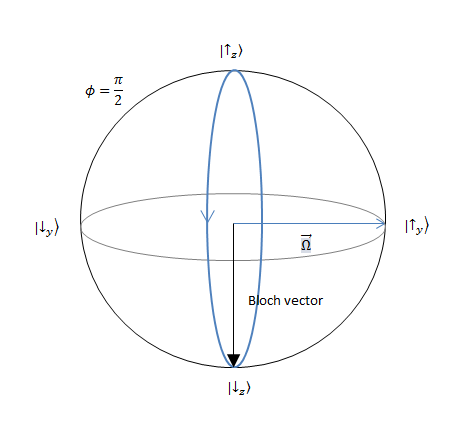
These vectors live in our Hilbert space. A simple qubit's state can be described as a linear combination of two basis states, and . This is the mathematical expression of superposition:
The numbers and are called They are complex numbers whose squared magnitudes give us the probability of measuring the qubit in the corresponding basis state. For the state to be physically valid, the vector must be normalized, meaning its length must be 1. This is equivalent to saying the probabilities of all possible outcomes must add up to 100%.
Measuring Overlap
To extract probabilities from state vectors, we need a way to measure them. This is done using the a mathematical operation that takes two vectors and produces a single number. To define it, we first need to introduce the "bra," written as . The bra is the dual of the ket . For column vectors, this means taking the transpose and then the complex conjugate of each element.
The inner product of a state with another state is written as . This complex number tells us the extent to which the state overlaps with, or contains, the state . The squared magnitude of this inner product, , gives the probability that a system in state will be measured to be in state .
When two vectors have an inner product of zero, they are called orthogonal. This has a clear physical meaning: if a system is in one state, there is a zero percent chance of measuring it in an orthogonal state. The basis states and are defined to be orthogonal.
Let's bring this all together. Any valid quantum state can be expressed as a linear combination of orthogonal basis vectors. This is the superposition principle, framed in the language of linear algebra. The coefficients of this combination, the complex amplitudes, tell us the probability of finding the system in each of those basis states upon measurement. By using the inner product, we can precisely calculate these probabilities.
This framework, built on vectors and Hilbert spaces, moves us from qualitative descriptions to a robust mathematical engine for predicting the behavior of quantum systems.
In quantum mechanics, if a system is in a state described by the vector , what does the value of represent?
How does the description of a system's state in quantum mechanics fundamentally differ from that in classical physics?