Quantum Mechanics and Formalism
Classical to Quantum
The Classical World Unravels
At the close of the 19th century, physics seemed nearly complete. Scientists believed the universe operated like a predictable, well-oiled machine, governed by Newton's laws of motion and Maxwell's equations for electromagnetism. Throw a ball, and you could calculate its exact path. Heat an object, and you could predict its radiation. But a few stubborn experimental results refused to fit this tidy picture. These weren't minor errors; they were deep contradictions that hinted at a reality far stranger than anyone imagined.
One of the most glaring problems was the so-called . According to classical physics, an ideal object that absorbs and emits all frequencies of radiation—a "black body"—should emit an infinite amount of energy as the wavelength gets shorter and moves into the ultraviolet part of the spectrum. This was obviously wrong. If it were true, every hot object, from a glowing poker to the sun itself, would instantly radiate away all its energy in a blinding flash of ultraviolet light.
In 1900, German physicist Max Planck found a radical solution. He proposed that energy could not be emitted or absorbed in a continuous flow, but only in discrete packets, or "quanta." The energy of each quantum was directly proportional to its frequency. He described this relationship with a simple equation that perfectly matched the experimental data for black-body radiation.
Planck's idea was revolutionary, but it was another puzzle, the photoelectric effect, that cemented the quantum concept. When light shines on a metal surface, it can knock electrons loose. Classical wave theory predicted that a brighter light (higher intensity) should give the ejected electrons more energy, and that a dim light might need some time to build up enough energy to eject one. But experiments showed something different: the energy of the electrons depended only on the light's frequency (its colour), not its intensity. And there was no time delay; electrons were ejected instantly, even by very dim light, as long as the frequency was above a certain threshold.
In 1905, Albert Einstein explained this by taking Planck's idea a step further. He proposed that light itself is not a continuous wave, but a stream of these energy packets, later named photons. Each photon carries an energy . A photon hits the metal and transfers its entire energy to a single electron. If the photon's energy is high enough to overcome the forces holding the electron to the metal, the electron is ejected. Any extra energy becomes the electron's kinetic energy. This perfectly explained why frequency, not intensity (the number of photons), determines the energy of the ejected electrons.
A Universe of Waves and Particles
So, light, which everyone thought was a wave, sometimes behaves like a particle. This raised a tantalizing question. If waves can act like particles, could particles act like waves? In 1924, a young French physicist named proposed exactly that in his PhD thesis. He suggested that all matter, not just light, has a wave-like nature. He even provided an equation to calculate the wavelength of a particle.
De Broglie's equation shows that the wavelength is inversely proportional to momentum. For large objects like a tennis ball, the momentum is so great that the wavelength is astronomically small, far too tiny to ever be detected. But for a very small particle like an electron, the wavelength can be comparable to the spacing between atoms in a crystal.
This insight provided a testable prediction: if electrons are waves, they should exhibit wave-like behaviours such as diffraction.
In 1927, physicists Clinton Davisson and Lester Germer confirmed de Broglie's hypothesis by accident. They were studying how a beam of electrons scattered off a nickel crystal. When their equipment broke, they heated the crystal to repair it, which caused the small, individual nickel crystals to merge into a few large ones. When they resumed the experiment, they saw a distinct pattern in the scattered electrons. It wasn't a random spray; it was an interference pattern, exactly what you'd expect if waves were diffracting off the regularly spaced atoms in the crystal lattice.
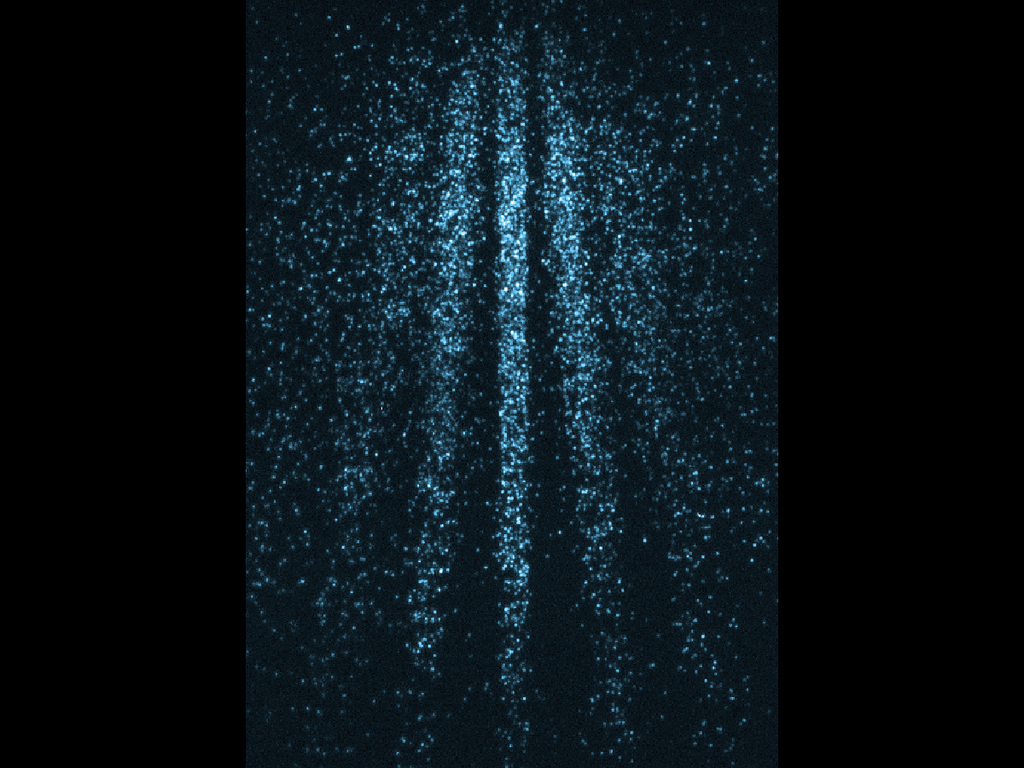
This wave-particle duality is a cornerstone of quantum mechanics. It means that at the fundamental level, particles like electrons don't follow neat, predictable paths like planets orbiting the sun. A classical trajectory is meaningless. Instead, the 'position' of a particle is described by a wave of probability. We can't say for certain where it is, only where it is likely to be found when we look for it. This probabilistic view marks the final, decisive break from the clockwork universe of classical physics.
What was the 'ultraviolet catastrophe'?
How did Max Planck's proposal solve the 'ultraviolet catastrophe'?