Quantum Mechanics: A Historical and Mathematical Journey
Classical Mechanics Foundations
The Clockwork Universe
For a long time, physics seemed to have it all figured out. The universe, from planets orbiting the sun to an apple falling from a tree, appeared to operate like a giant, intricate clock. It was a predictable system governed by a clear set of rules. The person who wrote the rulebook was Isaac Newton.
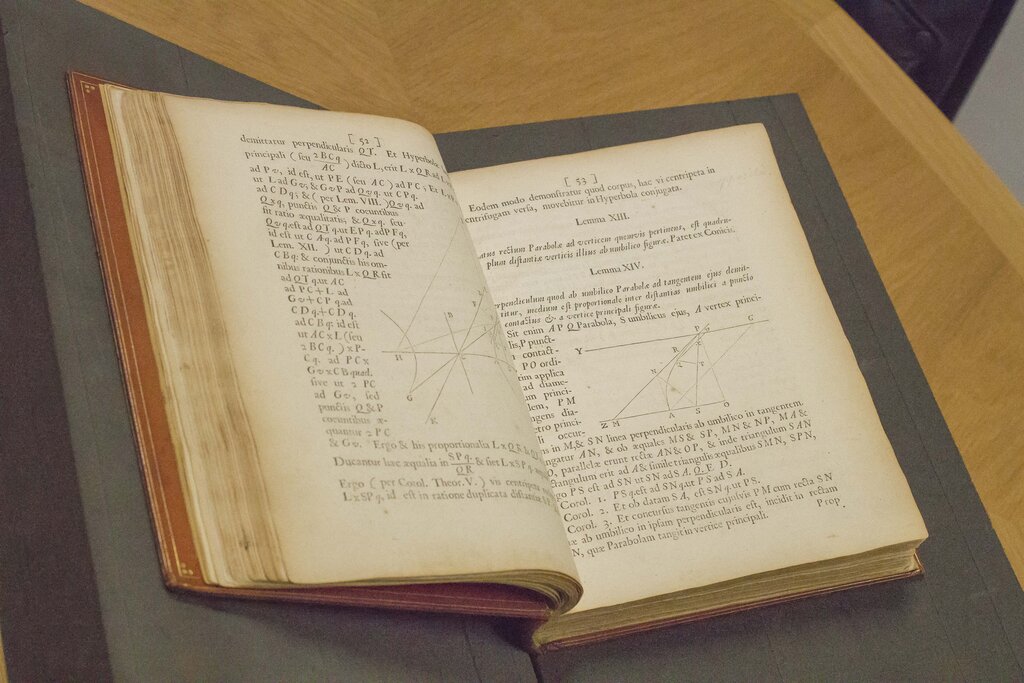
His work, known as classical mechanics, described the world with stunning accuracy. It gave us the tools to build bridges, send rockets to the moon, and understand the tides. At its heart are three simple but powerful laws of motion.
The Laws of Motion
Newton’s laws describe the relationship between an object and the forces acting upon it. They are the foundation of classical mechanics.
| Law | The Gist | Example |
|---|---|---|
| First Law | An object in motion stays in motion, and an object at rest stays at rest, unless a force acts on it. This is called inertia. | A hockey puck glides across the ice until it hits the wall or friction stops it. |
| Second Law | The force needed to move an object is proportional to its mass and acceleration. | It takes more force to push a heavy car than a light shopping cart to the same speed. |
| Third Law | For every action, there is an equal and opposite reaction. | A rocket pushes hot gas down (action), and the gas pushes the rocket up (reaction). |
The second law is often expressed as a tidy equation that became one of the most important in all of physics. It shows that force (), mass (), and acceleration () are all linked.
This simple formula carries a profound implication. If you know an object's mass and the net force acting on it, you can calculate its exact acceleration. And if you know its starting position and velocity, you can predict its entire future path. This idea is known as determinism.
In a classical world, the future is not a mystery. If you have enough information about the present, you can calculate the future with perfect certainty. The universe is a predictable machine.
Universal Currencies
Beyond the laws of motion, classical mechanics is built on a few deep principles of conservation. Think of them like unbreakable rules in a game. Two of the most important are the conservation of momentum and energy.
Momentum is essentially an object's quantity of motion. It’s a combination of its mass and its velocity. In any interaction, like two billiard balls colliding, the total momentum of the system before the collision is the same as the total momentum after. Momentum is transferred, but never lost.
Momentum
noun
A measure of an object's motion, calculated as its mass multiplied by its velocity.
Energy works the same way. Energy can change forms, shifting from potential energy (stored energy) to kinetic energy (energy of motion), or even into heat and sound. But the total amount of energy in a closed system always remains constant. It can't be created or destroyed.
These conservation laws, combined with Newton's laws, reinforced the deterministic view of the universe. Everything was accounted for. The books were always balanced.
Cracks in the Foundation
For over 200 years, classical mechanics reigned supreme. It explained the world so well that some physicists in the late 19th century believed there was little left to discover. They were wrong.
As scientists began to probe the very small, the world of atoms and electrons, the classical rules started to break down. Phenomena were observed that made no sense from a Newtonian perspective. Particles seemed to be in multiple places at once. Energy wasn't continuous but came in discrete packets. The predictable, clockwork universe started to look fuzzy and uncertain.
Classical mechanics is perfect for describing the world we see, but it fails to explain the bizarre rules that govern the hidden world at the atomic scale.
This failure didn't mean Newton was wrong. His laws are still fundamentally important for our everyday world. But it did mean the story was incomplete. A new set of rules was needed to understand the universe at its most fundamental level, leading to the birth of quantum mechanics.