Quantum Fun for Young Minds
Wave-Particle Duality
The Two-Faced Nature of Reality
In the world we see every day, objects are distinct. A baseball is a particle. The ripples in a pond are waves. They are fundamentally different things with different behaviors. But in the quantum realm, the rules change. Tiny objects like electrons and photons don't play by these rules. They exhibit a strange property called wave-particle duality.
Wave-particle duality means that a quantum object can behave like a particle in some situations and like a wave in others. It's not one or the other; it's a single entity that shows different faces depending on how you look at it.
A particle is a localized speck of matter, like a grain of sand. You can point to it and say, "it's right there." A wave, on the other hand, is spread out. It's a disturbance that travels through space, like the sound from a speaker. It doesn't have a single, precise location.
How can something be both? The classic experiment that reveals this bizarre nature is the double-slit experiment.
The Double-Slit Experiment
Imagine a barrier with two thin, parallel slits in it. On one side, you have a machine that can fire tiny objects, one at a time. On the other side is a detector screen that records where each object lands.
If you fire tiny marbles (particles) at the barrier, some will bounce off, while others will pass through one of the two slits. Over time, you'll see two distinct bands on the detector screen, right behind each slit. This makes perfect sense.
Now, let's try it with waves, like ripples in water. When a wave hits the barrier, it passes through both slits. The two new waves that emerge on the other side interfere with each other. Where their crests meet, they reinforce each other (constructive interference). Where a crest meets a trough, they cancel out (destructive interference). The result on the detector screen is an interference pattern: a series of bright and dark bands, not just two.
Finally, let's fire electrons, one by one. An electron is a particle, right? So we should expect to see two bands, just like the marbles. But that’s not what happens. The first electron lands at a seemingly random spot. So does the second, and the third. But after firing thousands of electrons, an astonishing pattern emerges: the interference pattern of a wave.
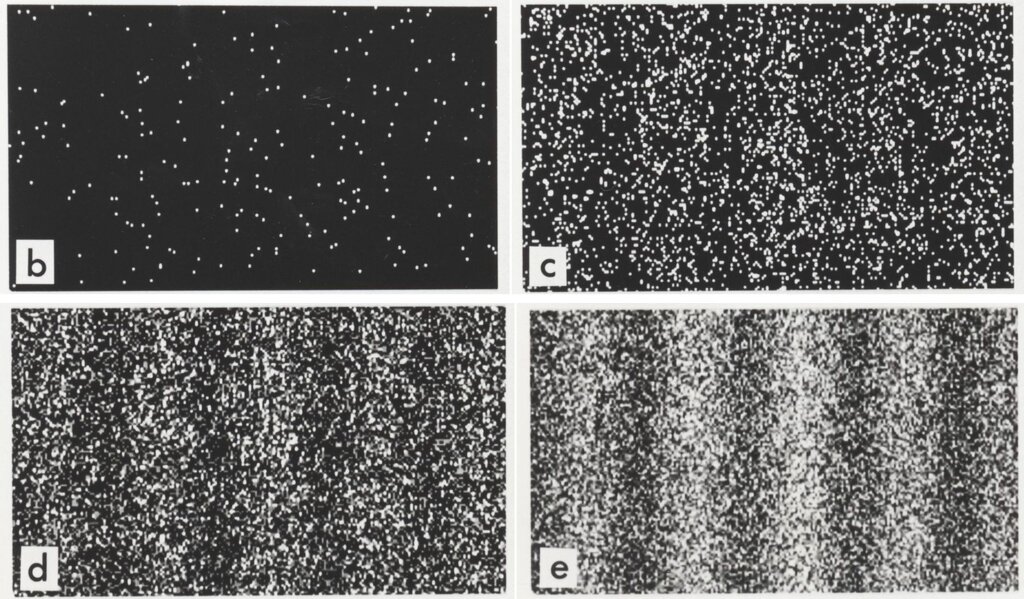
This is the heart of the mystery. Each electron, traveling alone, somehow behaves like a wave, passes through both slits simultaneously, and interferes with itself before landing on the screen as a single, localized particle.
It gets even stranger. If you place a detector at the slits to see which one each electron goes through, the interference pattern vanishes. The very act of observing forces the electron to “choose” a path and behave like a particle. The result is just two bands, like the marbles. This is known as the observer effect.
The Wave of Probability
So, is an electron a particle or a wave? It's both, and neither. It's a quantum object whose behavior depends on how it's measured. When it's not being observed, it's best described as a probability wave. This wave doesn't carry energy like a water wave; it carries information about where the particle is likely to be found. The peaks of the wave correspond to places where the particle has a high probability of appearing, and the troughs are where it has a low probability.
This wave-like nature isn't limited to electrons. Every object has a wavelength, an idea proposed by Louis de Broglie in 1924. This wavelength is related to the object's momentum.
Because Planck's constant is so tiny, this wavelength is only significant for objects with very small momentum, like subatomic particles. A thrown baseball also has a wavelength, but its mass is so large that its wavelength is trillions of times smaller than a single proton. It's so minuscule that it's completely undetectable, which is why we only ever see a baseball act like a particle.
Time to review what we've covered.
Let's test your understanding.
What is the central concept of wave-particle duality?
In the double-slit experiment, if electrons are fired one at a time without any observation at the slits, what pattern eventually emerges on the detector screen?
Wave-particle duality challenges our everyday intuition. It shows us a world where objects exist in a state of potential, described by waves of probability, only snapping into a definite state when we measure them. This is a fundamental principle that separates the quantum world from our own.