Quantum Field Theory Explained
Classical Field Theory
Fields Everywhere
When we think about physics, we often picture objects: baseballs flying through the air, planets orbiting the sun. We can describe their motion with things like position and velocity. But there's another, more fundamental way to look at the universe. Instead of focusing on discrete particles, we can think about continuous fields.
A field is a physical quantity that has a value for each point in space and time.
Imagine the temperature in a room. At every single point—near the ceiling, by the window, in the middle of the air—there's a specific temperature. You could, in theory, map it all out. That temperature map is a scalar field. It's called a scalar field because at each point, there's just a single number (a scalar) representing the temperature, like 20°C.
But what if the quantity at each point also has a direction? A weather map showing wind shows this perfectly. At every point, there's a wind speed (a magnitude) and a wind direction. This is a vector field. Another classic example is the electric field.

A single positive charge, for instance, generates an electric field that radiates outward in all directions. The field is strongest near the charge and gets weaker as you move away. If you place another positive charge in this field, it will feel a push in the direction of the field lines. The field itself is invisible, but its effect is real.
The Rules of the Field
Fields aren't just static backgrounds. They evolve, they ripple, and they interact with each other. The rules governing their behavior are called field equations. These are typically differential equations that describe how a field changes from one point to the next, both in space and in time.
The most famous set of field equations governs electricity and magnetism: Maxwell's equations. These four equations beautifully describe how a changing electric field creates a magnetic field, and how a changing magnetic field creates an electric field. This dance between the two fields is what gives us light, radio waves, and all other forms of electromagnetic radiation.
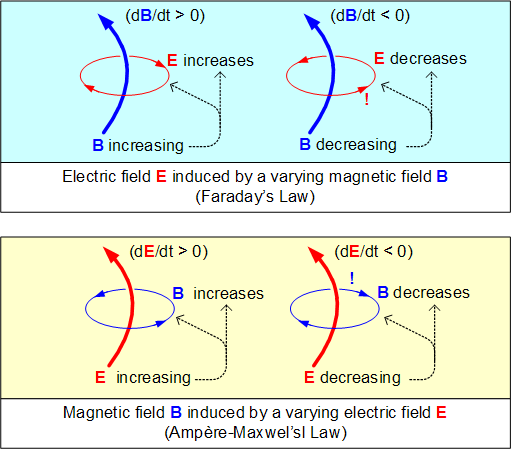
A solution to a field equation is a function that describes the field's value at every point in space and time. For Maxwell's equations, one possible solution is a self-propagating wave of electric and magnetic fields traveling at the speed of light. That solution is a light wave. Many field equations have this wave-like solution, which is described by the general wave equation.
In this equation, represents the field, is time, is the wave speed, and is a spatial derivative that measures how the field curves in space. It simply states that the field's acceleration in time is proportional to its curvature in space.
A Deeper Principle
Where do field equations come from? While we can discover them through experiments, physicists found a more elegant and powerful way to derive them: the Principle of Least Action.
This principle states that a physical system will always evolve in a way that minimizes a certain quantity called the "action." Think of a ball rolling down a bumpy hill. It won't take a wild, looping path; it will follow the path of least resistance to get to the bottom. The principle of least action is a cosmic version of this idea.
To apply this, we first need a way to describe the energy of a field. We do this with a function called the Lagrangian.
The Lagrangian, usually denoted by , is a function that summarizes the dynamics of a field. It's typically defined as the kinetic energy density of the field minus its potential energy density. The "density" part is important—we're looking at the energy per unit volume at each point in space.
Once we have the Lagrangian for a particular field, we can plug it into a master equation called the Euler-Lagrange equation. The result? Out pops the correct field equation that describes the field's behavior. It's a remarkably powerful recipe. By starting with a single function describing energy—the Lagrangian—we can derive the complex rules, or field equations, that govern the system.
There's another, related formulation called the Hamiltonian. While the Lagrangian focuses on kinetic and potential energy, the Hamiltonian focuses on the total energy of the system. It describes how the field and its momentum evolve over time. Both the Lagrangian and Hamiltonian formulations are cornerstones of classical field theory, providing the essential mathematical tools we need before we can even begin to think about the quantum world.
Let's check your understanding of these foundational ideas.
A weather map that displays both wind speed and wind direction at every point is a classic example of what?
What is the primary purpose of a field equation?
Understanding these classical concepts is the first crucial step toward grasping how modern physics describes reality at its most fundamental level.