Quantum Evolution and Cloud Integration
Hardware Evolution
From Noisy to Reliable
For years, the quantum computing world was defined by the Noisy Intermediate-Scale Quantum (NISQ) era. We had quantum processors with a growing number of qubits, but they were incredibly fragile. Like a faint whisper in a loud room, the quantum states would quickly get drowned out by environmental noise, a process called decoherence. This meant calculations had to be short and were often riddled with errors. These NISQ devices were powerful enough to explore new algorithms and simulate quantum systems, but not reliable enough for solving large-scale, practical problems.
However, quantum hardware is fragile — qubits can lose their quantum state (a process called decoherence) due to environmental noise, making error correction a significant challenge.
The fundamental challenge is that a physical qubit, the basic building block of a quantum computer, is inherently unstable. The solution? Build a better qubit out of many flawed ones. This is the core idea behind fault-tolerant quantum computing.
The Logical Qubit
Instead of relying on a single, fragile physical qubit, fault-tolerant systems use quantum error correction (QEC) to create a more robust 'logical qubit'. Think of it like encoding a single, important piece of information across multiple hard drives. If one drive fails, the information isn't lost because you have backups. Similarly, a logical qubit bundles many physical qubits together. The system constantly checks for errors in the physical qubits and corrects them, preserving the integrity of the logical qubit's information.
This spreads a single bit of quantum information across multiple hardware qubits, making it more robust.
This approach marks a critical shift in the industry. The focus is no longer just on how many physical qubits a processor has, but on the quality and reliability of its logical qubits. A computer with a few high-quality logical qubits is far more powerful than one with thousands of noisy, error-prone physical ones.
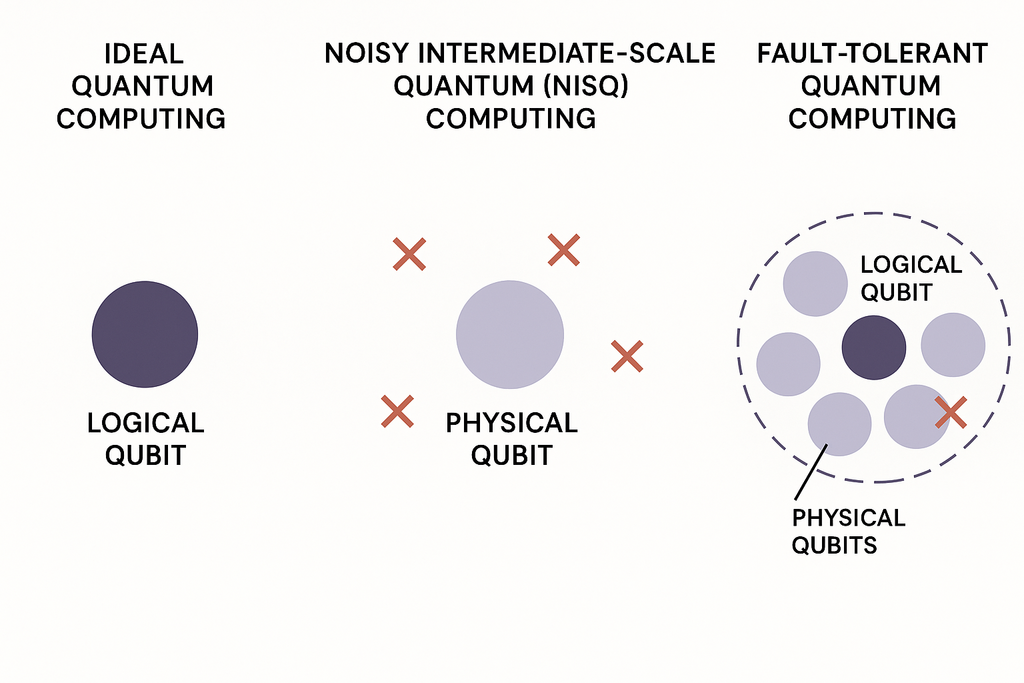
To achieve this, researchers are developing sophisticated error-correcting codes. One of the most promising is the surface code, which arranges physical qubits in a 2D grid. By measuring stabilizer qubits within this grid, the system can detect and correct errors without disturbing the encoded logical information.
Recent Breakthroughs
The period between 2020 and 2025 has seen crucial steps toward fault tolerance. In 2023, Google demonstrated a key principle of the surface code. They showed that by increasing the number of physical qubits in their code (from 17 to 49), they could actually suppress errors. For the first time, a larger error-correcting code performed better than its smaller components, proving that scaling up can lead to less noise, not more.
Then, in 2024, Microsoft and Quantinuum announced another major leap. Using a trapped-ion quantum computer, they created four highly reliable logical qubits from just 30 physical ones. They demonstrated an error rate 800 times lower for the logical qubits compared to the physical qubits, a massive improvement in reliability. This was achieved using a new, more efficient error-correcting code, showing that both hardware improvements and better codes are driving progress.
The Hardware Race
Different companies are betting on different types of hardware to build these fault-tolerant machines. Each approach has its own set of strengths and weaknesses.
| Modality | Key Players | How it Works | Pros | Cons |
|---|---|---|---|---|
| Superconducting Circuits | IBM, Google | Tiny electrical circuits cooled to near absolute zero. Qubits are represented by microwave photons. | Fast gate operations; well-established fabrication techniques. | Shorter coherence times; requires extreme cold; limited qubit connectivity. |
| Trapped Ions | Quantinuum, IonQ | Individual charged atoms (ions) are held in place by electromagnetic fields. Lasers manipulate their quantum states. | Very long coherence times; high-fidelity gates; all-to-all qubit connectivity. | Slower gate operations compared to superconducting. |
| Neutral Atoms | QuEra, Pasqal | Uncharged atoms are held in arrays by lasers (optical tweezers). Qubits are encoded in atomic energy levels. | Can scale to large numbers of qubits; flexible arrangement of qubits. | Gate fidelities are currently lower than other leading modalities. |
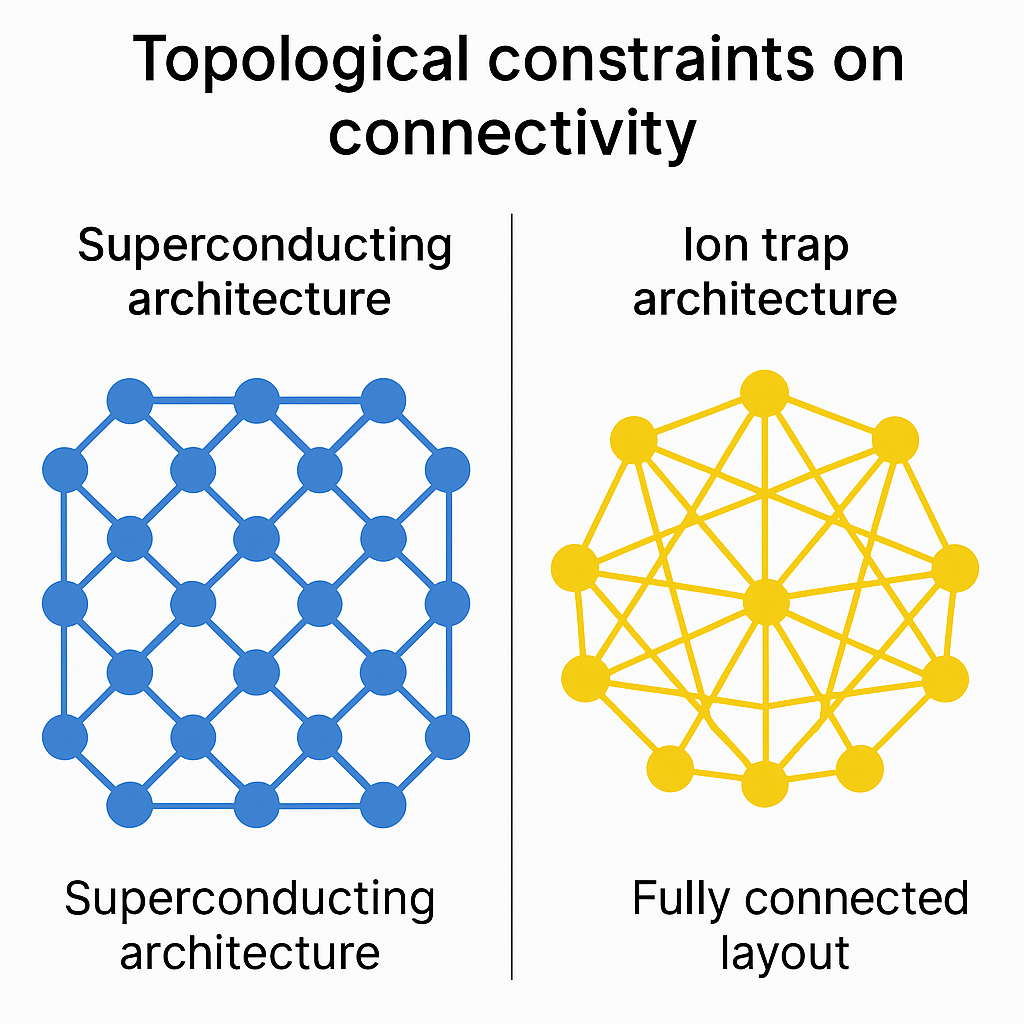
The different physical structures of these systems have a huge impact on how they perform. For instance, the grid-like layout of superconducting chips means qubits can typically only interact with their immediate neighbors. In contrast, trapped-ion systems allow any qubit to interact directly with any other, which can make running certain algorithms more efficient.
The journey from noisy devices to fault-tolerant quantum computers is a marathon, not a sprint. Recent milestones show that we are moving beyond simply counting qubits and are now entering an era defined by quality, reliability, and the practical suppression of errors.
What was the main limitation of quantum computers during the Noisy Intermediate-Scale Quantum (NISQ) era?
What is the fundamental concept behind creating a 'logical qubit'?